Over the past 15 years, Germany has moved from being the “sick man of Europe” to being the region’s most important growth engine. The shift occurred as the country overcame the challenges of reunification in the prior decade, and reformed the economy in a way that significantly improved its competitiveness.
While the German outperformance was notable in recent years, especially as other eurozone economies were engulfed in the recent sovereign crisis, recent developments challenge this trend. In an increasingly protectionist world, plagued by escalating trade tensions, the German economy is clearly suffering.
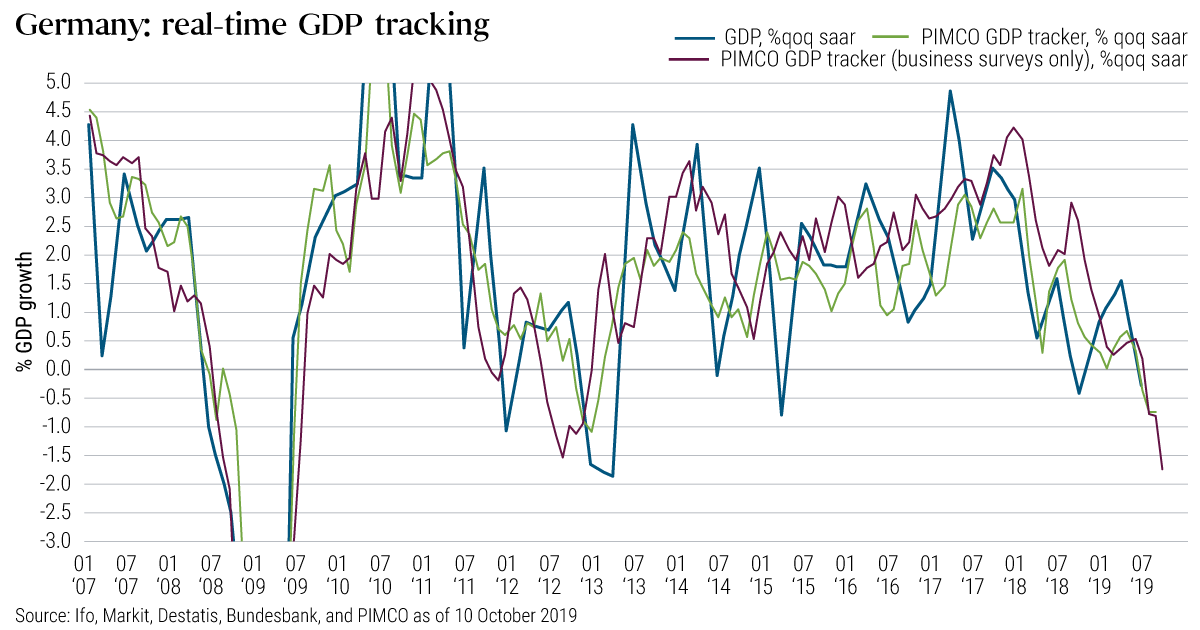
The country’s well-known Ifo business confidence index has been on a steep downtrend, with the expectations component – highly correlated to gross domestic product (GDP) – falling to the lowest level in a decade in September. The fall in the Ifo came alongside a decline in the composite purchasing managers index (PMI) to 48.5, showing outright contraction in activity. Combined, the PMI and Ifo surveys point to negative quarterly growth in the order of -1.5% annualized late in the third quarter, as shown in Figure 1.
Figure 1

It now seems very likely that Germany will experience a technical recession in mid-2019, with a slight -0.3% annualized GDP decline in the second quarter possibly followed by a deeper fall afterwards.
And chances are rising that the recession will be more prolonged, given the deep slump in global manufacturing and the consequent precipitous decline in German industrial data. Looking ahead, the German economy looks challenged on several fronts:
-
Global trade wars: With exports representing around half of the economy, global trade tensions are having an outsized impact on Germany. Some relief in U.S.–China tensions should help the outlook, but at PIMCO we do not expect a full resolution of the conflict anytime soon. This means that any improvement might be only gradual.
-
Spillover into services: While the German service sector has held up better than manufacturing, there are signs that the industrial weakness is increasingly spilling into the rest of the economy (as signaled by the recent 3.4-point fall in the German services PMI to 51.4). The banking sector could be further challenged in this context, in light of already weak profitbility and the need for several banks to restructure their business models.
-
Structural problems: Selling cars may become more challenging going forward as more climate-change-sensitive generations forego owning a car, or opt for electric vehicles, where other countries are currently at the forefront in terms of technology. Also, as Western economies become less capital-intensive and more technology-dependent, demand for industrial machinery may be dented. Europe has seen a dearth of IPOs in recent years.
-
European neighbours will not be of much help: Germany’s neighbours are hardly significant engines of growth, with Italy experiencing significant structural growth headwinds, France needing to recoup losses in competitiveness that have built since the inception of the eurozone, and Spain improving but not being big enough to lift the region. In this context, the eurozone composite PMI in September dropped 1.8 points to 50.1, a level consistent with stagnant GDP.
Looking ahead
Our base case for Germany over the next year is one of gradual improvement, given the potential easing of trade tensions through 2020, and monetary stimulus getting some traction. But the reacceleration is likely to be slow.
The European Central Bank (ECB) has just embarked on a new easing program, but the data suggest that this may need to be beefed up given growing downside risk and a continued decline in inflation expectations.
With negative rates in place and asset purchases having already been conducted for some time, monetary policy seems almost out of steam. Germany’s ailing economy could well do with some fiscal stimulus, especially since the country can afford it (with a budget surplus of around 1.5% of GDP). But recent comments from German officials have poured cold water on that prospect, confirming our expectation that a fiscal regime shift in Germany is unlikely to happen soon.
Germany could be affected by the outcome of Brexit, as the U.K. is a key trading partner. Turkey’s recent woes and weak currency have also had a significant impact. The uncertainty stemming from both situations may last longer than we wish.
Investment implications
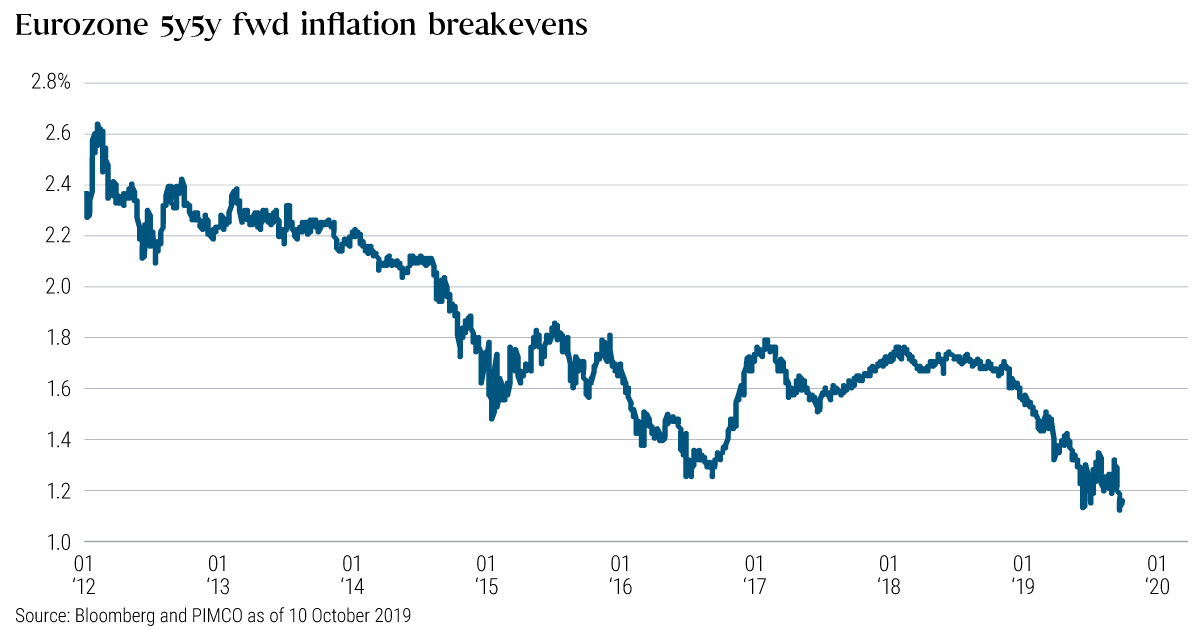
The significant weakness of the German and eurozone economies, and of the global economy more broadly, have supported European duration. In our portfolios, we tend to be underweight the short end of the bund curve, based on the fact that the ECB has limited room to cut policy rates further. The longer end of the curve, on the other hand, should remain supported, as monetary stimulus is likely to prove insufficient and largely ineffective in raising depressed inflation expectations. Indeed, Figure 2 shows that eurozone five-year, five-year inflation breakevens are around 1.2%, close to all-time lows.
In the periphery, meanwhile, the ECB’s engagement and positive developments in Italian and Europe-wide politics from a market perspective point towards a supportive picture for Italian government bonds in the near term. But, medium-term risks warrant caution, and argue against taking large risk positions here.
Figure 2
© PIMCO
www.pimco.com
© PIMCO
Read more commentaries by PIMCO