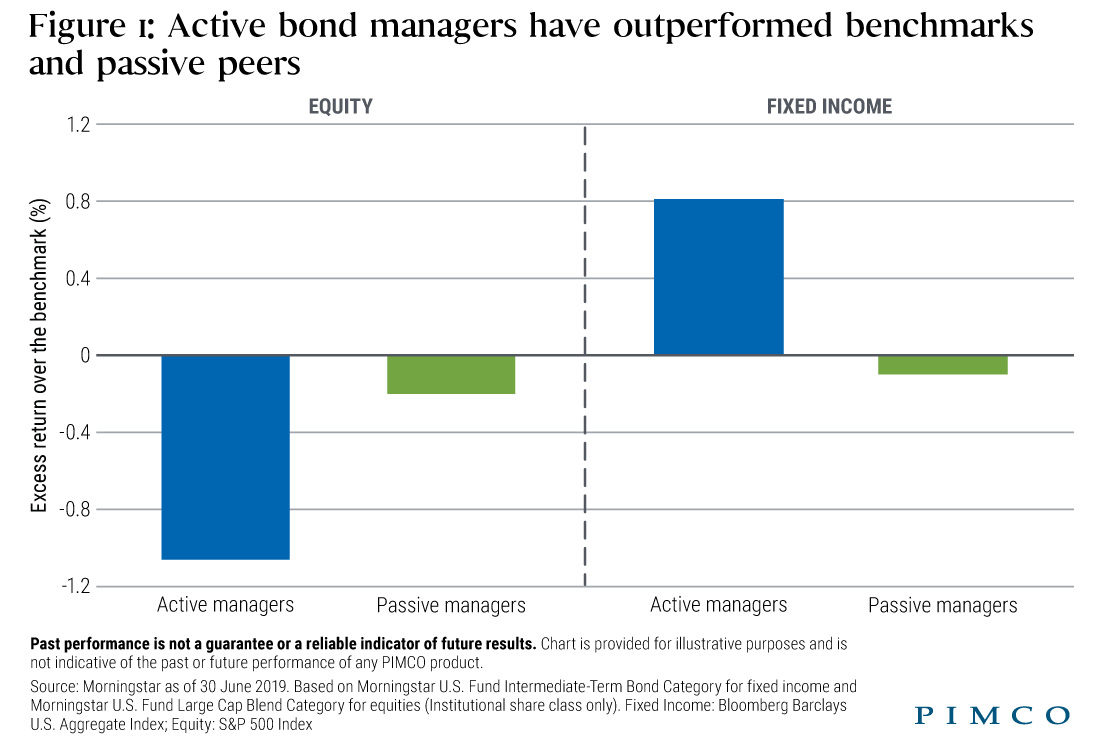
With investors looking to reduce risk in uncertain late-cycle markets, it’s not surprising that flows into bond exchange-traded funds (ETFs) have surged this year, outpacing flows to equity ETFs for the first time in a decade. The lion’s share of the $97 billion in fixed income ETF flows through September have gone to passive, index-tracking ETFs (according to Bloomberg). But are investors missing out by defaulting to passive approaches?
Many investors may assume ETFs are passive by nature or by definition (they are not). Passive bond ETFs are not the only option – and for investors looking to potentially improve performance, actively managed fixed income ETFs may offer distinct advantages.
Bonds are different when it comes to active management
A key rationale many investors cite for preferring index-tracking equity approaches is that active management hasn’t paid off historically. But this has not held true for fixed income allocations.
Over the past 10 years, the median active equity manager has underperformed passive peers by approximately 86 basis points (bps) and lagged stated benchmarks by another 20 bps (see Figure 1). The opposite has been true for fixed income: The median active bond manager has beaten its stated benchmark by an average of 81 bps per year and outperformed passive peers by 91 bps over the past decade (as of 30 June 2019).

Bond market inefficiencies provide alpha opportunities
Why is the story so different for bonds than for equities? We believe it boils down to inefficiencies across the fixed income markets, which can provide rich ground for active managers to seek beyond-benchmark returns – often with more attractive risk profiles.
Equities are traded in milliseconds on public exchanges, while bonds are largely still traded over the counter, slowly and in large blocks. And whereas equities are highly standardized, perpetual securities, bonds are far more heterogeneous in their terms and have finite maturities. New issues of bonds (analogous to initial public offerings for stocks) are frequent, constituting about 20% of the U.S. corporate bond market each year, versus about 1% for U.S. equities. This can give a potential advantage to asset managers with strong credit teams to analyze these new issues.
Moreover, when looking at the most prominent bond and equity indices – the Bloomberg Barclays U.S. Aggregate Bond Index and the S&P 500 – both give greater weight to entities with some of the least attractive characteristics: stocks with the highest market caps, and issuers with the most debt outstanding. That means that passive bond investors are essentially lending more to those with more debt.
Reconsider being ‘aggressively passive’ in bond ETFs
The ETF vehicle offers certain advantages, including efficient trading on an open exchange, continuous pricing throughout the day, and a simple way to gain diversified allocations. But passive ETFs generally suffer from below-index performance given the impact of trading costs and fees. And given that overall return potential for bonds may be modest relative to equities, the potential return differential between a passive and active approach could have a significant impact. Especially in a low yield world, the excess return potential from active management may be particularly meaningful as a means to boost overall returns (and it would represent a larger share of that overall return). Of course, as with all investments, it is possible to lose money.
For investors wanting to make the most of their fixed income allocations as they seek to manage risk, we believe the compelling potential return advantage of actively managed ETFs should not be overlooked.
DISCLOSURES
Investors should consider the investment objectives, risks, charges and expenses of the funds carefully before investing. This and other information are contained in the Fund’s prospectus, which may be obtained by contacting your PIMCO representative. Please read the prospectus carefully before you invest.
Past performance is not a guarantee or reliable indicator of future results.
Exchange Traded Funds (“ETF”) are afforded certain exemptions from the Investment Company Act. The exemptions allow, among other things, for individual shares to trade on the secondary market. Individual shares cannot be directly purchased from or redeemed by the ETF. Purchases and redemptions directly with ETFs are only accomplished through creation unit aggregations or “baskets” of shares. Shares of an ETF are bought and sold at market price (not NAV). Brokerage commissions will reduce returns. Investment policies, management fees and other information can be found in the individual ETF’s prospectus. Buying or selling ETF shares on an exchange may require the payment of brokerage commissions. Due to the costs inherent in buying or selling Fund shares, frequent trading may detract significantly from investment returns. Investment in Fund shares may not be advisable for investors who expect to engage in frequent trading. Current holdings are subject to risk. Holdings are subject to change at any time. An investment in an ETF involves risk, including the loss of principal. Investment return, price, yield and Net Asset Value (NAV) will fluctuate with changes in market conditions. Investments may be worth more or less than the original cost when redeemed. ETF shares may be bought or sold throughout the day at their market price on the exchange on which they are listed. However, there can be no guarantee that an active trading market for PIMCO ETF shares will develop or be maintained, or that their listing will continue or remain unchanged. Premiums (when market price is above NAV) or discounts (when market price is below NAV) reflect the differences (expressed as a percentage) between the NAV and the Market Price of the Fund on a given day, generally at the time the NAV is calculated. A discount or premium could be significant. Data in chart format displaying the frequency distribution of discounts and premiums of the Market Price against the NAV can be found for each Fund at pimcoetfs.com.
A word about risk:
Investing in the bond market is subject to certain risks including the risk that fixed income securities will decline in value because of changes in interest rates; the risk that fund shares could trade at prices other than the net asset value; and the risk that the manager’s investment decisions might not produce the desired results. Equities may decline in value due to both real and perceived general market, economic and industry conditions.
There is no guarantee that these investment strategies will work under all market conditions or are suitable for all investors and each investor should evaluate their ability to invest long-term, especially during periods of downturn in the market. Investors should consult their investment professional prior to making an investment decision.
PIMCO as a general matter provides services to qualified institutions, financial intermediaries and institutional investors. Individual investors should contact their own financial professional to determine the most appropriate investment options for their financial situation. This material has been distributed for informational purposes only and should not be considered as investment advice or a recommendation of any particular security, strategy or investment product. Information contained herein has been obtained from sources believed to be reliable, but not guaranteed. No part of this material may be reproduced in any form, or referred to in any other publication, without express written permission.
PIMCO Investments LLC, distributor, 1633 Broadway, New York, NY 10019, is a company of PIMCO.
© PIMCO
© PIMCO
More ETF Topics >