SUMMARY
- The retirement of the baby boomer generation represents a secular money-in-motion opportunity for financial advisors – one which may transform the asset management industry and individual advisory practices.
- But the withdrawal of assets over an uncertain remaining lifetime – decumulation – remains both the solution most in demand and the problem the industry has been least able to solve.
- Our Income to Outcome decumulation framework incorporates behavioral insights that have become central to how the industry understands investor decisions.
- It seeks to help investors set and automate regular withdrawals, protect against sequence-of-returns risk, embed better advice around optimal strategies for claiming Social Security, address longevity risk and pursue long-term growth in an endowment-like portfolio to support unknown expenditures and maximize potential for bequests.
Retirement is the primary planning challenge for investors. And here in the U.S., as the wave of baby boomer retirements crests, advisors may be looking at a truly secular opportunity. We think solving the decumulation problem could transform the asset management industry and individual advisory practices. Our “Income to Outcome” framework aims to address this complex challenge. It seeks to deliver a simpler, more intuitive approach to investing for retirement.
Decumulation – which begins when paychecks stop and individuals finally begin to draw down their accumulated assets over a remaining lifetime of uncertain length – is a daunting challenge. Here’s how Richard Thaler, University of Chicago Booth School of Business professor and PIMCO senior advisor on retirement and behavioral science, framed it:
“I believe decumulation is a more difficult challenge than accumulation. My generation, the baby boomers, have begun retiring, and the ones who have managed to build up a nest egg are going to need a lot of help figuring out how to make it last. At least from my perspective, this is the sort of problem that would be fun to think about.”
Whether fun or not, the decumulation challenge has already moved center stage among advisors and asset managers. The first signs of the tectonic shift appeared in 2014: That year, for the first time, aging investors withdrew more from their retirement savings accounts, in the form of 401(k) distributions or IRA rollovers, than they contributed. It marked a tipping point – from accumulation to decumulation – of the wealthiest cohort of investors in the U.S. Since 2000, the number of individuals turning 65 has doubled to over 10,000 a day. The pace is not likely to slow for another 20 or 30 years, at which point the next wave begins to swell (the first of some 80 million Gen Xers turn 65 in 2034 )(see Figure 1).i
 Image Pop Up
MONEY IN MOTION
For advisors, the retirement of baby boomers represents a secular “money-in-motion” opportunity. Those with demonstrated expertise in retirement portfolio construction, withdrawal strategies, and tax optimization will be best positioned to distinguish their practices from peers.
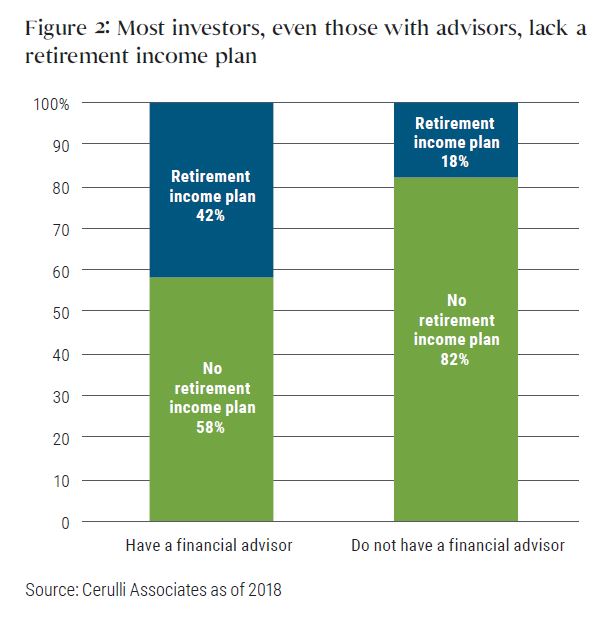
But decumulation is hard because it is a literal crux: It is both the solution most in demand and the problem the industry has been least able to solve. Nearly 60% of individuals with advisors lack a retirement income plan (the number rises to over 80% for those without an advisor), according to Cerulli. And our research finds that the area where advisors feel the least confidence is in their ability to formulate and implement strategies that seek to provide a predictable, tax-aware stream of income and liquidity in retirement (see Figure 2).
Image Pop Up
Prior work on the accumulation side of the ledger may show the way to proceed -- in particular, Thaler’s insights into behavioral economics (for which he won the Nobel Memorial Prize in Economic Sciences in 2017). Nudged by the teachings of Thaler and his peers, industry and government embraced policies to instill better saving habits, encouraging workers with 401(k)s to start investing early, on a regular and increasing basis (via auto-enrollment into plans and auto-escalation of contributions); to invest in target-date funds with long-term horizons and age-based glide paths; and to discourage early withdrawal of assets dedicated for retirement.
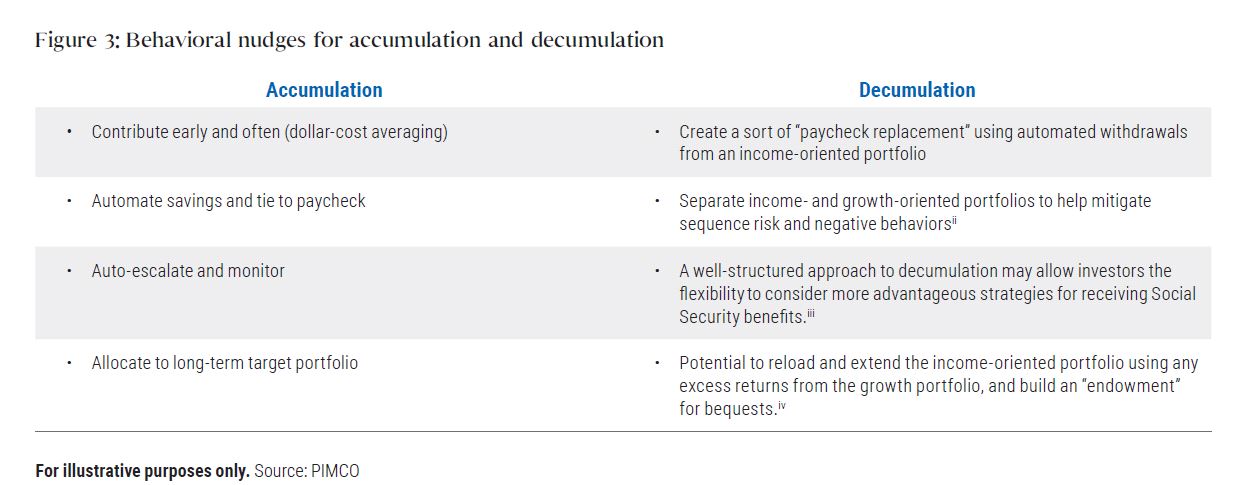
In a similar way, our decumulation framework incorporates behavioral insights that have become central to how the industry understands investor decisions. We believe a viable approach should help investors set and automate regular withdrawals; help protect against sequence-of-returns risk at the start and throughout their retirement journey; embed better advice around optimal strategies for claiming Social Security; address longevity risk; and seek long-term growth in an endowment-like portfolio to support unknown expenditures and maximize potential for bequests (see Figure 3).
Image Pop Up
BEHAVIORALLY MINDED
PIMCO’s Income to Outcome framework seeks to make the process simple and intuitive. It proposes having two dedicated portfolios – one, a laddered bond portfolio, such as a targetmaturity bond (also known as defined-maturity bond) portfolio designed to mature and pay out principal (minus defaults) after a specific number of years (a sort of “paycheck replacement”v); the other composed of higher-risk, long-term growth-oriented assets such as equities.vi It leaves details of the growth-oriented portfolio in the hands of advisors, who are often more at home in this role, and who are certainly best-positioned to advise their clients.
The creation of two portfolios is a key differentiator. On the surface, it’s an approach similar in some ways to a traditional blend of stocks and bonds which would be similarly exposed to sequence risk. But separating assets in this way may bring big advantages.
For instance, an anticipated stream of income from the bond portfolio may help the investor ride out the natural, and sometimes violent, volatility that often accompanies growth-oriented investments. This, in turn, may help investors avoid potentially costly, knee-jerk reactions – such as untimely shifts to cash – when their growth portfolio slumps. Key goals are to help prevent losses from being crystallized, give more time for growth-oriented assets to mean-revert should they fall at the outset, and help mitigate the impact of sequence risk. In addition, a portfolio that seeks to provide a predictable stream of income may give investors flexibility to consider more advantageous strategies for receiving Social Security benefits. Over time, should growth assets rise in value, investors could “reload” their bond ladder, extending the horizon over which they seek predictable income.
We believe our Income to Outcome framework could make a significant contribution to the retirement discussion among advisors and asset managers. As one of the world’s leading fixed income managers, with hundreds of billions of dollars deployed in strategies earmarked for retirement, PIMCO is eager to help address the decumulation challenge, and the opportunity it presents for advisors and their clients.
i Source: U.S. Census Bureau, Haver Analytics and the Centers for Disease Control as of September 2019
ii See PIMCO’s Income to Outcome framework for details
iii Investors should speak with their investment and tax professionals.
iv There is no guarantee a growth portfolio will generate excess returns
v Investment products contain risk and may lose value. There is no guarantee that an investment product will be successful in producing income. Investors should consult their investment professional prior to making an investment decision.
vi Low-volatility income-oriented fixed income strategies could also be used to approximate a similar outcome in the income-oriented portfolio.
The PIMCO Decision Research Laboratories at the University of Chicago Booth School of Business Center for Decision Research enable academics to conduct the highest-impact behavioral science experiments where people live and work. Through this innovative partnership with the University of Chicago, PIMCO supports diverse and robust research that contributes to a deeper understanding of human behavior and decision-making and helps empower leaders to make wiser choices in business and society.
DISCLOSURES
A bond ladder or “targeted maturity” bond portfolio is only one potential income strategy and may not be the best solution or suitable for all investors. Income replacement needs may vary by household. An investor should consider and discuss how best to address their income needs with their financial and tax professionals.
The retirement allocation framework presented here is based on what PIMCO believes to be generally accepted investment theory. It is for illustrative purposes only and may not be suitable for all investors. The retirement allocation framework is not based on any particularized financial situation, or need, and is not intended to be, and should not be construed as, a forecast, research, investment advice or a recommendation for any specific PIMCO or other strategy, product or service. Individuals should consult with their own financial and tax advisors to determine the most appropriate allocations for their financial and tax situation, including their investment objectives, time frame, risk tolerance, savings and other investments. Fixed income is only one possible portion of an investor’s portfolio, which can also include equities and other products. Investors should speak to their financial advisors regarding the investment mix that may be right for them based on their financial situation and investment objectives.
Investing in the bond market is subject to risks, including market, interest rate, issuer, credit, inflation risk, and liquidity risk. The value of most bonds and bond strategies are impacted by changes in interest rates. Bonds and bond strategies with longer durations tend to be more sensitive and volatile than those with shorter durations; bond prices generally fall as interest rates rise, and low interest rate environments increase this risk. Reductions in bond counter party capacity may contribute to decreased market liquidity and increased price volatility. Bond investments may be worth more or less than the original cost when redeemed. Equities may decline in value due to both real and perceived general market, economic and industry conditions.
PIMCO as a general matter provides services to qualified institutions, financial intermediaries and institutional investors. Individual investors should contact their own financial professional to determine the most appropriate investment options for their financial situation. This material contains the opinions of the manager and such opinions are subject to change without notice. This material has been distributed for informational purposes only and should not be considered as investment advice or a recommendation of any particular security, strategy or investment product. Information contained herein has been obtained from sources believed to be reliable, but not guaranteed. No part of this material may be reproduced in any form, or referred to in any other publication, without express written permission. PIMCO is a trademark of Allianz Asset Management of America L.P. in the United States and throughout the world.
©2019, PIMCO.
CMR2019-1004-417696
© PIMCO
More Tax Planning Topics >
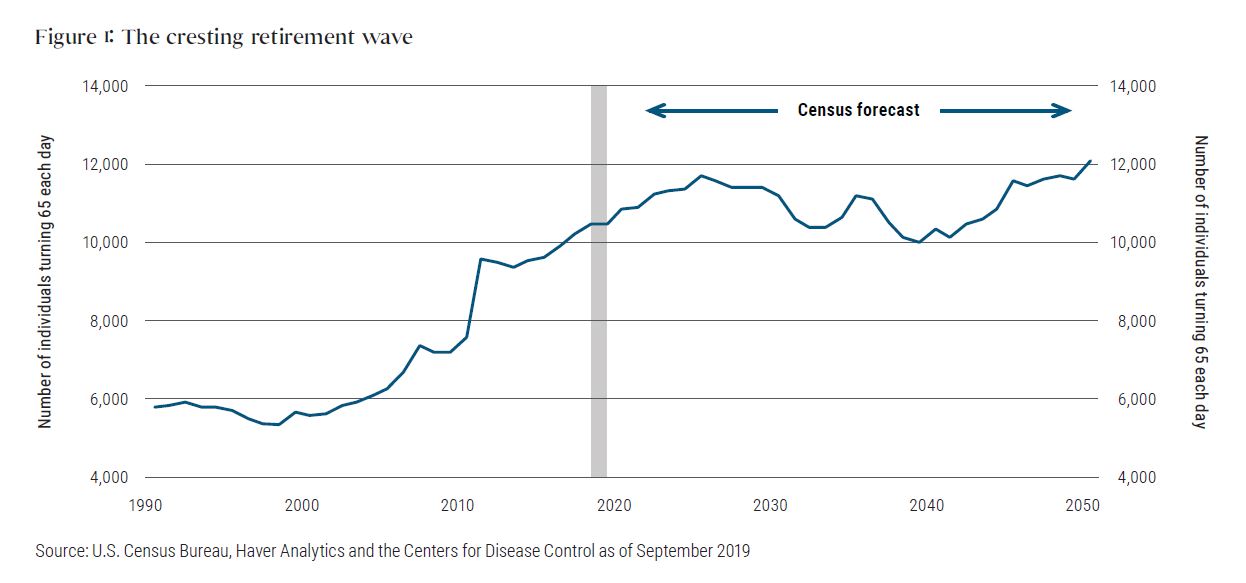 Image Pop Up