SUMMARY
- Target date funds that blend active and passive investments have historically garnered limited attention, not due to lack of interest, but because of limited product offerings.
- However, blend TDF assets have grown nearly five-fold since 2013 as the number of offerings has doubled.
- We expect the trend to continue because blend TDFs typically carry lower fees than active offerings, without fully sacrificing alpha potential. Hence, our mantra, “Go active where it matters and passive where it saves.”
Over a third of defined contribution (DC) plan sponsors offer both active and passive funds on their core menus, representing 52% of total DC core menu assets. Yet, target date funds (TDFs) that blend the two have historically garnered limited attention, not due to lack of interest, but because of limited product offerings.
However, that’s changing.
Blend TDF assets have grown nearly five-fold since 2013 as the number of offerings has doubled, with many fully active or fully passive TDF asset managers introducing a blended (or hybrid) fund, each slightly different from the others. We expect the trend to continue because blend TDFs typically carry lower fees than fully active offerings, without fully sacrificing alpha potential.
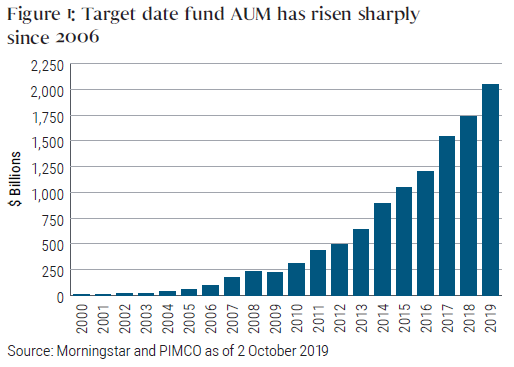
TDFs have existed since the early 1990s, but gained popularity only after passage of the 2006 Pension Protection Act, which set the stage for sponsors to automatically enroll DC plan participants in Qualified Default Investment Alternatives (QDIAs). TDFs represent the vast majority of these QDIAs and have rapidly gathered hundreds of billions of assets under management (AUM), further supported by strong asset returns after the financial crisis (see Figure 1).
Although active TDFs dominated at the outset, capturing over 90% of the market in the early 2000s, passive TDFs have gained momentum and three years ago surpassed active TDFs in market share. This trend toward passive does not appear to have been driven by disappointment in active management (i.e., due to underperformance versus the benchmark) but rather by factors such as fees and litigation risk. In our view, the pendulum has swung too far from active to passive, and a compromise that incorporates investment considerations may be warranted.
As such, the blend segment has emerged as an attractive alternative and is quickly gaining broad adoption. According to Morningstar data, blend TDF AUM has grown by 485% since 2013, while the number of blend TDFs, including mutual funds and collective investment trusts (CITs), has doubled.

Benefits of blend TDFs
A blend TDF typically carries lower fees than fully active options. In addition, blend TDFs offer alpha potential from active management, which over the long term may translate into higher income-replacement ratios or improved longevity of assets in retirement versus a fully passive TDF, typically for only a modest fee premium. However, some alpha potential may be lost due to the lower-fee passive component.
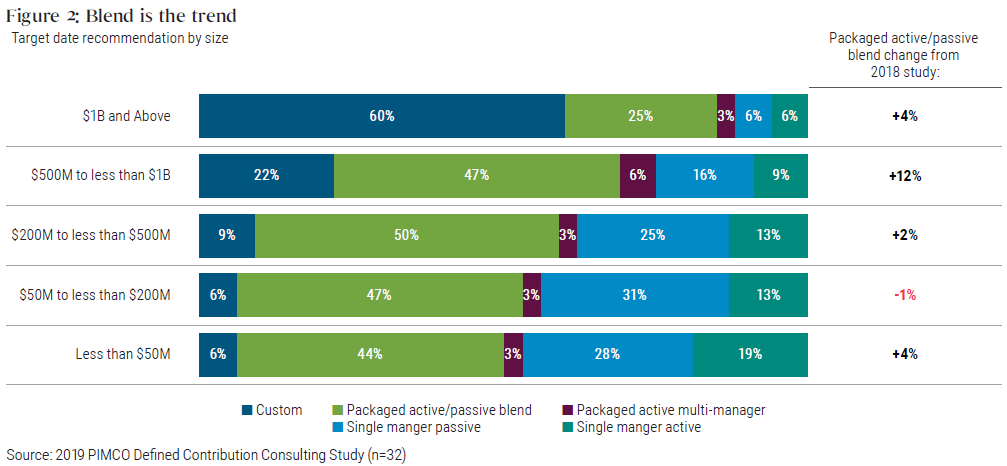
The merits of blend TDFs are clear in our view. When plan sponsors and advisors select individual funds on the DC core menu, over half the time they are blending active and passive funds. Blend TDFs bring a similar philosophy to the QDIA space. Based on the 2019 PIMCO Defined Contribution Consulting Study, roughly half of consultants and advisors recommend packaged active/passive (blend) TDFs for plans below $1 billion (see Figure 2). Additionally, most consultants highly rank the importance of going active in fixed income. The consultants surveyed believe that active management is extremely important or very important for both U.S. bonds (88%) and non-U.S. bonds (82%), the two largest fixed income sectors across the TDF industry’s bond exposure.
There are certain objectives to consider when evaluating the spectrum of blends:
- Optimizing the mix of active and passive underlying funds based on cost-benefit analysis. This is the same process that consultants and advisors use to select the core menu lineup. It is also quite similar to how mega plans (above $1 billion) design custom TDFs, determining where there’s value in going active and where to use passive to keep costs low. On DC core menus, the ratio of active to passive fixed income offerings is 2-to-1, while active to passive equity is 1-to-2.
- Deciding which managers are best in class in the underlying offerings, and recognizing that few active managers are equally adept at managing equities and fixed income.
The case for going active in bonds
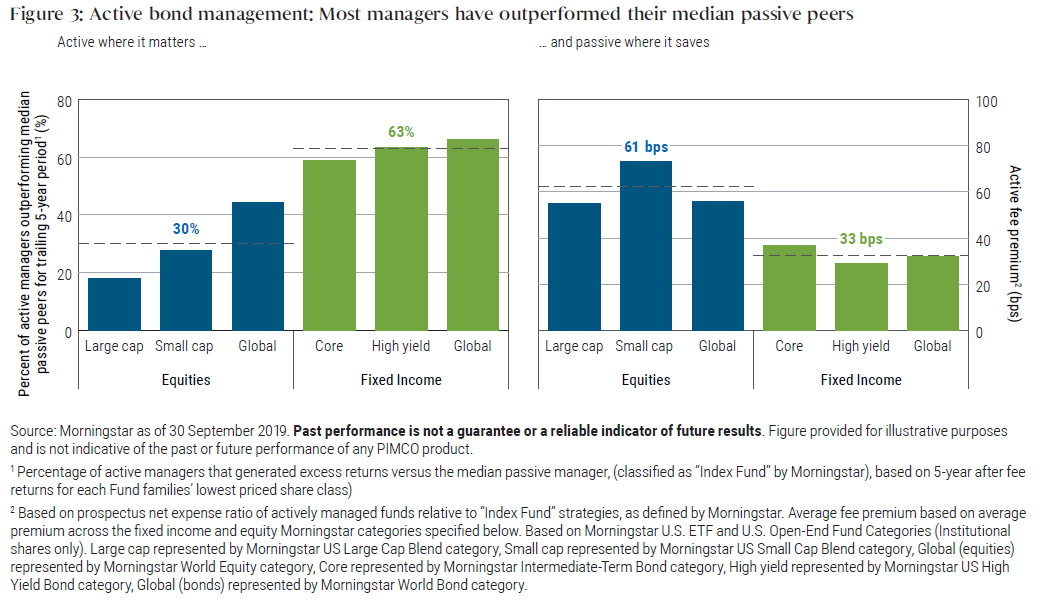
Fixed income managers have tended to deliver positive net-of- fee returns with relative consistency for their investors. This is borne out in the data for the last 5 years – active equity managers have struggled to beat their passive peers, while active fixed income managers have often outperformed their passive counterparts. As Figure 3 shows, active fixed income managers in the top three DC categories (core, high yield, and global) have outperformed their passive counterparts on average in 63% of cases, compared to only 30% in the equity space for the five-year period ending 30 September 2019.
Why is this the case? For active managers such as PIMCO, bond markets offer a more expansive opportunity set than equities. The equity market is transparent with relatively few issuers. In contrast, fixed income markets have tens or hundreds of thousands of issues that are traded largely over the counter, creating inefficiencies that can be exploited by active managers. Additionally, we estimate about half of the $100 trillion global bond market is held by noneconomic investors, who buy or sell bonds for purposes other than generating alpha. These include central banks that manage their currency reserves and level of interest rates, or asset liability managers who buy bonds to defease liabilities. This is in stark contrast to almost all equity investors, who share one common economic interest – maximizing returns.
Further, accessing active management of bonds is relatively cheaper than equities based on the active fee premium paid (the fee differential between otherwise similar active and passive offerings). As Figure 3 also shows, the average fee premium for going active in equities is 61 basis points (bps) versus only 33 bps for fixed income. Our mantra from the beginning was to go active where it matters (fixed income) and passive where it saves (equity).
As participants age, their DC plan balances (hopefully) increase while their investment horizon, and hence risk appetite, declines. Not surprisingly, over half of all TDF assets are held by participants with fewer than 15 years to retirement, and are primarily invested in fixed income. Active fixed income management may help mitigate downside risk for these large balances in more challenging market environments. In addition, the excess return potential sought by active managers of fixed income portfolios may help improve retirees’ ability to maintain their standard of living in retirement.
PIMCO’S approach in TDFs
We take a “best of both worlds” approach by blending PIMCO active fixed income and Vanguard passive equities. The mix is optimized to direct participants’ fee dollars where we believe they will be most effective. Hence, all fixed income is actively managed and all equity is passively managed. Hence our mantra, “Go active where it matters and passive where it saves.”
DISCLOSURES
Past performance is not a guarantee or a reliable indicator of future results.
All investments contain risk and may lose value. Investing in the bond market is subject to risks, including market, interest rate, issuer, credit, inflation risk, and liquidity risk. The value of most bonds and bond strategies are impacted by changes in interest rates. Bonds and bond strategies with longer durations tend to be more sensitive and volatile than those with shorter durations; bond prices generally fall as interest rates rise, and low interest rate environments increase this risk. Reductions in bond counterparty capacity may contribute to decreased market liquidity and increased price volatility. Bond investments may be worth more or less than the original cost when redeemed. Equities may decline in value due to both real and perceived general market, economic and industry conditions.
Target date funds are designed to provide investors with a comprehensive retirement solution tailored to the time when they expect to retire and plan to start withdrawing money (the “target date”). Each Fund follows a target asset allocation schedule that changes over time to help reduce portfolio risk, increasing its exposure to conservative investments as the target date approaches. The principal value of the Fund is not guaranteed at any time, including the target date.
Figures are provided for illustrative purposes and are not indicative of the past or future performance of any PIMCO product.
Statements concerning financial market trends or portfolio strategies are based on current market conditions, which will fluctuate. There is no guarantee that these investment strategies will work under all market conditions or are suitable for all investors and each investor should evaluate their ability to invest for the long term, especially during periods of downturn in the market. Outlook and strategies are subject to change without notice.
PIMCO as a general matter provides services to qualified institutions, financial intermediaries and institutional investors. Individual investors should contact their own financial professional to determine the most appropriate investment options for their financial situation. This material contains the opinions of the manager and such opinions are subject to change without notice. This material has been distributed for informational purposes only and should not be considered as investment advice or a recommendation of any particular security, strategy or investment product. Information contained herein has been obtained from sources believed to be reliable, but not guaranteed. No part of this material may be reproduced in any form, or referred to in any other publication, without express written permission. PIMCO is a trademark of Allianz Asset Management of America L.P. in the United States and throughout the world.
©2020, PIMCO.
© PIMCO
Read more commentaries by PIMCO