SUMMARY
- Representing a highly volatile month for the muni market, the 10-year AAA MMD yield reached its highest level since 2013, only two weeks after hitting all-time lows.
- In the face of challenging economic and market conditions, Congress enacted the Coronavirus Aid, Relief, and Economic Security (CARES) Act, and the Fed intervened in the municipal market.
- In just 10 trading days, muni yields relative to Treasuries moved to their highest levels on record.
- We continue to diligently monitor the pandemic’s effect on municipal credit quality in an effort to protect against downside risk and uncover opportunity in clients’ muni bond portfolios.
IMPORTANT NOTICE: Please note that the following contains the opinions of the manager as of the date noted, and may not have been updated to reflect real-time market developments. All opinions are subject to change without notice.

Month in review
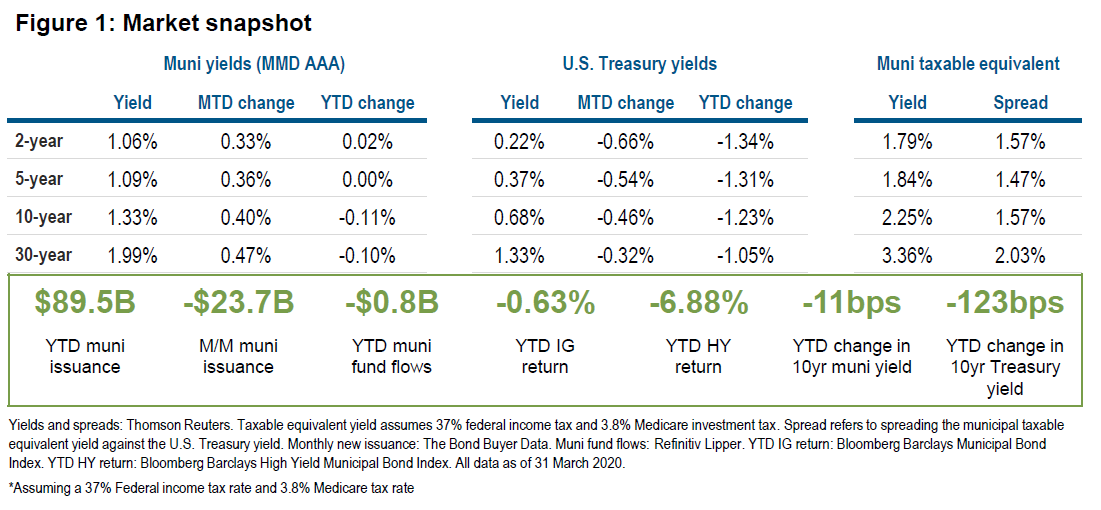
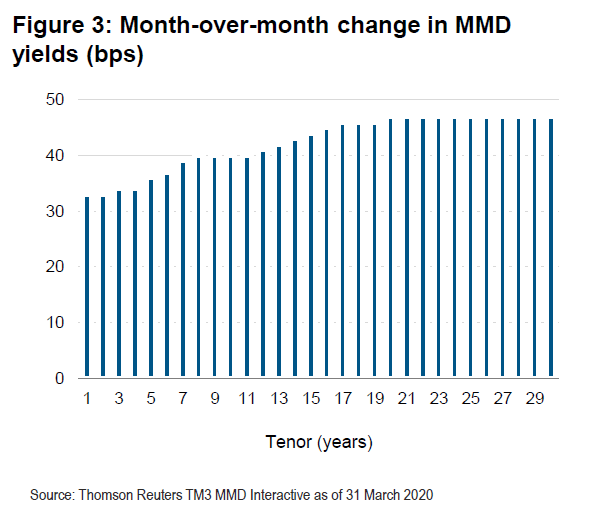
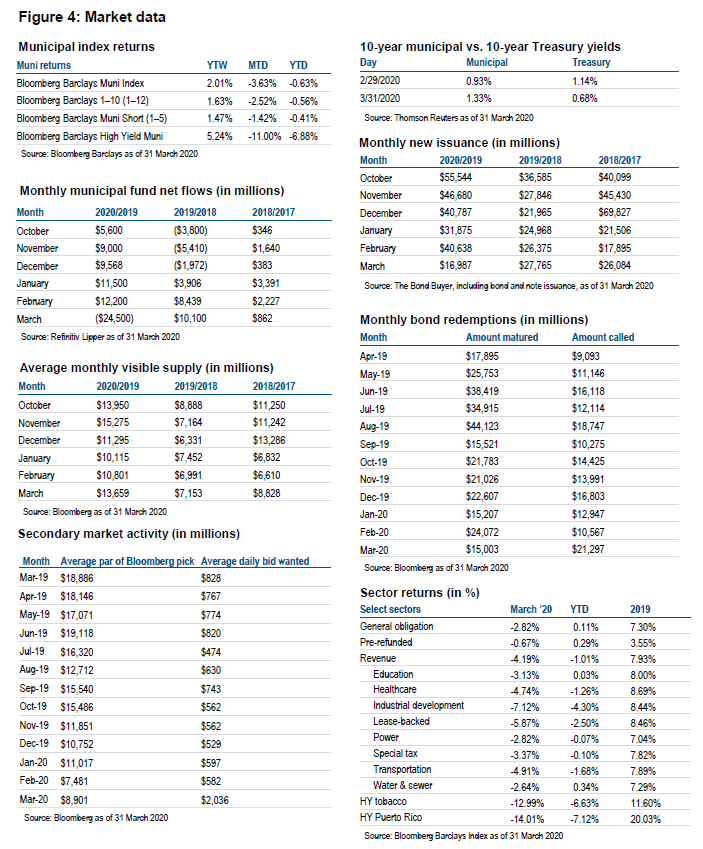
Against the backdrop of the COVID-19 pandemic, the AAA Municipal Market Data (MMD) yield curve ended the highly volatile month of March with yields up 33–47 basis points (bps) relative to February month-end. Coming less than two weeks after AAA MMD yields reached all-time lows, with the 10-year tenor hitting 0.78% on 9 March, a significant sell-off caused the 10-year AAA MMD yield to reach its highest level since 2013 at 2.79%.1 March total municipal bond issuance of $17.0 billion — approximately $3.0 billion of which was attributable to taxable municipal debt — represented a dramatic decline from February’s $40.6 billion and was the lowest monthly issuance figure since February 2014.2
- The Federal Reserve cut short-term interest rates twice in March, initially by 50 bps at an emergency policy meeting on 3 March, and then by an additional 100 bps on 15 March. As part of its multi-faceted approach to combat the growing threat of a U.S. and global recession, the Fed also announced the reintroduction of quantitative easing measures, pledging to purchase at least $700 billion in Treasury and mortgage-backed securities.3
- Municipal bond indices were down on the month, with high yield municipals taking the biggest hit, following the mid-March municipal bond sell-off. The Bloomberg Barclays Municipal Bond Index returned -3.63% and the Bloomberg Barclays High Yield Municipal Bond Index returned -11.00%.4
- As Treasury yields declined and muni yields increased through March, muni/Treasury ratios spiked across the curve. The one-year ratio ended the month at 700% (up from 73% at the end of February), the two-year ratio at 482% (up from 83%), the five-year ratio at 295% (up from 80%), and the 10-year ratio at 196% (up from 82%).5
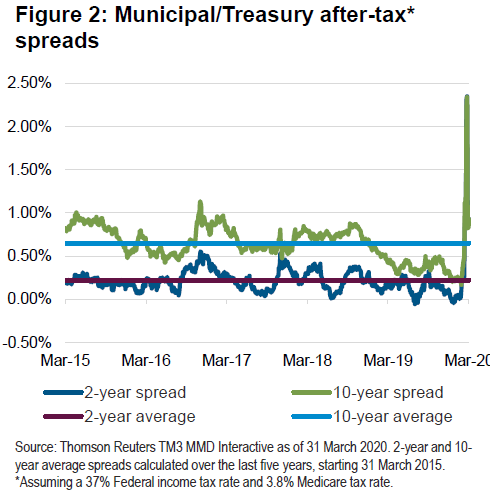
- Muni/Treasury taxable-equivalent spreads* also soared in March. At month-end, spreads equated to 162 bps at the one-year tenor, 157 bps at the two-year tenor, 147 bps at the five-year tenor, and 157 bps at the 10-year tenor.6
- March secondary market trading reached the highest levels since 2008, as the month’s 1,104,000 total trades and $515 billion in par traded marked the largest such figures since October 2008 and March 2008, respectively.7
Muni technicals in focus: A historic month due to broader market dislocation
The global spread of COVID-19 and an energy conflict, which sent crude oil prices tumbling the most since the Gulf War, fueled recession fears and shook global financial markets in March. The Dow plunged by over 37% from its peak in February, abruptly ending the equity market’s 11-year bull run.8 In nine trading days spanning from 9 March to 19 March, the Bloomberg Barclays U.S. Aggregate Bond Index fell by 6.3%.9 Even the world’s most liquid markets were challenged, as the gap between the three-month AA Financial Commercial Paper Index and Overnight Indexed Swap widened to over 1%.10
Following five-straight months of positive returns for the municipal market, the Bloomberg Barclays Municipal Bond Index fell in March, returning -3.63%.11 Further, Treasuries and municipals briefly diverged this month, as the 10-year Treasury yield plummeted to a new low of 0.51% on 9 March, while the 10-year AAA municipal yield surged to 2.79% on 20 March.12 As such, in just 10 trading days, muni yields relative to Treasuries moved to their highest on record, with the 10-year muni/Treasury ratio briefly peaking at nearly 370% during March.13
With dealers finding it difficult to hedge with Treasuries and crossover investors slow to enter the market, new issuance was largely shelved. A roughly $24.5 billion exodus from municipal bond funds — including the largest weekly outflow on record of $13.7 billion — served to sharply reverse the previous 60 consecutive weeks of net inflows.14 As funds unwound leveraged strategies and liquidated to meet redemptions, supply outstripped retail demand and bid-ask spreads widened considerably. Despite elevated bid-ask spreads, daily volume traded jumped to approximately $30 billion at mid-month, and daily bids-wanted posted on Bloomberg surpassed 11,840, the highest on record.15
Given this backdrop of challenged liquidity conditions, the Fed expanded its emergency lending facilities to include short-term municipal bonds and variable-rate muni debt held in money market funds.16 The Coronavirus Aid, Relief, and Economic Security (CARES) Act authorized the Fed to purchase munis beyond the six-month maturity limit noted in the Federal Reserve Act.17 Monetary policy action coupled with the fiscal stimulus response has provided some relief to municipal markets, and market technicals began to stabilize toward month-end.
We anticipate the COVID-19 pandemic and resultant widespread shutdowns to have far-reaching credit consequences, emphasizing the need for diligent credit selection to navigate potentially increased default risk centered around specific segments of the high yield market. Although we do not expect high quality municipal obligors to see higher default risks, we believe they will face challenges in the coming months. Those obligors that are dependent on economically sensitive revenues — such as income or sales taxes — will experience declines in collections, and we expect frequent negative headlines focused on high-profile obligors’ budget conditions. We believe high quality municipal obligors will respond with budget adjustments to close emerging budget gaps, and that credit risk will remain modest for the vast majority of the high grade municipal market. Against the current backdrop, our team’s ongoing credit surveillance and limited downside risk tolerance continue to be key facets of our highly disciplined portfolio management process.
1 Thomson Reuters TM3 MMD Interactive Data, 31 March 2020
2 The Bond Buyer: Primary Market Statistics – A Decade of Bond Finance, 31 March 2020
3 David Goldman, “Federal Reserve cuts rates to zero to support the economy during the coronavirus pandemic,” CNN Business, 16 March 2020; Nick Timiraos, Harriet Torry and Josh Mitchell, “Fed Takes Emergency Steps as Virus Pushes Economy Toward Recession,” The Wall Street Journal, 15 March 2020
4 Bloomberg Barclays, 31 March 2020
5 Thomson Reuters TM3 MMD Interactive Data, 31 March 2020
6 Thomson Reuters TM3 MMD Interactive Data, 31 March 2020
7 SIFMA: US Municipal Trading, 9 March 2020; The Bond Buyer: Secondary Market Data, 31 March 2020
8 Bloomberg, 31 March 2020
9 Ibid
10 Ibid
11 Bloomberg Barclays Indices, 31 March 2020
12 Thomson Reuters TM3 MMD Interactive Data, 31 March 2020
13 Ibid
14 Refinitiv Lipper, 31 March 2020
15 Bloomberg, 31 March 2020
16 Nick Timiraos and Heather Gillers, “Federal Reserve Considering Additional Support for State, Local Government Finance,” The Wall Street Journal, 27 March 2020
17 Coronavirus Aid, Relief, and Economic Security (CARES) Act, 27 March 2020
© PIMCO
© PIMCO
Read more commentaries by PIMCO