August 2020 was a month for the record books, just a few months removed from quite possibly the deepest but shortest recession in modern times. With U.S. 10-year Treasury yields setting record lows, and U.S equities (S&P 500) hitting record highs, some investors are questioning whether traditional core fixed income can still serve as effectively as a ballast in portfolios.
The interest rate sensitivity of core bonds has historically served as a diversifier to equities, providing price appreciation potential and resiliency in the face of stock market declines. Core bonds generally have been used to help dampen overall portfolio volatility while pursuing attractive returns that can outpace inflation.
Let’s look at how the traditional appeal of core bonds stacks up today.
Re-examining the value proposition of traditional fixed income
Dampening volatility: In isolation, core bonds display higher volatility than cash. However, in a portfolio that includes equity and other riskier holdings, core bonds have historically offered a reduction in volatility similar to that achieved by holding cash, but with higher returns (see chart). This volatility-dampening benefit is a function of the generally negative correlation that core bonds can display to equities. Even with interest rates somewhat range-bound at lower levels, we believe this correlation benefit should persist – that is, rates could still go lower in a negative growth scenario when equities and risk assets underperform.
 Image Pop Up
Diversifying risk assets in periods of market stress: Core bonds also have had the ability to provide positive return potential when riskier assets face drawdowns. This is because interest rates tend to fall (benefiting rate-sensitive assets) when credit or equity performance is challenged (e.g., by the end of Q1, the Bloomberg Barclays U.S. Aggregate Index (“U.S. Aggregate Index”) was up 3.15% when the S&P 500 was down 19.60%). With interest rates at today’s low levels, the room to decline is potentially more limited than before – but rates can still fall even in what will likely remain a fairly range-bound rate environment. Moreover, to the extent a more negative growth scenario were to take hold, we would expect rates to decline substantially and thus deliver price appreciation potential (a severe negative shock could push yields to zero, and with 10-year Treasuries yielding about 0.7% lately, a decline to 0% yield would imply price appreciation of over 4%i).
Supplementing returns: Although the level of yields may have declined, we believe the potential for active management to generate alpha has remained fairly consistent. In fact, with yields on the U.S. Aggregate Index just above 1%, active management may become more critical as alpha could likely be a larger share of returns going forward. With the average active core plus manager capturing a 0.7% yield advantageii over the U.S. Aggregate Index, the return potential is not that dissimilar to years past at inflation plus 1% to 2%. The opportunity for solid returns from active core management – and the potential for price appreciation and resiliency during volatility – can be compelling in a world of low return expectations across asset classes.
Adapting portfolios to the world ahead
Fearing lower returns from core bonds, some investors may be tempted to reduce such holdings in favor of cash or equities. However, if one were to use the example of insurance, it becomes clear that the response to a decline in the potential payout should not be to either own less insurance (i.e., go to cash) or take more risk (buy more equities).iii
Instead, investors may find it prudent to examine their asset allocation through the same lens that we apply within core portfolios. With duration offering somewhat diminished diversification to credit and other spread risk, reducing concentrations and broadening the types of spread risk is critical in our view – i.e., emphasizing less correlated assets to embed resiliency.
In addition to maintaining duration, we find value in U.S. agency mortgage-backed securities, where overall yields are compelling, especially for an asset class with a government or Agency guarantee, direct and substantial Federal Reserve support (via current asset purchases),iv and robust liquidity (compared to corporate credit). We are emphasizing higher-quality investment grade credit and focusing on sector- and credit-selection over generic beta exposure given the dispersion between and within sectors (for markets but also the broader economy) and in recognition of an evolving credit cycle that could lead to more downgrades and defaults. Other securitized credit, particularly higher up the capital structure, can also provide compelling risk-reward profiles and the potential for resiliency in what is likely to be a long and uneven economic recovery.
So yes, rates are low, but we believe the defining features of core bonds – diversification and return potential – continue to make them a critical component of a well-balanced portfolio.
i As of 31 August 2020 – and based on the Bloomberg Barclays U.S. Aggregate Index duration of 6.09 years.
ii Yield advantage based on the average SEC yield (current 30-day yield) in the Morningstar Intermediate-Term Core Plus category (U.S.) versus the yield on the Bloomberg Barclays U.S. Aggregate Index as of 31 July 2020.
iii Cash and investment products are not insurance. The term is being used for illustrative purposes only. PIMCO does not offer insurance guaranteed products or products that offer investments containing both securities and insurance features.
iv U.S. agency mortgage-backed securities issued by Ginnie Mae (GNMA) are backed by the full faith and credit of the United States government. Securities issued by Freddie Mac (FHLMC) and Fannie Mae (FNMA) provide an agency guarantee of timely repayment of principal and interest.
DISCLOSURES
Past performance is not a guarantee or a reliable indicator of future results.
Investing in the bond market is subject to risks, including market, interest rate, issuer, credit, inflation risk, and liquidity risk. The value of most bonds and bond strategies are impacted by changes in interest rates. Bonds and bond strategies with longer durations tend to be more sensitive and volatile than those with shorter durations; bond prices generally fall as interest rates rise, and low interest rate environments increase this risk. Reductions in bond counterparty capacity may contribute to decreased market liquidity and increased price volatility. Bond investments may be worth more or less than the original cost when redeemed. Equities may decline in value due to both real and perceived general market, economic and industry conditions. Mortgage- and asset-backed securities may be sensitive to changes in interest rates, subject to early repayment risk, and their value may fluctuate in response to the market’s perception of issuer creditworthiness; while generally supported by some form of government or private guarantee, there is no assurance that private guarantors will meet their obligations. Management risk is the risk that the investment techniques and risk analyses applied by an investment adviser will not produce the desired results, and that certain policies or developments may affect the investment techniques available to the manager in connection with managing the strategy. The credit quality of a particular security or group of securities does not ensure the stability or safety of the overall portfolio. Asset allocation is the process of distributing investments among various classes of investments (e.g., stocks and bonds). It does not guarantee future results, ensure a profit or protect against loss. Diversification does not ensure against loss.
Statements concerning financial market trends or portfolio strategies are based on current market conditions, which will fluctuate. There is no guarantee that these investment strategies will work under all market conditions or are appropriate for all investors and each investor should evaluate their ability to invest for the long term, especially during periods of downturn in the market. Investors should consult their investment professional prior to making an investment decision. Outlook and strategies are subject to change without notice.
© PIMCO
© PIMCO
Read more commentaries by PIMCO
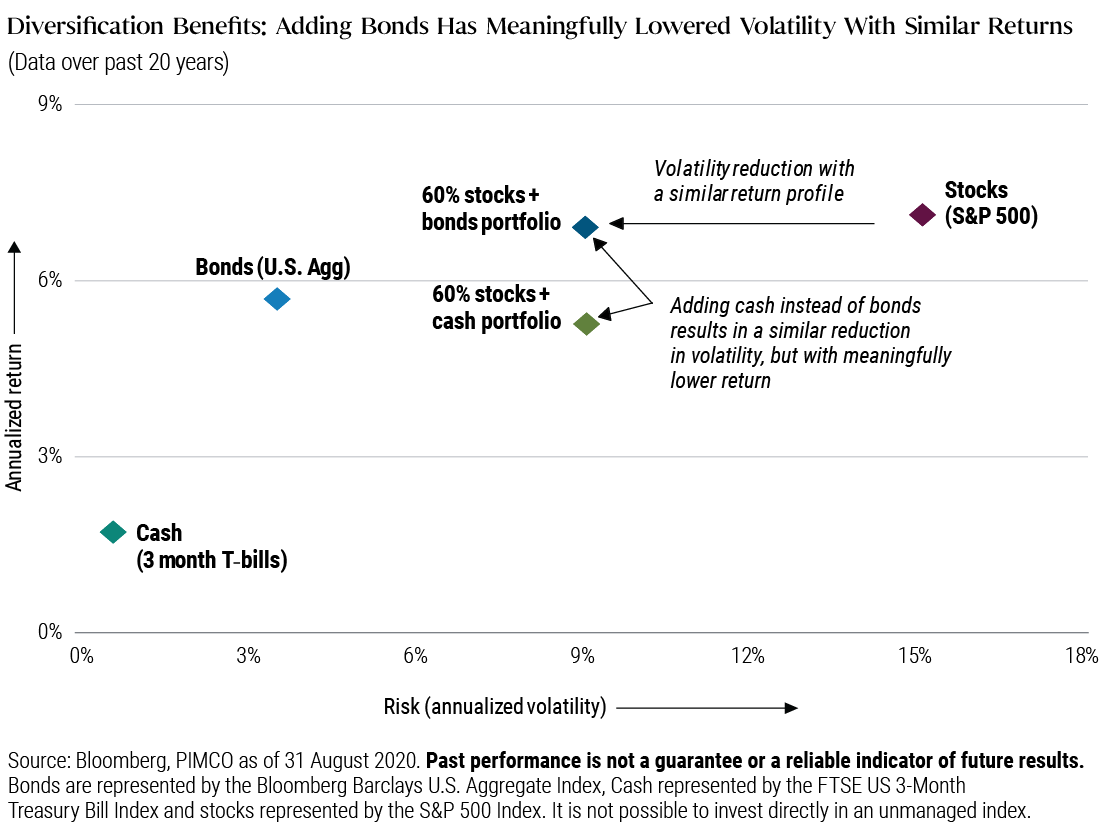 Image Pop Up