Current Market Volatility – Ukraine & Fed Policy Effects
Membership required
Membership is now required to use this feature. To learn more:
View Membership BenefitsUpdated as of 2.24.22
TRUST BUT VERIFY – THOUGHTS ON THE RUSSIAN INVASION OF UKRAINE
Brian Barish – The history of extreme headline geopolitical events is that (generally and for the most part) buying the event-risk pays off in the medium term, if you can stomach the short term.
This was true following the June 1989 Tiananmen Square massacre, following the commencement of hostilities in both Iraq wars, post-9/11, post Russia’s invasion of Crimea in 2014, and post the surprise Brexit vote in 2016. All these triggered immediate and broad-based risk-asset selloffs. Generally the market low occurred within a week or so of these specific headline events.
“Shock” world events tend to cause indiscriminate selling and therefore unusual buying opportunities for investors that can show a modicum of patience. This used to be owing to a higher retail investor presence in markets broadly speaking. More recently, retail investors’ panicky tendencies have been replaced by those in the world of leveraged finance. A big increase in systemic volatility leads to forced selling and smaller risk-books, as risk/volatility per dollar of exposure suddenly embed more volatility and therefore more risk than intended. In an investment landscape overshadowed by index-fund flows and thematic investing via ETFs, the markets’ capacity to clear the above can be (alarmingly) inconsistent. This can entail some rather wild moves in individual stocks, not based much, if at all, on business fundamentals.
It is also true, however, that geopolitical risk events of this sort can be signposts to longer developments which fail to be anticipatable in the moment. The shock factor of 9/11 brought about major changes in American foreign policy focus, national security policy, and two long and expensive wars – wars that were popular at the time but accomplished little for national security or foreign policy clarity. The Tiananmen Square massacre was a large step backwards for political freedom in China, but in its wake, China’s industrialization and modernization were accelerated.
What’s Putin’s end game here?
Masha Carey – Almost every long-time observer of the post-Soviet regime has admitted to having been caught on the back foot with the full-scale invasion this week. Everyone wants to know what Putin is thinking. Most say this is impossible, as the leader has become increasingly isolated and his inner circle has become ever-smaller in the wake of the pandemic. We do still believe that a pro-Kremlin government in Ukraine is the likeliest outcome, perhaps even more so with the overt outbreak of war.
We can only theorize, but perhaps one of the better potential summations of Putin’s mindset here is that the invasion embodies domestic, rather than foreign policy. Whenever Putin needs to shore up domestic support, he has typically triggered conflicts that allow him to be cast as a hero. This strategy was first employed in 1999 when Putin stepped into the role of victorious military leader in the Chechen War, and again in 2014’s invasion of Ukraine which came on the heels of flagging domestic support (Putin was infamously booed at a martial arts event right before duma elections in late 2011) and culminated in the annexation of Crimea.
While some polls show a majority of Russians believe the conflict in Ukraine has been caused by the west, the true level of domestic support for the war remains difficult to gauge. It is important to emphasize that despite a notorious increase in repression when it comes to political dissent in Russia in recent years, nearly two thousand anti-war protestors across fifty-three Russian cities were detained on the day of the invasion. While Putin may be following a familiar playbook, the usual outcome is far from certain.
What then to make of this week’s full invasion of Ukraine?
Brian – From the Russian angle, we continue to believe that Putin intends to install a pro-Kremlin government in Kiev, thus cutting off any possibility of closer Western military and economic ties for Ukraine, and that Russia will (eventually) seek greater European access for its gas exports, for which Western Europe has no clear substitutes right now. We admittedly thought this could be accomplished without a full ground invasion. However, the actions so far suggest that Putin has fairly low expectations of the severity of any Western responses. A wet noodle as compared to a sharp stick is all that resulted from Putin’s last military campaign in Crimea. Why expect anything different now? We are (already) reading that Russian aluminum and oil exports won’t be subject to any sanctions given a global shortage of raw aluminum and high current oil prices, and could easily see something similar with respect to other scarce resource Russian exports, such as natural gas. We do expect the financial dealings of Russia and wealthy Russians to be generally restricted.
From the Western side, we believe that expectations for highly aggressive central bank rate actions in 2022 need to be dialed back, at least from the levels reached in recent weeks. The Fed likely still intends on bringing monetary policy to a “neutral” rate over the balance of 2022 to stem an inflation problem that is only partially a result of overly aggressive monetary policy actions taken in 2020-2021. Fed credibility is an asset, and this asset ought not to be depleted any further. Supply chain damage and repair remain mostly outside Fed influences. Proceeding to “neutral” policy is a very different goal than proceeding to “restrictive” monetary policy in terms of objectives, the rationale, or the means to get there. No one at the Fed has, to the extent of our knowledge, suggested the latter as an appropriate goal. Embarking immediately in the direction of restrictive policy won’t help credibility either. With asset prices embedding higher risk premia, risk books contracting, and other effects likely from the policing and sanctioning policies that are actually implemented, the “neutral rate” is apt to be a lower number.
The End of the Post-Cold War Order? Today? Maybe that already happened some time ago.
Brian – It is no overstatement to say that the globalization of trade, finance, media, politics, and (not to be forgotten) investment mandates, were forged in the optimism that proliferated after the fall of the Iron Curtain in 1989, and subsequent collapse of the Soviet Union in 1991. Investment flows towards “less developed countries” or “LDCs” swelled after they were renamed as “Emerging Markets” given the tone at the time. An American free markets economic structure was viewed as an inevitability in the third world LDCs (now renamed) and the former-Communist second world, with Marxism and other flavors of state-led development ideologically disgraced.
In a famous book written at the time, The End of History by Francis Fukuyama, Western liberal democracy and its economic analogue, a free market economy, were pronounced as an end state to mankind’s development – no further progress to be made, and democracy as a natural and durable state. Free market economics, aka capitalism, as inevitable (capitalism was Karl Marx’s derisive name for free market economics, and he thought something very different was inevitable). In the wake of all this general optimism, Ukraine gave up its nuclear weapons stash in 1994 in exchange for various Western and Russian security guarantees.
We see some flaws in the post-Cold War optimism bubble and its sweeping conclusions. This is hardly a new thought. But the degree to which large nations such as Russia and China have veered off the expected course is striking.
Where the world’s political and economic structure goes from here are not at all clear to us. On the one hand, global supply chain linkages have progressed mightily since the early 1990s. Disconnecting back to ideological and political poles and closed off economic systems would be challenging to say the least. Global trade, which was 50% denominated in U.S. dollars in 2008, is now 80% denominated in dollars (!), a nearly total victory for the globalist economic vision in some sense. On the other side, China and Russia appear to be clear adversaries ideologically and in terms of national intentions. What can they accomplish as quasi-outsiders possessing large armies to the globalized world economic order? We are doubtful either can “get ahead” of the West, or forestall economic stagnation domestically by doubling down on a resources-based economy (for Russia) or centralized controls (for China). Having spent 30+ years in international finance, the cultural, legal, and institutional foundations needed to sustain a free market economic system are not consistently present in the former second and third world, a huge impediment to the inevitability argument. Whether it’s China’s Marxist turn last year or Russia’s turn towards some version of the world as it was in 1991, globalization, democracy, and free market economics are not likely to be universal realities, broadly speaking. Maybe general trends at most.
Ronald Reagan is generally associated with the statement: “Trust but Verify”. Ironically it is a rhyming Russian proverb, Доверяй, но проверяй. (Pronounced as Doveryay, no proveryay).
We still trust in the inevitability of some form of globalization to economic and financial flows. Planned economies stripped of property rights and the free movement of prices, a common feature of dictatorial police states, cannot possibly respond correctly or in a timely manner to the complexity of a modern economy. Like the proverb, we would advise verifying that these general features reside in the geographic and corporate destinations for investment capital, and abstain where it does not.
______________________________________________________________________________ Original post – 2.15.22
What do you make of the current tone of the markets?
Brian Barish – The markets have reacted and continue to react to the prospects of a rapid Fed tightening cycle, as well as geopolitical news with respect to Russia and Ukraine.
How serious are these issues?
Brian – A change in the Fed policy stance and direction is always meaningful for financial markets. It is overdue and welcome, as continuing to fuel demand and credit growth when we have a pronounced supply-side problem is the wrong policy. Nonetheless, as is well documented in the financial press, the stock market started 2022 on the higher end of long-term valuation at 22x forward earnings, with an ample number of companies at very high multiples. A policy-shifting Fed is a serious risk to financial valuations. Multiples ought to compress. The Russian stuff is far less serious matter though – it mostly a crisis of the moment.
Masha Carey – There have been roughly 100,000 Russian troops on the border of Ukraine for about one year. This is not a new development. Putin’s main goal is not to have a dialogue with the West, but to have the West pay attention to him. He wants to keep the West guessing. The best resolution for Putin is some kind of face-saving policy gesture by the West that enables him to avoid doing something far more provocative (like a full invasion of Ukraine).
So what does Putin actually want, besides attention?
Masha – We believe he wants the Nord Stream 2 gas pipeline approved by the E.U. He may also want some assurances that Ukraine would not join NATO and will be Kremlin-friendly. Although it seems like an old Cold War reality, there are few physical barriers between Russia and the West. Russia has engaged in similar regional conflicts, including in the Caucasus, to maintain this buffer. Anytime these former Soviet Republics have moved closer to the West, Russia has disabused them of the notion that a closer relationship, especially militarily, could be a reality.
How do you see this being resolved?
Masha – A sufficiently pro-Kremlin pivot from Ukrainian leadership, and the eventual approval of Nord Stream 2.
Is that appeasement? Isn’t that what countries are not supposed to do with aggressors?
Masha – It’s more a return to the status quo. Post-Soviet Ukraine has made multiple overtures towards a closer relationship with NATO and the West, and every time Putin has reacted. The current crisis began in February of last year when the Ukrainian government took pro-Kremlin TV channels off the air and seized the assets of the oligarch who ran them. This oligarch, Viktor Medvedchuk, is a close friend and ally of Putin – the two have gone on vacation together and Putin is the godfather to Medvedchuk’s daughter. The initial troop buildup began mere weeks after Medvedchuk’s TV channels went off the air. To some degree, this is personal, and the West is playing into Putin’s hands by acting alarmist. U.S. and European political leaders do not fully seem to appreciate Putin’s mentality here. Few people do, given the small size of his inner circle.
Brian – Russia has a strange habit of showing up at odd times with respect to capital markets. The Russian debt default of 1998 happened (late) in the process of other East Asian countries experiencing severe financing problems during the Asian Financial crisis of 1997-98. In the United States, few people have any understanding of what this was. Still, it was a seminal event in Asian emerging markets, and not unlike the 2008-09 financial crisis in the U.S., it reverberates today. Speaking of the 2008 financial crisis, recall that Russia invaded the former Soviet Republic of Georgia, weeks before the Lehman Bros failure, creating some added stresses and (very briefly) popping the price of oil.
So when do you estimate this issue recedes/what happens?
Masha – We hesitate to make calls on timelines. Geopolitical events can have short life spans, however. Probably the West’s attention moves to something else. Russia’s interest in keeping NATO-type alliances out of former Soviet Republics will not go away. It is not like Russia wants Ukraine “back” – they never really lost it. They just want to keep some form of post-1991 status quo. The West, mainly Europe, has a keen interest in natural gas flowing, and that interest will be less pronounced as the weather starts to warm up. So the window to induce high stress (by Russia) and obtain greater attention (by the West) is right now.
Could Europe sever its energy dependency on Russia in the future?
Masha – Western Europe is far, far away from being able to do this. Recall that after the Fukushima nuclear disaster in Japan in 2011, Western European countries have spent the last 11 years de-commissioning their nuclear power infrastructure or just not investing in it. Western Europe has built a lot of renewables generation, in the form of wind and solar, but sadly renewables-based generation is both intermittent and irregular. It can’t fully replace the reliable baseload power of nuclear or natural gas powered generation. This winter has been more cloudy and less windy than normal, amplifying these issues. One day this will change, but for now Europe’s energy dependency on Russia is unavoidable.
Switching gears to the U.S., can the market stabilize once the Fed begins raising rates, as is expected in March?
Brian – My (general) observation is that financial markets are riskier when the Fed’s current policy is perceived to be “off target” versus what is necessary. This can be true in either potential tightening or loosening episodes. Obviously, they need to be tightening and not adding to their balance sheet as inflation rates have blown out above most forecasts from a year ago. Aggregate demand is high, while aggregate supply has decreased/been damaged by the myriad Pandemic-related issues. Providing continuous monetary accommodation to (high demand) is not helping the supply-side issue.
What do you think the Fed will actually do in upcoming meetings? Would they make an intra-meeting move?
Brian – There is little predictive value in guessing what the Fed may do, other than they are definitely going to actually do something in March and keep doing it for several meetings thereafter. Is it 50 bps right away, or 25 bps and consistent hikes all year, or do they bring forward the balance sheet roll-off? Appearances matter and the Fed does not want to appear to be panicking; that does not help their credibility (and they care a lot about their credibility). So I would rule out an intra-meeting move because that would look panicky. As for 50 bps in March, I rather doubt that also for the same reason, but there is a decent argument that the Fed ought to front-load the rate increases in the near term (this is what St. Louis Fed President Bullard has been saying in public) given how protracted the policy shift process has been.
My own view is that the Fed’s slow-reaction function to increasingly ridiculous inflation data is explicitly a consequence of the timing of new Fed appointments vis-a-vis the political calendar. If Governor Youngkin does not win Virginia and Biden’s approval rating isn’t bumping up against Nixonian levels, does Powell get re-appointed? Does Biden signal to Powell in a public manner to deal with inflation please? I seriously doubt either. The political machinations are slow because the U.S. Senate is involved and anything requiring the Senate is by definition slow. So a re-appointment process that should have been over with on December 1 is not in fact over with until March 1. But as of March, Powell and Co. are immovable, politically speaking, for several years and can finally get on with it and ignore the whining that will follow. Because surely, some folks will be hurt by the end of this particular era of capital subsidization. The wait is unfortunate because the inflation issues are just getting worse while we wait.
How far will the Fed go then?
Masha – Based on Powell’s public commentary, the Fed needs to get to a “neutral” interest rate and policy position versus an accommodative position presently. There are notorious problems with backward-looking Fed models. We don’t believe the Fed, or anyone else, really knows what this absolute rate should be. Estimates tend to move up in periods of high inflation and down in periods of low inflation. So it is natural that policymakers would proceed cautiously towards neutral, and try not to surprise market participants.
Brian – There are two phases to this return to neutral process. The first is obviously getting the Fed Funds rate up, probably over 1%, through a series of rate actions. After they get the Fed Funds rate over 1%, the Fed will begin shrinking its balance sheet, also known as Quantitative Tightening, or QT. The market is well aware that as the Fed expands its balance sheet, financial risk premia tend to decline, and thus as the balance sheet declines, risk premia tend to rise. This is happening as we speak. This leads to wider corporate bond spreads and lower multiples, broadly speaking. Corporate bond spreads reached all-time lows in 2021, so this process has considerable ways to go, but if you use a microscope, you can see spreads widening in 2022. Echoing Masha’s comments about the challenge of estimating the neutral rate, the Fed does not have a very good idea of what size its balance sheet needs to be versus a range of financial system assets, including debt and derivatives, that is bigger than ever. Smaller than $9 trillion, and bigger than $4 trillion, somewhere in there. That’s a wide range.
What would expect to be the impact of these policy steps?
Brian – With equity markets always forward-looking, the bear market is on in speculative asset classes and high multiple stocks. It is estimated the equity market has already baked in ~90 bps of tightening so far. But the starting point for the Fed moving to a new and much less accommodative policy is a basic challenge. We have made this point in various publications: the percentage of non-earning companies in broad indexes such as the Russell 2000 is at all-time highs, and yet corporate profits as a percentage of GDP are also at an all-time high. Something is very wrong with this picture! There is probably a lot of alpha to be had through abstention in these areas of the market (high multiple and non-earning businesses). Investors, we believe, will care a lot more about companies actually having profits with capital less freely available / not subsidized by the Fed.
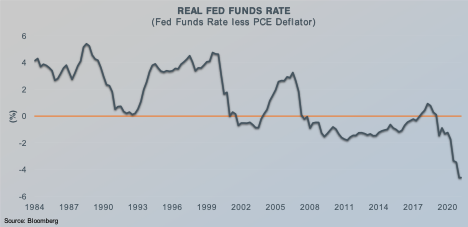
One larger thought to ponder is the scope of time that we have spent with negative real interest rates. We have had negative real rates for a preponderance of the 21st century, and nearly all of the post-GFC time period other than a brief period of positive real rates in 2018-19. If you are heavily invested in the high-multiple class of stocks, you have to wonder if we will ever come back to negative real rates in the medium to longer-term? The fact that nobody can really know whether negative real interest rates will re-occur as a deliberate policy decision is…well it’s really something to think hard about, I would just leave it at that.
Masha – The yield curve has flattened as the market anticipates normalization in Fed policy. We feel reassured that as long as 10-year yields are rising, then nominal growth issues are not a concern for more typical (profit-earning) businesses. This tells us that the market is not so concerned about the Fed moving too quickly so as to derail economic growth prospects entirely. We still feel comfortable holding banks and other rate-sensitive financials, given this backdrop. We would be less comfortable if the 10-year yield starts to fall; this suggests a negative shift in nominal growth prospects.
The ECB has made some suggestions of moving its interest rate stance. Can they really move and to where?
Masha – We are seeing some interesting strength in nominal economic indicators in Europe that we have not seen since pre-2008, in terms of capex, loan growth, etc. The relative strength in Europe of these indicators is nothing like that of the United States however. The ECB will proceed very cautiously as there is not the same degree of urgency as in the U.S. where inflation is clearly interally-reinforced. The market is currently pricing a return to near-zero for Europe by the end of this year (50 bps of hikes), but getting much above this will be tough especially given structural sovereign debt concerns. The ECB has been very careful to back away from hawkish rhetoric despite strong inflation prints. We expect an update to guidance in March, likely focused on a wind-down of the bond-buying program. The neutral rate in the euro area is likely much lower than it would be in the United States, and any cautiousness by the Fed is apt to be magnified by the ECB.
Any other thoughts?
Brian – My gut feeling is a rough/volatile market until Fed acts in March, and probably a relief rally no matter what they do (I predict 25 and strong guide towards definitive action at the next three Fed meetings getting us to 1.0% in August). This is more consistent with the Fed of the last ~18 years and notionally is more consistent with wanting the market to believe they have this under control/are not panicking. It may all be academic as 4 x 25 bps by mid-August versus a 50 bps + 25 bps + 25 bps by July 1, per Mr. Bullard, entails a mere six weeks at slightly lower rates than may otherwise be the case. This relief rally, should it occur, may be the last ride of the high multiple stuff for a while. The Fed’s tightening and walk away from extreme unconventional policy and the market’s (correct in my view) estimation that resources and capital need to be repositioned in more physical parts of the economy – this seems to me likely to be a longer process.
One other risk factor worth watching is China and its Zero-Covid policy, especially after the Olympics. China, for now, appears to be alone among major countries in trying to eradicate Covid entirely via lockdowns two years after the Pandemic began. Zero-Covid appears impossible to achieve in the wake of Delta and Omicron. Over the weekend China apparently approved Pfizer’s Paxlovid Covid antiviral for domestic use. This may entail they are backing away from Zero-Covid and will accept Covid as an endemic reality. This would be very beneficial for the global supply chain, should it prove to be true.
Masha – We will continue to focus on various nominal growth indicators on both sides of the Atlantic to corroborate our views. Even Europe is showing loan growth at a post-GFC high. This is encouraging, especially combined with a type of fiscal momentum we haven’t ever really seen before in the common currency area. Eventually, if policymakers get it right, we could get to a scenario where the ECB can actually raise rates above 0%. Although rates in the U.S. are apt to go up further and faster, getting above 0% is probably bullish for the Euro, as it is very difficult at present to hold savings in Euros given the negative yield issue, and ultimately a normalization of rates would arrive in hand with solid growth momentum.
Membership required
Membership is now required to use this feature. To learn more:
View Membership BenefitsSponsored Content
Upcoming Virtual Events View All











