As trade wars and tariffs dominate the early days of President Trump’s second term, a closer look at the broader landscape reveals why the United States remains positioned to pursue this strategy. The United States commands a unique position in global trade. Despite running a large trade deficit, it holds immense influence as the world’s largest importer. By exploring trade openness and balances among major economies, we can better understand the growing reliance on tariffs as a negotiation tool and why they are likely to remain central to global trade policy.
How Open Are the World's Largest Economies?
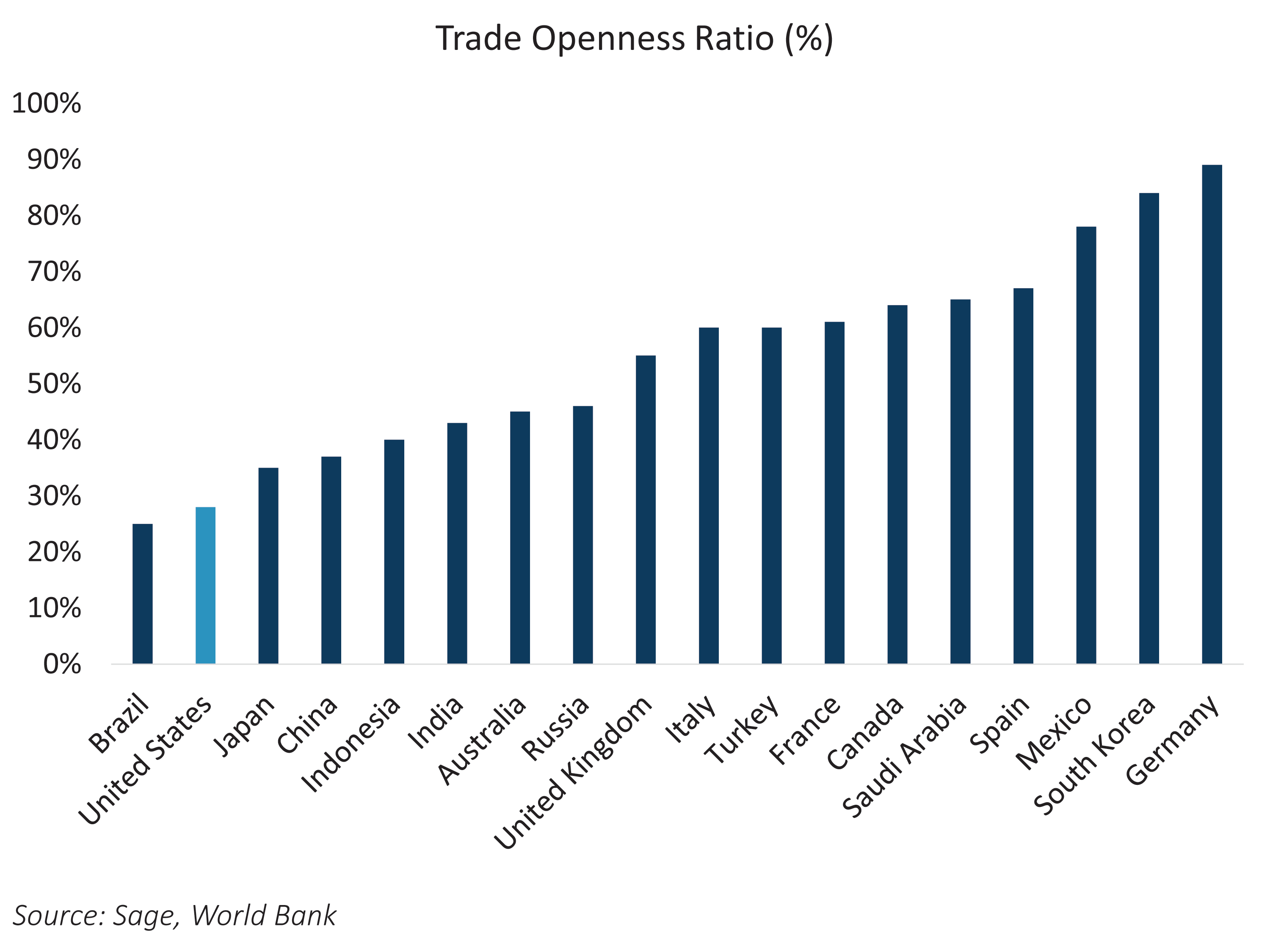
Trade openness reflects the extent to which a country engages in global trade by calculating the total value of its exports and imports as a share of its GDP. A high ratio suggests a country is deeply dependent on international trade, while a low ratio indicates a more self-sufficient, domestically driven economy.

With a trade openness ratio of just 28%, the US is far less reliant on global trade than most major economies. The US economy is largely sustained by domestic consumption, which shields it from the kind of economic shocks that can rattle countries that are more deeply entrenched in global trade networks. In contrast, economies such as Germany (89%), South Korea (84%) and Mexico (78%) are far more dependent on cross-border commerce, meaning they are more vulnerable to disruptions in trade agreements or tariff increases.
For the US, its relatively low trade openness means that it has more room to maneuver in negotiations. It can impose tariffs without fear of immediate domestic economic collapse, unlike countries with higher trade dependencies. While other nations scramble to maintain access to American consumers, the US can afford to play hardball.
The US as the World's Biggest Customer
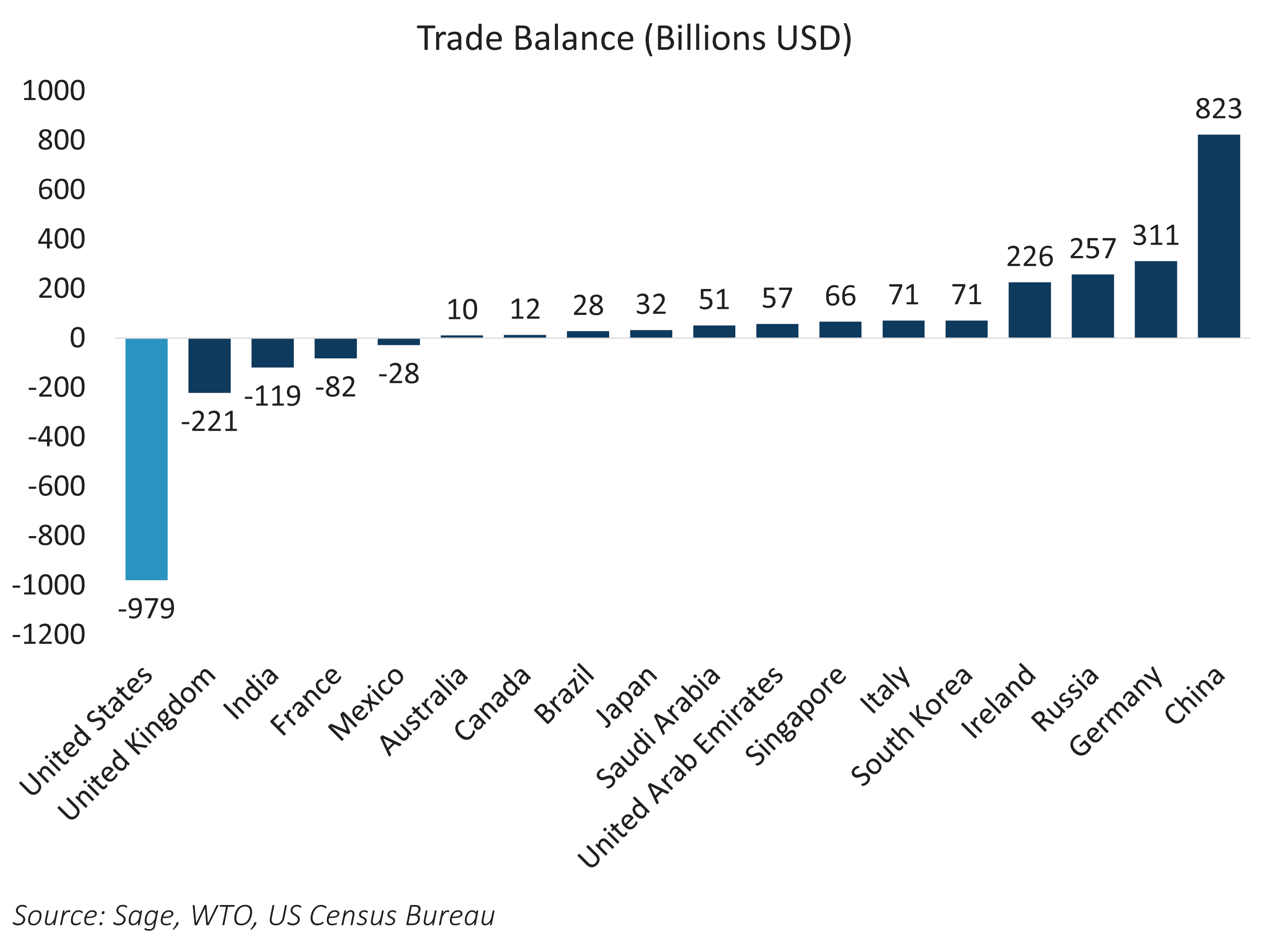
A country’s trade balance — the difference between what it exports and imports — shapes its role in the global economy. A trade deficit occurs when imports exceed exports, while a surplus arises when a country sells more than it buys.
A staggering -$979 billion trade deficit makes the US the world's largest customer, absorbing massive amounts of goods and services from economies around the globe. Countries that manufacture more than they consume, like China (+$823 billion trade surplus) and Germany (+$311 billion trade surplus), depend on the US market to absorb their goods. While this might seem like a disadvantage, it underscores the power of the American consumer. As the world’s largest buyer, the US holds leverage over exporting nations that depend on American demand.
Tariff Uncertainty Remains in A Changing Global Trade Order
The United States is in a unique and powerful position. Its relatively closed economy and role as the world’s top importer provide significant leverage to use tariffs as a powerful bargaining chip. Tariffs come with risks, however. On the one hand, they can protect domestic industries, incentivize local manufacturing, and generate government revenue. On the other hand, they can lead to higher prices for consumers, provoke retaliatory trade measures, and disrupt supply chains that American businesses depend on.
The key takeaway is that tariffs aren’t going away anytime soon. Given global trade dynamics and the current US administration’s approach, they will likely remain a key fixture in American trade negotiations — not as an end in themselves, but as a tool to extract better trade terms. The challenge for policymakers will be to strike the right balance, ensuring that trade remains a source of economic strength rather than an arena for escalating conflict.
For more news, information, and strategy, visit the ETF Strategist Channel.
Disclosures:
This is for informational purposes only and is not intended as investment advice or an offer or solicitation with respect to the purchase or sale of any security, strategy or investment product. Although the statements of fact, information, charts, analysis and data in this report have been obtained from, and are based upon, sources Sage believes to be reliable, we do not guarantee their accuracy, and the underlying information, data, figures and publicly available information has not been verified or audited for accuracy or completeness by Sage. Additionally, we do not represent that the information, data, analysis and charts are accurate or complete, and as such should not be relied upon as such. All results included in this report constitute Sage’s opinions as of the date of this report and are subject to change without notice due to various factors, such as market conditions. Investors should make their own decisions on investment strategies based on their specific investment objectives and financial circumstances. All investments contain risk and may lose value. Past performance is not a guarantee of future results.
Sage Advisory Services, Ltd. Co. is a registered investment adviser that provides investment management services for a variety of institutions and high net worth individuals. For additional information on Sage and its investment management services, please view our web site at sageadvisory.com, or refer to our Form ADV, which is available upon request by calling 512.327.5530.
A message from Advisor Perspectives and VettaFi: To learn more about this and other topics, check out our most recent white papers.
Read more commentaries by Sage Advisory