U.S. stocks underperformed in the first quarter of 2025, hit by a double whammy from intensifying policy uncertainty and a U-turn in select mega cap stocks. Into this volatile backdrop, April 2—President Trump’s so-called Liberation Day—was circled on investors’ calendars as a catalyst.
Tariff talk
Yesterday’s announcement from the Rose Garden marked another bold policy step, charging large reciprocal tariffs against many of the United States’ largest trading partners. For example, the policy includes:
- A new 10% base tariff on most trading partners, effective April 5
- A ramp-up a few days later to match half of the tariff and non-tariff barriers that countries impose on the U.S.
We estimate the average effective tariff rate could increase by almost 14%—a historically large increase in trade duties.
Two higher level observations are important here. First, the reciprocal tariffs leave room for the duties to get negotiated away. Case-in-point: Some very large exporters like Vietnam have already said that they will cut all tariffs on U.S. products. Second, the exemptions separate the reciprocal policy from Trump’s sector-level tariffs like steel, aluminum, and automobiles. This suggests to us that those sector-level tariffs are likely to be more permanent.
Growth hit
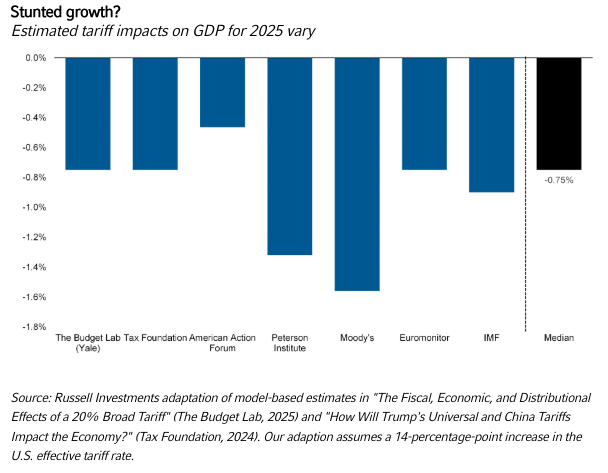
The administration had already pushed harder than expected on trade policy with tariffs on imports from China, Canada, Mexico, steel, aluminum, and automobiles & parts. While the policies could support domestic manufacturing over the longer-term, we estimated these measures were likely to act as a drag on real GDP growth of 0.5-0.75% and a boost to core PCE inflation of 0.75%.
Today’s reciprocal tariffs could dent real GDP growth by another 0.75% and lift core PCE inflation by an additional 1%. That would likely leave the U.S. growth outlook at 1% or less for 2025 and push core inflation north of 3.5%. Accordingly, we’ve raised our estimate of U.S. recession risk in the year ahead from 30% to 35-40%.

Pessimism not panic
U.S. markets were moderately risk-on through Wednesday's session, but sold off sharply Thursday morning. As of 8 a.m. Pacific time on Thursday, the S&P 500 was down approximately 4% and the Dow Jones had shed roughly 1,500 points. Meanwhile, Treasury yields declined by approximately 15 basis points as investors flocked to the safety of bonds.
We remain focused on holding diversified portfolio strategies into this period of extreme policy uncertainty. And we will be closely monitoring our measures of market psychology for potential dislocations in markets. Currently our signals show pessimism in the U.S. stock market but haven’t reached an extreme level of panic. Treasury yields at 4% are in line with our estimates of fair value for bonds.
A message from Advisor Perspectives and VettaFi: To learn more about this and other topics, check out some of our webcasts.
Disclosures
These views are subject to change at any time based upon market or other conditions and are current as of the date at the top of the page. The information, analysis, and opinions expressed herein are for general information only and are not intended to provide specific advice or recommendations for any individual or entity.
This material is not an offer, solicitation or recommendation to purchase any security.
Forecasting represents predictions of market prices and/or volume patterns utilizing varying analytical data. It is not representative of a projection of the stock market, or of any specific investment.
Nothing contained in this material is intended to constitute legal, tax, securities or investment advice, nor an opinion regarding the appropriateness of any investment. The general information contained in this publication should not be acted upon without obtaining specific legal, tax and investment advice from a licensed professional.
Please remember that all investments carry some level of risk, including the potential loss of principal invested. They do not typically grow at an even rate of return and may experience negative growth. As with any type of portfolio structuring, attempting to reduce risk and increase return could, at certain times, unintentionally reduce returns.
Frank Russell Company is the owner of the Russell trademarks contained in this material and all trademark rights related to the Russell trademarks, which the members of the Russell Investments group of companies are permitted to use under license from Frank Russell Company. The members of the Russell Investments group of companies are not affiliated in any manner with Frank Russell Company or any entity operating under the "FTSE RUSSELL" brand.
This material is proprietary and may not be reproduced, transferred, or distributed in any form without prior written permission from Russell Investments. It is delivered on an "as is" basis without warranty.
CORP-12749
© Russell Investments
Read more commentaries by Russell Investments