At the start of last week, the S&P 500 rallied three days in a row, with investors believing that the tariffs announced on Wednesday would be targeted. But with increasing expectations comes the potential for disappointment. On April 2, the much-anticipated tariff announcements arrived—and investors did not like the news. President Trump announced 10 percent tariffs across the board on all imports from all other countries, excluding Canada and Mexico. Had that been the extent of it, the market’s expectations would most likely have been met. But it also included tariffs on countries identified as bad actors when it comes to trade, which included 34 percent tariffs on China, 24 percent on Japan, and 20 percent on the EU.
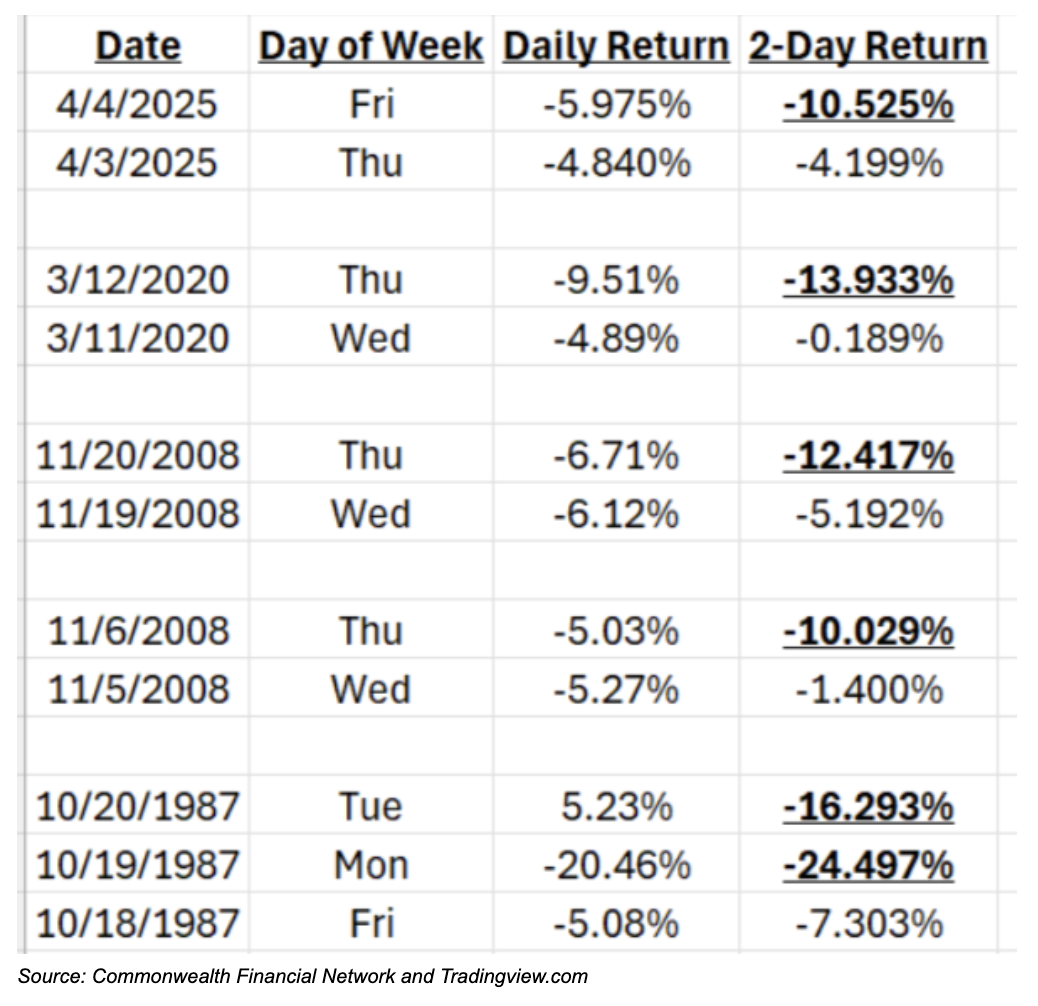
If fully implemented, the average tariff rate would likely be between 22 percent and 23 percent. This would be the highest level in over a century and have implications for inflation and economic growth. As a result, the S&P 500 declined 10.5 percent over two days. Further, China’s announcement that it would retaliate with 34 percent tariffs of its own exacerbated Friday’s sell-off.
Ben Graham, “the father of value investing,” once said, “In the short term the market is a voting machine, but in the long-term it is a weighing machine.” The market has voted over the last two days, so let’s look at previous market sell-offs and what they might indicate about the path ahead.
Have We Been Here Before?
Thursday and Friday mark only the sixth time since 1950 that the S&P 500 has fallen more than 10.5 percent over a two-day period. It happened once in 2020, twice in 2008, and twice in 1987. These periods were the global pandemic, the great financial crisis, and Black Monday, respectively. In other words, what happened on Thursday and Friday has only occurred during periods of systematic shock over the past 75 years.
The chart below shows those periods and how they compare to what happened last week.

Have Investors Reached Peak Fear?
Uncertainty around trade policy and the implementation of tariffs has weighed on markets for the better part of two months. Last week’s announcement has increased that uncertainty. The paths forward for the economy, inflation, interest rates, and corporate earnings now have a wider range of outcomes than they did on Wednesday. While that increased uncertainty will most likely lead to further downside volatility in the markets, the end of last week has raised the level of concern among investors to levels not seen in several years.
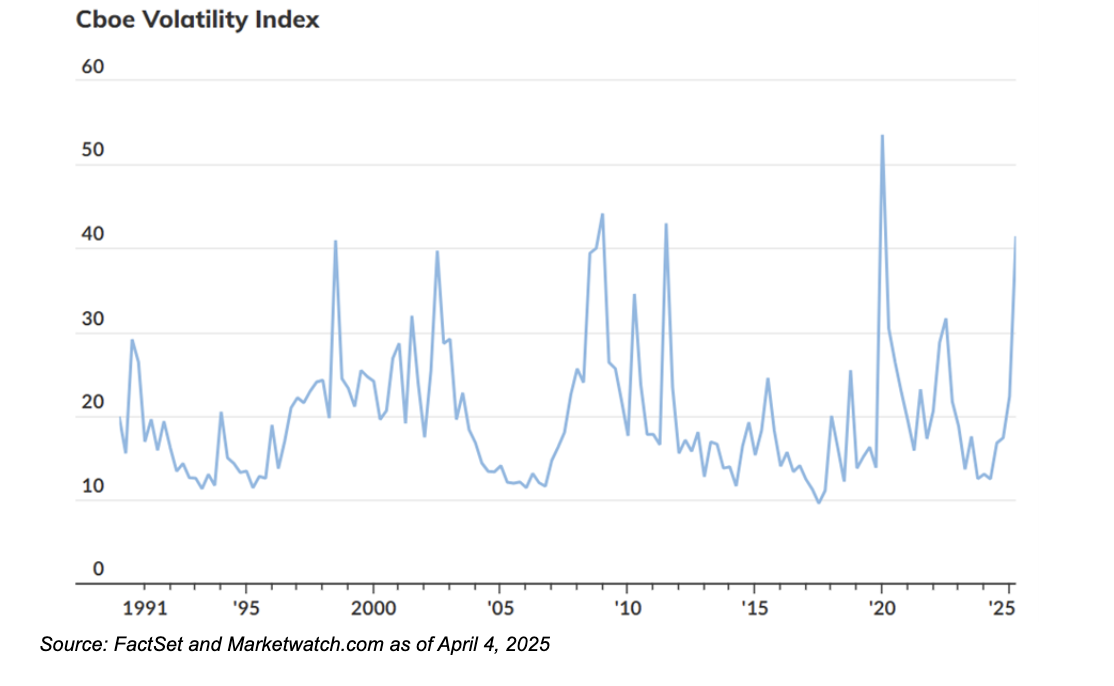
The VIX (CBOE Volatility Index) is investors’ favorite fear index. It has risen over the past several weeks and closed over 45 on Friday. The chart below illustrates how that compares to previous periods.
While the VIX can and has gone higher, we are approaching peak levels of fear seen over the past 35 years.
Opportunity Ahead?
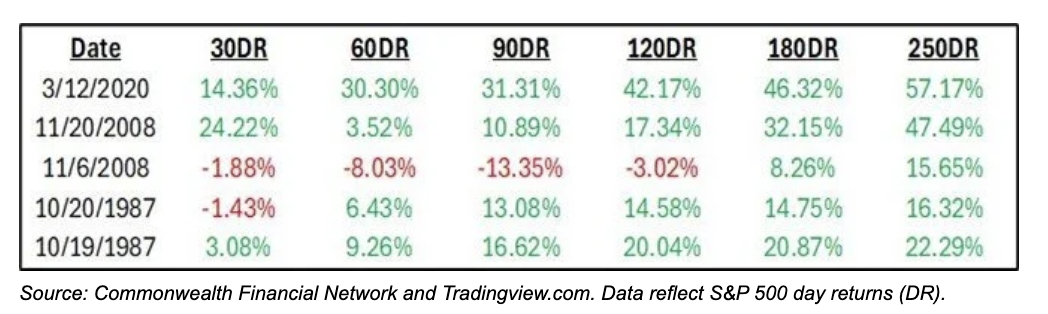
I was in the investing business through all those systematic events mentioned above. Fear, heightened emotions, and just how bad it feels to commit capital were all part of those market periods. But they were also good times to look for chances to deploy capital that could enhance portfolios for the long term. The chart below shows the S&P 500 returns after those two-day selloffs.
While the lows for the market didn’t always happen on the above-mentioned days, over time, those periods did prove to be the beginning of a buying opportunity once the dust settled. Of course, past performance is no guarantee of future results.
Gains over the past 12 months have been erased, with the S&P 500 closing price on Friday returning to where it was in April 2024. As unpleasant as that is, it also changes the inputs to investment decisions. Valuations have improved, declining from 22x at the peak in February to 18.2x. During this period, yields on the 10-year U.S. Treasury have dropped from 4.8 percent in January to 4.0 percent. All eyes will be on the third piece of the puzzle as corporations update investors about earnings over the next several weeks.
What Now?
The current situation remains fluid. There is still much to learn about how tariffs will be implemented and at what level. We also need to assess the effects on global trade going forward. This will all continue to weigh on investors. But media reports over the weekend said more than 50 countries had reached out to negotiate deals, and several countries have announced they won’t retaliate.
That said, it takes time to rebuild investor confidence, just as it did in 1987, 2008, and 2020. And it doesn’t happen without signs of improvement in the economy or earnings. But now may not be the time to move to the sidelines, as markets anticipate improving fundamentals and begin to rise before the bad news ends.
Investors should revisit long-term goals, ensuring that they are still appropriate and that they are being met. As we have espoused throughout the years, if investors only do one thing year in and year out, it should be to rebalance portfolios.* Finally, sell-offs can create opportunities to enhance portfolios over the long term. Investors should consider looking for those opportunities with a focus on diversification.
This month will provide numerous chances to get a read on where the economy is and how corporations are viewing their future. The Fed will meet in May and June, and Congress will begin discussing pro-growth policies like tax cuts and deregulation. All of this could lead to another change in investors’ perceptions on the path ahead.
A message from Advisor Perspectives and VettaFi: To learn more about this and other topics, check out some of our webcasts.
Disclosure
The information on this website is intended for informational/educational purposes only and should not be construed as investment advice, a solicitation, or a recommendation to buy or sell any security or investment product. Please contact your financial professional for more information specific to your situation.
Certain sections of this commentary contain forward-looking statements that are based on our reasonable expectations, estimates, projections, and assumptions. Forward-looking statements are not guarantees of future performance and involve certain risks and uncertainties, which are difficult to predict. Past performance is not indicative of future results. Diversification does not assure a profit or protect against loss in declining markets.
The S&P 500 Index is a broad-based measurement of changes in stock market conditions based on the average performance of 500 widely held common stocks. All indices are unmanaged and investors cannot invest directly in an index.
The MSCI EAFE (Europe, Australia, Far East) Index is a free float‐adjusted market capitalization index that is designed to measure the equity market performance of developed markets, excluding the U.S. and Canada. The MSCI EAFE Index consists of 21 developed market country indices.
One basis point (bp) is equal to 1/100th of 1 percent, or 0.01 percent.
The VIX (CBOE Volatility Index) measures the market’s expectation of 30-day volatility across a wide range of S&P 500 options.
The forward price-to-earnings (P/E) ratio divides the current share price of the index by its estimated future earnings.
Third-party links are provided to you as a courtesy. We make no representation as to the completeness or accuracy of information provided on these websites. Information on such sites, including third-party links contained within, should not be construed as an endorsement or adoption by Commonwealth of any kind. You should consult with a financial advisor regarding your specific situation.
Member FINRA, SIPC
Please review our Terms of Use.
Commonwealth Financial Network®
© Commonwealth Financial Network
Read more commentaries by Commonwealth Financial Network