Key Takeaways
-
S&P 500® EPS growth expected to come in at 7% for Q1, which would be the seventh consecutive quarter of growth
-
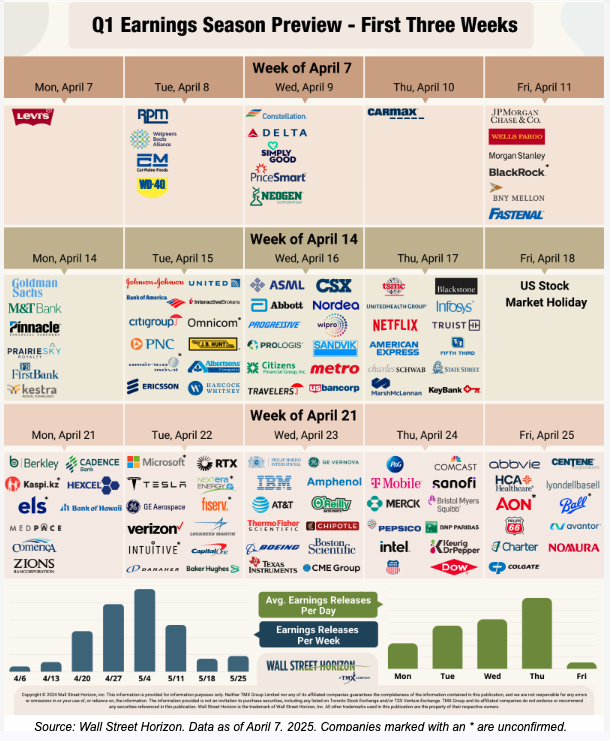
Banks unofficially kick off the season when JPMorgan Chase, Wells Fargo and Morgan Stanley release results on Friday
-
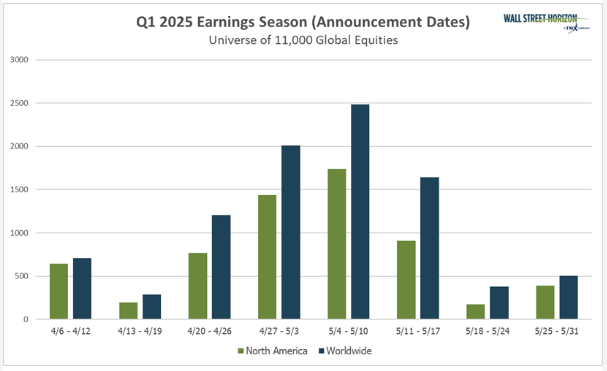
Q1 peak earnings season falls between April 28 - May 16
Early Earnings Reports Off to a Rocky Start
Q1 earnings season is about to kick off amidst what some might consider to be the most uncertain environment for US corporations since the COVID-19 pandemic.
S&P 500® companies are expected to post year-over-year (YoY) earnings growth of 7% according to FactSet and, while that is a slight downtick from last week’s estimate of 7.1%, it is still a healthy growth rate, historically speaking.1 However, part of that downturn week-over-week is due to weaker than expected results from early reporters. Of the 20 companies that have reported at this point, only 12 have surpassed Wall Street estimates, resulting in a beat rate of only 60%. This is well below the 5-year beat rate of 77% and the 10-year average of 75%.2 Many of these names are considered bellwethers due to their early reporting status, and their broad representation of sectors (Industrials, Consumer Staples, Technology, Consumer Discretionary), and therefore these early numbers don’t bode well for the season overall.
Will Companies Provide Guidance this Season?
However, we know the Q1 numbers are backwards looking, and what investors really want to know is what future growth looks like. That may get a little murky this earnings season, as US corporations will likely struggle to provide accurate quarterly and yearly outlooks as trade policy continues to fluctuate. Case in point, just hours before the publication of this article the Trump administration amended trade policy once again by placing a 90-day pause on some new tariffs, excluding China which has been raised to 125%.3 It’s difficult to say whether this will help corporations with their Q2 guidance and beyond as no one can guess when the next change will be announced, or what will happen when the 90-day pause is over. The level of uncertainty that companies face hearkens back to the COVID-19 pandemic when several corporations refrained from giving guidance during Q1 2020 earnings calls.4
Could we be facing a quarter of little to no corporate guidance? Or vague guidance at best? As I spoke about on a recent episode of The Wall Street Journal’s Take On The Week podcast, we’re starting to see the beginnings of that trend. Back on March 26, when Dollar Tree reported their Q4 results, CEO Michael Creedon said tariff proposals (at the time) could hit the retailer’s bottom-line by $20M per month. However, the fiscal 2025 guidance they gave did not include the impact of the tariffs, as the company was unclear as to their scope and timing.5
Then there was Delta Airlines which reported Q1 2025 earnings earlier today, April 9. After lowering 2025 revenue expectations last month, to 3 - 4% YoY growth from the 7 - 9% growth expected at the beginning of the year, the company said they were unable to reaffirm that newer guidance figure during their earnings call “given current uncertainty.” The airline went further to say they “will provide an update later in the year as visibility improves.”6
The markets sure seem hopeful that the trade policy proposed on April 2, “Liberation Day,” will not stick. After falling in every session after that announcement, major indices came roaring back briefly on Monday, April 7 when a rumor regarding a 90-day pause on tariffs circulated. The White House quickly debunked that rumor, sending markets back down.7 The same happened on Tuesday, April 8 when President Trump announced on his Truth Social account that he had a “great call” with Han Duck-Soo, the acting president of South Korea, and that China “also wants to make a deal badly.”8 US markets rallied, with the Dow Jones increasing at much as 1400 points, before fizzling out and ending flat on the day. And with the S&P 500 still trading around 19x current consensus earnings for 2025, it seems markets are still eager to price in a solution to tariff uncertainty.9
Kicking Off with Big Banks
In its usual fashion, the Q1 earnings season will unofficially kick off with results from big US banks. Tariff confusion aside, the banks come into the season with some tailwinds from the first quarter, although it’s anyone’s guess how long those will remain given the current state of affairs.
Some pluses for the big banks come in the form of net interest income. With interest rates remaining high, profitability on loans increases for banks. Wells Fargo CFO, Michael Santomassimo, commented, during their Q4 earnings call, that they expect 2025 net interest income to be 1 - 3% higher than 2024’s total.10
Trading revenues will likely also see a boost in Q1. Volatile markets in the first three months of the year could lead to higher trading activity as investors looked to buy low and sell high. Research from BCG Expand, owned by Boston Consulting Group, says that the five largest U.S. investment banks (JPM, GS, BAC, MS, C) generated approximately $34B in trading revenues, marking one of their highest totals for a first quarter.11
One suppressed stream of banking revenues - mortgage lending - may have shown a comeback for Q1, although it’s hard to say how long that could last. Mortgage lending may have received this boost from increasing housing inventory during the first quarter and pent-up demand. Existing home sales unexpectedly increased in February, rising 4.2% MoM to a seasonally adjusted rate of 4.26M units.12 Economists polled by Reuters were expecting home resales would drop to 3.95M units. 13 Bank of America also reported that mortgage applications jumped 80% in Q1, and that they saw increased home buying due to more supply.14 However, pending contracts for February, which lead sales by a month or two, saw only a modest increase of 2%, and on a YoY basis that metric fell 3.6%.15
A headwind for the banks that continues to persist is light dealmaking activity. When the Federal Reserve lowered interest rates for the first time in four years back in September 2024, many rejoiced that this would help spur M&A and IPO activity. It’s been six months and we’re still waiting for any meaningful improvement. The Federal Reserve’s “we’re in no hurry” to lower rates any further means interest rates have remained high, increasing the cost of borrowing.16 And now, with many big banks such as Goldman Sachs 17 and JPMorgan18 increasing their probability of a forthcoming recession, it's unlikely private companies on the sideline will make the leap until they have more clarity on the underpinnings of the global economy. Our data at Wall Street Horizon shows that Q1 only saw 94 M&A announcements, the slowest pace since Q3 2023. IPO announcements only totaled 100, better than the 61 announcements reported in Q4 2024, but the slowest Q1 amount since 2022.
Take for instance Swedish buy-now-pay-later company, Klarna, who has been rumored to be preparing for their IPO for months now, seemingly putting that plan on pause as a result of president Trump’s tariff announcement on April 2.19 The Wall Street Journal reports that Klarna is not alone, with sources telling the news outlet that plans to publicly debut have also been put on hold at StubHub, Chime, Circle Internet Financial and Hinge Health.20

What to Listen for on Bank Calls
As for what the banks will say, well, their CEOs don’t usually mince words. JPM CEO Jamie Dimon has already published a 59-page shareholder letter describing in detail how tariffs will impact future economic growth. Among other things, Dimon believes they will produce short-term inflation and slow down growth. In one section of the letter titled “We’re not in Kansas anymore,” Dimon said on trade policy: "The quicker this issue is resolved, the better because some of the negative effects increase cumulatively over time and would be hard to reverse." He went on to say "In the short run, I see this as one large additional straw on the camel’s back.” However, he wouldn’t go as far as to say the new tariff policy would cause a recession, commenting only that “remains in question.”21
Q1 Earnings Wave
The peak weeks of the Q1 earnings season are expected to fall between April 28 - May 16, with each week expected to see over 2,000 reports. Currently, May 8 is predicted to be the most active day with 1,202 companies anticipated to report. Thus far, only 44% of companies have confirmed their earnings date (out of our universe of 11,000+ global names), so this is subject to change. The remaining dates are estimated based on historical reporting data.
A message from Advisor Perspectives and VettaFi: To learn more about this and other topics, check out some of our webcasts.
1 FactSet Earnings Insight, John Butters, April 4, 2025, https://advantage.factset.com
2 FactSet Earnings Insight, John Butters, April 4, 2025, https://advantage.factset.com
3 S&P 500 soars 7% after Trump pauses some of his tariffs, AP News, Stan Choe, April 9, 2025, https://apnews.com
4 Pandemic has companies dropping earnings guidance, and some say it should be nixed altogether, CNBC, Bob Pisani, April 17, 2020, https://www.cnbc.com
5 Dollar Tree, Inc. Reports Results for the Fourth Quarter Fiscal 2024, Dollar Tree, Inc., March 26, 2025, https://corporate.dollartree.com
6 Delta Air Lines Announces March Quarter 2025 Financial Results, April 9, 2025, https://ir.delta.com
7 False report of Trump considering a 90-day tariff pause sends markets on a wild ride, Fortune, Jeff John Roberts, April 7, 2025, https://fortune.com
8 Trump Says He Had a 'Great Call' With South Korea; Waiting for a Call From China, Barron’s, Mackenzie Tatannani, April 8, 2025, https://www.barrons.com
9 FactSet Earnings Insight, John Butters, April 4, 2025, https://advantage.factset.com
10 Wells Fargo (WFC) Q4 2024 Earnings Call Transcript, Motley Fool, January 15, 2025, https://www.fool.com
11 Banks set for bumper Q1 trading revenues, IFR, Christopher Whittall, March 28, 2025, https://www.ifre.com
12 Existing-Home Sales, National Association of Realtors, March 20, 2025, https://www.nar.realtor
13 US existing home sales unexpectedly rise in February, Reuters, March 20, 2025, https://www.reuters.com
14 Bank of America mortgage applications jumped 80% in Q1, executive says, Reuters, Saeed Azhar, March 27, 2025, https://www.reuters.com
15 Pending Home Sales Advanced 2.0% in February, National Association of Realtors, March 27, 2025, https://www.nar.realtor
16 Powell Says Fed in No Hurry to Cut as Markets Continue to Swoon, Bloomberg, Catarina Saraiva, Jonnelle Marte, April 4, 2025, https://www.bloomberg.com
17 Chances of U.S. Recession Have Risen to 45%, Goldman Sachs Says, Wall Street Journal, Katy Barnato, April 7, 2025, https://www.wsj.com
18 JPMorgan Sees Global Recession Odds at 60% If Tariffs Sustained, Bloomberg, Matt Boesler, April 3, 2025, https://www.bloomberg.com
19 Exclusive: Klarna Pauses Planned IPO in Wake of Trump Tariff Announcement, The Wall Street Journal, Ben Dummett, Joe Wallace, April 4, 2025, https://www.wsj.com
20 Tariff Turmoil Freezes the U.S. IPO Market, The Wall Street Journal, Corrie Driebusch, Angel Au-Yeung, April 4, 2025, https://www.wsj.com
21 Chairman and CEO Letter to Shareholders, JP Morgan Chase, April 7, 2025, https://www.jpmorganchase.com
Copyright © 2025 Wall Street Horizon, Inc. All rights reserved. Do not copy, distribute, sell or modify this document without Wall Street Horizon's prior written consent. This information is provided for information purposes only. Neither TMX Group Limited nor any of its affiliated companies guarantees the completeness of the information contained in this publication, and we are not responsible for any errors or omissions in or your use of, or reliance on, the information. This publication is not intended to provide legal, accounting, tax, investment, financial or other advice and should not be relied upon for such advice. The information provided is not an invitation to purchase securities, including any listed on Toronto Stock Exchange and/or TSX Venture Exchange. TMX Group and its affiliated companies do not endorse or recommend any securities referenced in this publication. This publication shall not constitute an offer to sell or the solicitation of an offer to buy, nor may there be any sale of any securities in any state or jurisdiction in which such offer, solicitation or sale would be unlawful prior to registration or qualification under the securities laws of any such state or jurisdiction. TMX, the TMX design, TMX Group, Toronto Stock Exchange, TSX, and TSX Venture Exchange are the trademarks of TSX Inc. and are used under license. Wall Street Horizon is the trademark of Wall Street Horizon, Inc. All other trademarks used in this publication are the property of their respective owners.
© Wall Street Horizon
Read more commentaries by Wall Street Horizon