How We Got Here
Membership required
Membership is now required to use this feature. To learn more:
View Membership BenefitsWe are in the middle of the Strategic Investment Conference, a fabulous gathering of some of the best economic, political, and geopolitical minds anywhere. I’m really proud of what we’re doing. And at the last minute, we’ve added Dr. Mehmet Oz, nationally regarded cardiovascular surgeon, author of numerous best-selling books with my friend Dr. Mike Roizen, and now head of the Centers for Medicare and Medicaid Services. He will be joined by Dr. Robert Redfield, former CDC director, virologist, and currently one of the leading experts on Long COVID. And Mike Roizen, of course. We will be talking about the interaction of healthcare and government as well as your health. Even if you have not signed up, you can do so today and watch the videos, or read the transcripts and join us live Monday and Wednesday.
I asked my great friend George Friedman of Geopolitical Futures to write this week’s letter for me since my schedule is rather full right now. As you will see, he helps explain how we reached this somewhat fraught place in world history. So let’s jump in…
A Geopolitical Tale: How We Got Where We Are by George Friedman
This is the story of how we got to a moment in history defined by global and national crises. It is the story about how a radical geopolitical transition is taking place as old socio-economic and institutional cycles in the US end and new ones begin. But there is also a massive global geopolitical crisis taking place. The story is long and complex. I wish it were shorter, but the complexities are such that there is no way to tell it simply. It began 80 years ago and brings us to our current crisis. We are in the storm before the calm, and it’s as intense as storms can be.
During the Cold War, the geopolitical system had an anchor: the confrontation between the United States and Soviet Union. All other nations had three options. They could align with the US, align with the Soviet Union, or be neutral. This did not define all international activity, of course, but the Cold War set the rules around which international activity took place. The Cold War was based on the assumption that a Russian invasion of Western Europe was a genuine threat to the US, and that NATO and US forces were therefore indispensable. If anything, they might have been insufficient to stop a determined Russian assault, or so the thinking went.
The Cold War did not end with the fall of communism; it ended with Russia’s invasion of Ukraine in 2022. Some say Russia intended only to seize the parts of Ukraine it now holds. But this belies the nature of the invasion. Russia invaded Ukraine on four axes: an attack from the east, a second thrust from the north down the country’s center, a third from the north meant to occupy the capital, and a fourth one from the south. It was an all-out attack whose only purpose was to occupy the whole of Ukraine. Had Russia’s intentions been more measured, Moscow might have massed its forces against Eastern Ukraine. But that isn’t what it did.
This is important to the new geopolitical reality because the Russian invasion, in no uncertain terms, failed. It failed so badly that Vladimir Putin sent in mercenaries from the Wagner Group to bolster Russia’s conventional military. The mercenaries feuded with, but were not completely under the command of, Russian military leaders. So bad was the animosity between them that the Wagner Group staged an insurrection against Putin. This, too, failed, leading to the group leader’s death in a plane crash some weeks later.
Russia’s failure to rapidly subdue Ukraine, a much smaller and seemingly weaker country, was the point at which the Cold War really ended. After three years of war, it was clear that Russia was not the threat many had believed. Ukraine may have been receiving weapons and supplies from the West, but there were no Western troops on the ground. It became clear that the foundation of the Cold War—the Russian capacity to invade and occupy Western Europe—was not possible without radical reconstruction that would take many years to achieve. And perhaps not even then. The war in Ukraine showed that Russia could not invade and occupy Europe.
From the 1940s to the 1990s, the US justified its defense of Europe on moral grounds. It was framed as liberal democracy against tyrannical communism. This was true but not the whole truth, which lay in the geopolitical imperatives of the US—imperatives deeply embedded in US strategic reality. That reality rested on US geography.
The US is the dominant power in North America by massive degrees. It is one of the few countries in the world—and the only major power—that cannot be invaded by land. To the north is Canada, to the south Mexico, and neither is a conceivable military threat. Any threat to the US mainland would have come from the Atlantic and Pacific oceans, which are more reliable as buffers to attack than a source of it.
In 1890, Adm. Alfred Thayer Mahan wrote a book called “The Influence of Sea Power upon History,” which is the intellectual foundation of US grand strategy to this day. US national security, he argued, depends on command of the sea. So long as there is no threat in the Atlantic or Pacific, US security is assured. And by logical extension, the US does not have an interest in the Eastern Hemisphere.
Thus the US did not get involved in World War I until U-Boats started attacking Atlantic shipping lanes and sank the Lusitania, at the cost of many American lives. The US joined the war to block the German navy from accessing the Atlantic. Years later, Washington passed the Lend-Lease Act, an agreement with Britain aimed at making sure Germany didn’t invade, defeat, or take control of the Royal Navy and, in doing so, challenge the US. In fact, there was a proviso in the agreement that said that in the event of British capitulation to Germany, the Royal Navy would move to North America. Only after all this, when Japan devastated the American Pacific fleet at Pearl Harbor, did Washington conduct a strategy to drive Japan out of the Pacific.
The US approached the Soviet Union from an ideological position, but the fundamental geopolitical reality was that if Moscow took Western Europe, it would be able to hold Atlantic ports, construct a significant navy, and threaten the US via the Atlantic. In the third world, now called the Global South, the US and Russians competed for the most part through proxies for dominance. Neither really wanted dominance, but neither did they want the other to dominate. All of this dissolved with the outcome of the war in Ukraine. Now that it is unanchored by the Cold War, the US faces a new geopolitical reality that is redefining the global system and America’s place in it.
The end of the Cold War means the Russian threat to the Atlantic is gone. From the US perspective, China is a threat in the Pacific, but it is a future threat because it lacks the naval capabilities to control the seas. China cannot, for example, reliably navigate warships through waters in ready range of US drones. Even if its navy could break into the Pacific at some point, the ability of its vessels to return to base for supplies—or for supplies to reach the vessels—in amphibious operations would be a high risk.
The US has, then, returned to a familiar geopolitical reality: It controls the Atlantic, and there is only a limited threat in the Pacific. It has rebuilt its national security on its former foundations. The US has command of the seas, and its geopolitical imperative in Europe and the Third World has been achieved. The US national strategy must change accordingly, and the change is radical. Since the end of World War II, the US has been heavily involved in the Eastern Hemisphere. In Europe, it stood guard against Russia. In the Pacific, it built alliances with nations and islands to limit China’s access to the Pacific in the event of war.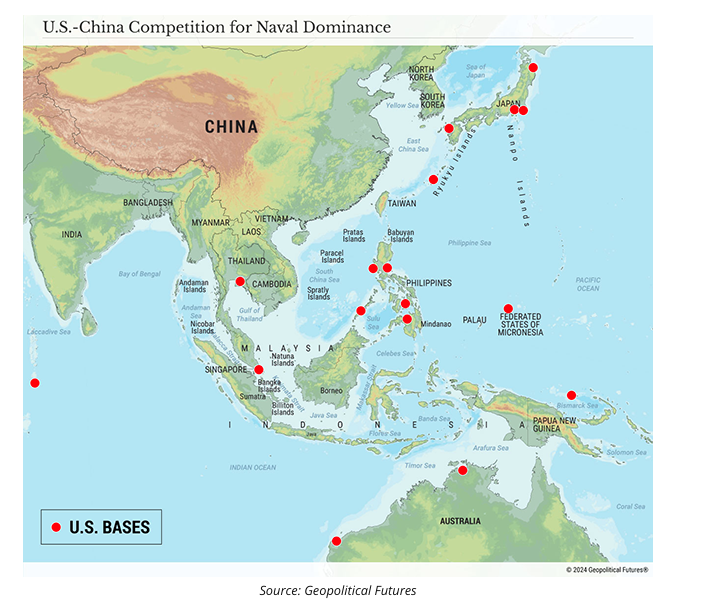
The US no longer needs a major forward deployment on the ground in Europe and needs only minimal exposure in the Pacific. Nor does the US feel the need to block Russian influence in the Global South. In other words, the need the US once felt to deploy major forces on a global basis is gone because the geopolitics of the Cold War are gone. The current US geopolitical imperative is to minimize the risk and cost of extensive engagement in the security of the Eastern Hemisphere. What was unthinkable for 80 years is now rational.
Russia’s greatest weakness was its economy. America’s greatest strength was its economy. The Russians might be able to guarantee the security of a nation, but not its economic growth or well-being. US strategy, therefore, had two dimensions: the martial and the economic. This was first made clear in the Marshall Plan, which was pivotal in resurrecting European economies. It also gave NATO members, for example, an opportunity to recreate their militaries and array them against the Russian threat. In creating this program, and then in creating an economic system that allowed them access to the powerful American market, the US used economic strategies to improve the internal security of militarily allied countries. This strategy was pursued geopolitically in the competition of the US and Russia in the Global South. Access to the Russian market was limited by both Russian policy and necessity. A relationship with Russia did not bring economic rewards. The US used foreign aid and access to American markets as an incentive to governments and the public to remain in the American sphere of influence. The method, beyond foreign aid, was in allowing the United States to maintain negative balances of trade with many countries.
Given the geopolitical situation, it was a cost-effective strategy, much cheaper than waging war, which in many cases was waged anyway. First, the US resurrected former enemies such as Japan to have favorable access to the American economy. “Made in Japan” was a common substitute for cheap and poorly made products. But it helped rebuild Japan as it did Europe and turned it into a military asset of bases and cooperation. Again, the US policy of ready access to US markets and initial aid was a powerful geopolitical tool Russia didn’t have. It was instrumental in winning the Cold War. Now this strategy is obsolete.
Two things are happening in tandem. First, the United States is abandoning or at least weakening its military obligations to other countries, and in doing so it is reducing the risk of becoming engaged in foreign wars, something that had been the norm in the past. Second, the United States is trying to equalize its balance of trade with the rest of the world. It was happy to float imbalances for decades, but it no longer believes that that’s a price worth paying.
Consider the case of China. China and Russia had hostile relations when they were both communist countries. At about the same time, Henry Kissinger went to China on his famous mission to establish relations, Russia was attacking China along their shared border on the Ussuri River. This and countless previous conflicts like it show the limits of ideology in geopolitics.
After Mao’s death and China’s adoption of controlled capitalism, China began to take Japan’s place as a low-cost, low-quality exporter. The decision to open up its economy was one of the key factors in China’s breakneck economic growth in the late 20th century. Many in the US saw US engagement with China as tantamount to strengthening an enemy. But two considerations took precedence: The US had become addicted to low-cost exports, and engaging China would further drive a wedge between China and Russia.
Central to the China policy was massive investment. China had economic relations with many countries, of course, but the US had (and still has) the largest economy in the world, so access to its markets would be vital for a growing economy such as China’s. Its economy would continue to boom until the late 2010s, when several structural issues and the COVID-19 pandemic slowed growth considerably. Geopolitical shifts are rapid in the face of outright war or economic catastrophe. They are slower when neither is present.
The United States now has three imperatives: end the social crisis of the culture wars; repair the economic realities that have become obsolete; and transform an obsolete institutional system. The socio-economic cycle transitions about every 50 years, the institutional cycles every 80 years. But there is no cycle in geopolitics. It happens when it happens, and it is happening now. This is therefore an intense period as major systems become obsolescent and thus create a crisis, followed by a political storm that disrupts the obsolete systems, followed by a new, engineered reality, and then ending with a calm after the storm. What has happened is all these cycles are hitting at once, and their convergence has led to a period of unusual intensity.
The US has a geopolitical imperative to disengage from the risks and burdens imposed by its involvement in wars globally. Reducing geopolitical risk involves reducing economic exposure to the world and military responsibility. One of the foundations of economic relations was a substantial imbalance in trade, the justification for which is now obsolete.
American security posture shifted over the course of the Ukraine war, when the failure of Russia to defeat Ukraine completely ended the Cold War’s foundational logic. In turn, this led to a shift in security policy as well as a massive shift in economic policy and the United States’ attitude towards free trade. Meanwhile, the end of the Cold War has created a crisis in Europe, which likewise has to redefine itself after 80 years of the status quo. The need is now for the United States to disengage to some significant extent from its global economic policy.
The US’s dramatic introduction of massive tariffs is thus geopolitically driven. Its method is an engineering decision intended to break the old system and open the door for a new one. It created a geopolitical crisis by its engineering.
Here again, China is a useful example. The US has troubled relations with China. The geopolitical problem is mitigated by the economic problem, but with the Cold War over, the cost is no longer essential. The economic problem with China has been integrated with the geopolitical. Relatively free trade with China achieved a geopolitical purpose but weakened the American economy in two ways: Lower labor costs allowed for cheap exports and for the relocation of businesses to China. But the problems went deeper than that. The US became dependent on imports of key components, sometimes entire alternatives, to US production. If those were cut off, it would create a massive crisis that would require Washington to revive domestic production of finished products and essential components alike.
US-Chinese relations may have been poor, but they were never so bad as to threaten war. China could choose to place the US into a very dangerous position, not unlike the Arab oil embargo of the 1970s. A war was fought by Egypt and Syria against Israel in 1973. The attackers were supplied by Russia, the Israelis by the US. Israel’s victory produced anti-US anger in the Arab world. Arab oil producers, who provided the US with a substantial portion of its oil, then imposed an embargo. This came at a great cost to the Arabs, but the geopolitics of the Arab world forced their hand. The loss of an essential energy import pushed the United States into a massive economic crisis. It was a case in which geopolitical necessity overrode economic considerations.
China exports essential industrial components to the United States. It is also a geopolitical competitor with the United States. If events force China to accept economic and financial costs for geopolitical advantage, it could talk itself into imposing an embargo. This results in a massive geopolitical vulnerability for the US. In addition to wanting to change economic relationships on a global level, the US urgently needed to do so first with China.
US efforts to distance itself from the rest of the world have predictably caused internal and external turmoil. Done more slowly, it would have caused merely long-term unease. Unease and turmoil are both parts of obsolete geopolitical models. The evolution of those models is both disruptive and poorly understood because of the perception that the forces of geopolitical necessity seem less deterministic than the forces behind economics.
But the truth—and this is the point of this story—is that the forces of humanity as a whole generate impersonal pressures that overwhelm human preferences as they define reality. The transition to new realities was less bloody than the end of the European age in 1945 and the emergence of the American age. But on the other hand, it did not change the fundamental geopolitical reality. Where Europe was replaced as the center of the world, the US remains the center, so the turmoil is not the beginning of the storm, but the last storm before the new calm.
John here again. I hope you enjoyed George’s perspective on the global economy and the geopolitical issues we face. I am lucky because I get to talk with George and from time to time, Shane and I can be with George and Meredith in the evenings and sometimes spend days enjoying both light and heavy conversations.
But between those times, I really look forward to my frequent missives from Geopolitical Futures with quick, thoughtful analysis of the week’s important topics. Plus, every so often, a walk through history to explain why the day is what it is. Frankly, it is one of the lowest-cost but essential analytical services that I read. Click here to subscribe and learn why I and thousands of others find George and his team indispensable.
Dallas, West Palm Beach, and DC
I will be in Dallas in two weeks, then likely West Palm Beach and DC after that as we continue opening clinics within the next few weeks. I will give you more details when they are actually open.
It has been a busy week with the SIC. My daughter Tiffani is also here. She worked with me for almost 15 years before taking a sabbatical, and as the idea for opening a new type of longevity clinic with Dr. Mike Roizen began to emerge, I asked her to shift her career and come back to explore the economics and reality of what it would take. In one sense, the business and science are straightforward. In another real sense, the medical world is every bit as regulated as the investment world, and I am having to learn whole new terminologies in legal documents, along with the usual complexities of starting any new business. We have a growing team and I’m learning a lot. It is good to be challenged and to work with people you like. Lots of new tricks for this old dog.
And with that, I will hit the send button. You have a great week. I will spend much of this weekend reviewing the SIC transcripts and thinking about how that impacts pretty much everything I do. On Friday I will interview Howard Marks and Joe Lonsdale. Both are friends but it is still intimidating to do it in front of thousands of people. I am glad that Ed D’Agostino is shouldering a lot of the moderation at this SIC. He excels at it in a way that I never would. Like I said, it’s good to have a team.
Your busier than ever analyst,
John Mauldin
P.S. If you like my letters, you'll love reading Over My Shoulder with serious economic analysis from my global network, at a surprisingly affordable price. Click here to learn more.
A message from Advisor Perspectives and VettaFi: To learn more about this and other topics, check out some of our webcasts.
Membership required
Membership is now required to use this feature. To learn more:
View Membership BenefitsSponsored Content
Upcoming Virtual Events View All












