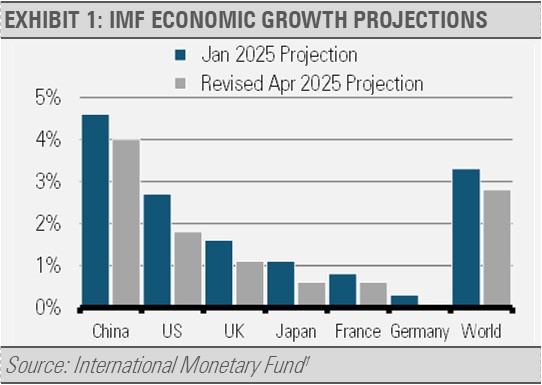
Recent revisions to the IMF’s World Economic Outlook reflect a sobering message: the world economy is entering a more volatile and fragmented era. Citing U.S. tariffs and escalating trade tensions, the IMF has downgraded growth forecasts for nearly every major economy. The new projections suggest a global economic system increasingly constrained by political uncertainty, supply chain disruptions, and inflationary pressures.
Specifically, the 2025 global growth forecast was lowered by 0.5% to 2.8%, down from 3.3% in January. The IMF emphasized that these changes are based on developments through early April 2025 and noted the highly uncertain environment.
In the U.S., growth is now projected at 1.8% in 2025, which is down 0.9% from previous estimates, and 1.7% in 2026. These declines reflect diminished investor confidence, weakening consumer sentiment, and direct costs from tariff-induced price increases.

Despite slowing growth, inflation is expected to remain above the U.S. Federal Reserve’s (Fed) 2% target. The IMF now projects global inflation to reach 4.3% in 2025 and 3.6% in 2026. This reflects the dual pressures of tariffs, which increase the cost of imported goods, and ongoing strength in services, where wage inflation has yet to abate.
Beyond cyclical factors, the IMF warns of deeper structural shifts. Global trade growth is forecasted to slow to just 1.7% in 2025, a 1.5% decline from earlier estimates, and less than half the rate seen in 2024. Much of this slowdown stems from reduced trade between the world’s two largest economies, the U.S. and China. Tariffs are effectively rewiring global supply chains and making trade costlier and less efficient. This process of “deglobalization” is contributing to what the IMF calls a reset of the post-World War II international economic order.
China’s growth is expected to fall to 4% in 2025 and 2026 based on the impact of U.S. tariffs along with structural challenges, such as property market corrections and aging demographics. Fiscal support from Beijing has helped cushion the blow, but long-term prospects remain uncertain.
In Europe, the situation is similarly challenging. Germany, the EU’s industrial engine, is projected to stagnate in 2025 with zero growth. Although Spain has bucked the trend with upgraded forecasts, the broader euro area faces tepid expansion and policy constraints. Meanwhile, the U.K. faces slower growth amid rising yields and private sector weakness. Japan is also projected to see growth cut by 0.5%, which highlights the global nature of the shock.
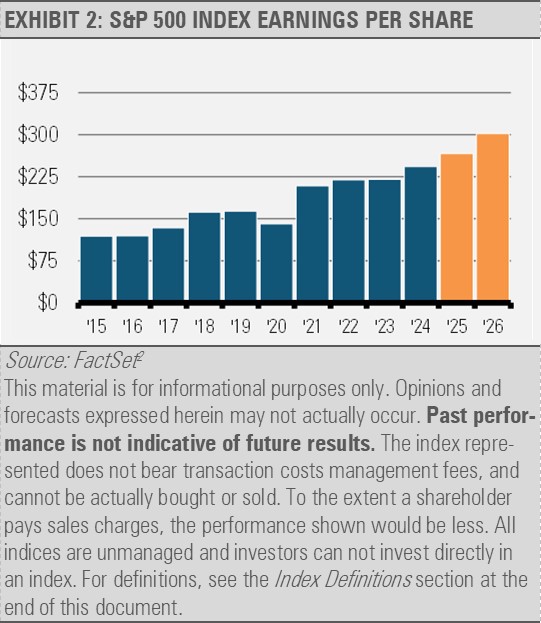
Investment professionals have already started to react to these shifting economic fundamentals. According to FactSet, analysts have lowered second-quarter earnings estimates for the S&P 500 Index by 2.4%. Particularly hard-hit is the energy sector, where Q2 earnings expectations have declined nearly 15%. Over the first four months of 2025, full-year earnings projections have fallen 3.1%.
Still, even with the recent reductions, calendar year 2025 earnings are still expected to be 9.5% higher than last year and may reach a new all-time high. Earnings growth of this magnitude reflects the health and resilience of the U.S. private sector. We are finding an abundance of opportunities amid the uncertainty.
While the market’s immediate reaction to the tariff news has been negative with a pronounced drop in equity prices, a weakening dollar, and falling commodity prices due to concerns over global economic growth, the long-term outlook remains more nuanced. The U.S. private sector continues to show strength with income growth outpacing inflation and steady jobs growth leading to higher personal disposable income.
For example, the March employment report came in well above expectations following soft data from January and February. The 3-month average jobs gain is now closer to long-term trends despite a reduction in the federal workforce, though many of those job losses are yet to be reflected in the data. Additionally, personal income is at an all-time high even after accounting for inflation and excluding government transfers, such as Social Security and Medicare.
INVESTMENT IMPLICATIONS
With continued economic and market uncertainty, risk management and diversification are playing a big role in our Strategies. We remain somewhat underweight equities and overweight high quality fixed income and cash. Within our equity allocations, we favor areas that we think will be less impacted by tariffs, including the U.S. insurance and North American software industries. Households and businesses tend to pay their insurance premiums even if they are cutting back on other expenses. Additionally, developments in artificial intelligence and the continuous need to increase productivity should propel business investment in this industry through a broad array of software solutions. We also added a broadly allocated commodity ETF that includes exposure to gold and silver as well as energy and agricultural goods. Overall, the recent equity market volatility has led us to increase our long-term equity return expectations. We think that disciplined investors will be able to benefit from the eventual equity market recovery now that valuations appear more attractive.
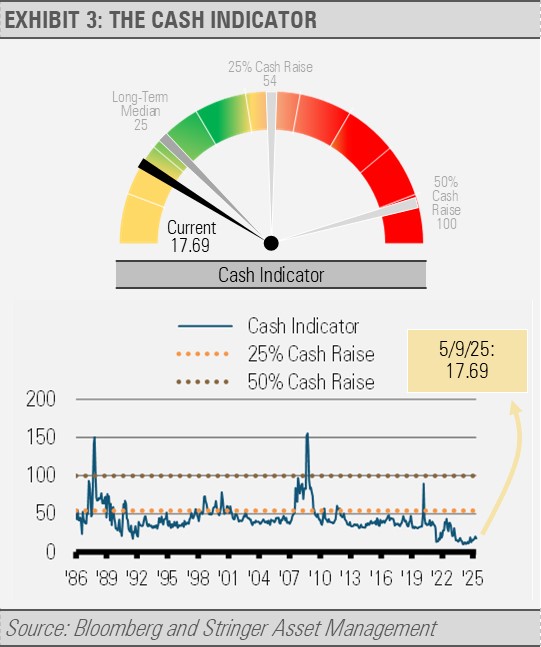
THE CASH INDICATOR
The Cash Indicator (CI) level has declined to below its long-term median as anxiety in the equity and credit markets has subsided. Still, we think the financial markets are pricing in a more appropriate estimate of risk than was the case before the recent market turbulence. With the risk of further shocks reduced, the broad financial markets offer attractive investment opportunities at this time.
For more news, information, and strategy, visit the ETF Strategist Channel.
A message from Advisor Perspectives and VettaFi: To learn more about this and other topics, check out some of our podcasts.
DISCLOSURES
Any forecasts, figures, opinions or investment techniques and strategies explained are Stringer Asset Management, LLC’s as of the date of publication. They are considered to be accurate at the time of writing, but no warranty of accuracy is given and no liability in respect to error or omission is accepted. They are subject to change without reference or notification. The views contained herein are not to be taken as advice or a recommendation to buy or sell any investment and the material should not be relied upon as containing sufficient information to support an investment decision. It should be noted that the value of investments and the income from them may fluctuate in accordance with market conditions and taxation agreements and investors may not get back the full amount invested.
Past performance and yield may not be a reliable guide to future performance. Current performance may be higher or lower than the performance quoted.
The securities identified and described may not represent all of the securities purchased, sold or recommended for client accounts. The reader should not assume that an investment in the securities identified was or will be profitable.
Data is provided by various sources and prepared by Stringer Asset Management, LLC and has not been verified or audited by an independent accountant.
Index Definitions:
S&P 500 Index – This Index is a capitalization-weighted index of 500 stocks. The Index is designed to measure performance of a broad domestic economy through changes in the aggregate market value of 500 stocks representing all major industries.
¹International Monetary Fund. (2025). World Economic Outlook, April 2025. https://www.imf.org/en/Publications/WEO/Issues/2025/04/22/world-economic-outlook-april-2025
²FactSet. (2025). Earnings Insight, May 2025. https://advantage.factset.com/hubfs/Website/Resources%20Section/Research%20Desk/Earnings%20Insight/EarningsInsight_050225A.pd
Read more commentaries by Stringer Asset Management