Credit Downgrade: Markets Poised to Shake it Off
Membership required
Membership is now required to use this feature. To learn more:
View Membership BenefitsOn Friday, Moody’s cut the United States’ long-term credit rating from Aaa to Aa1—matching similar moves by Standard & Poor’s in 2011 and Fitch in 2023. Moody’s cited persistent, large budget deficits for the move.
Markets took the decision in stride. The S&P 500 Index closed up slightly on Monday while the 10-year Treasury yield was little changed with the curve bear steepening.
Upheaval Unlikely
We see three reasons why the ratings action is unlikely to be particularly disruptive to markets.
1. It’s old news
The idea that the U.S. is on an unsustainable fiscal path is not new news. Every Fed Chair since Alan Greenspan in the mid-2000s has called out the problem in front of Congress. At the heart of it—underfunded entitlement programs and rising welfare costs as the population ages. This has been a slow-motion trainwreck for economists tracking the issue. For example, the nonpartisan Congressional Budget Office’s long-term projections have consistently showed a hyperbolic debt trajectory in the 2030s and 2040s. Higher interest rates post-2022 simply amplify this underlying dynamic.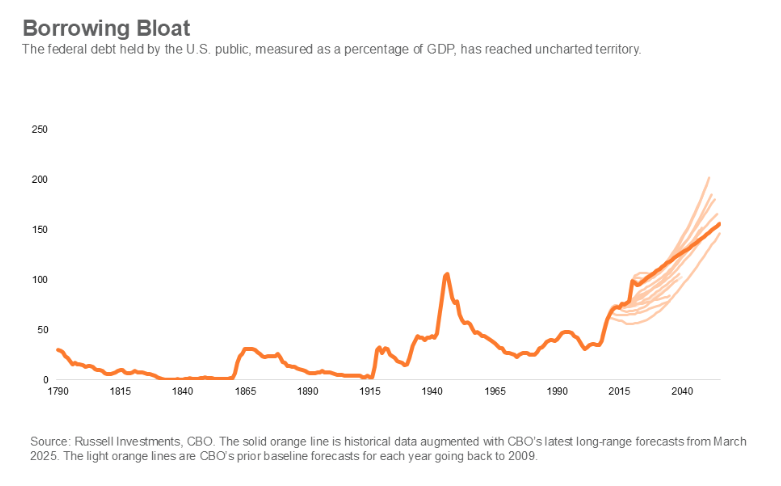
2. Markets are forward-looking
Our fixed income strategy team discussed how to price these fiscal risks onto long-dated Treasurys leading into and following the “red wave” election outcome last November. We pushed our estimate of the fair term premium on long bonds higher and have seen that come through in markets. Most models place the “risk premia” on U.S. bonds—the extra return required by investors to hold them—at the higher end of its post-financial-crisis range, at around 0.75%.
3. We don’t expect forced selling
Our trading desk flags that many investment guidelines were rewritten back in 2011 to prevent forced selling of positions in the instance of further ratings downgrades. Furthermore, Moody’s left the country ceiling for the United States at AAA, allowing the highest quality corporates (e.g. Microsoft, Johnson & Johnson) to retain their highest ratings marks.
Risks Ahead
None of this is to sneeze at the long-term fiscal challenges of the United States. They’re real. It’s just a known problem. What catalysts could accelerate the pricing of these risks into markets?
First, President Trump’s so-called “Big Beautiful Bill” is currently working its way through the House of Representatives. If markets judge it to be too inflationary, that could cause a riot in the bond market. For now, the bill’s impacts look modest—boosting growth by only a few tenths of a percent.
Second, later this decade Congress could be forced to deal with our much thornier entitlement problems, as the trust funds backing Social Security and Medicare are expected to run down their assets in 2035 and 2036, respectively. Without reform, program recipients would face an immediate reduction in benefits—a politically unpalatable situation that could catalyze long-needed action from Congress.
A message from Advisor Perspectives and VettaFi: To learn more about this and other topics, check out some of our webcasts.
These views are subject to change at any time based upon market or other conditions and are current as of the date at the top of the page. The information, analysis, and opinions expressed herein are for general information only and are not intended to provide specific advice or recommendations for any individual or entity.
This material is not an offer, solicitation or recommendation to purchase any security.
Forecasting represents predictions of market prices and/or volume patterns utilizing varying analytical data. It is not representative of a projection of the stock market, or of any specific investment.
Nothing contained in this material is intended to constitute legal, tax, securities or investment advice, nor an opinion regarding the appropriateness of any investment. The general information contained in this publication should not be acted upon without obtaining specific legal, tax and investment advice from a licensed professional.
Please remember that all investments carry some level of risk, including the potential loss of principal invested. They do not typically grow at an even rate of return and may experience negative growth. As with any type of portfolio structuring, attempting to reduce risk and increase return could, at certain times, unintentionally reduce returns.
Frank Russell Company is the owner of the Russell trademarks contained in this material and all trademark rights related to the Russell trademarks, which the members of the Russell Investments group of companies are permitted to use under license from Frank Russell Company. The members of the Russell Investments group of companies are not affiliated in any manner with Frank Russell Company or any entity operating under the "FTSE RUSSELL" brand.
The Russell logo is a trademark and service mark of Russell Investments.
The information, analyses and opinions set forth herein are intended to serve as general information only and should not be relied upon by any individual or entity as advice or recommendations specific to that individual entity. Anyone using this material should consult with their own attorney, accountant, financial or tax adviser or consultants on whom they rely for investment advice specific to their own circumstances.
Products and services described on this website are intended for United States residents only. Nothing contained in this material is intended to constitute legal, tax, securities, or investment advice, nor an opinion regarding the appropriateness of any investment, nor a solicitation of any type. The general information contained on this website should not be acted upon without obtaining specific legal, tax, and investment advice from a licensed professional. Persons outside the United States may find more information about products and services available within their jurisdictions by going to Russell Investments' Worldwide site.
Russell Investments is committed to ensuring digital accessibility for people with disabilities. We are continually improving the user experience for everyone, and applying the relevant accessibility standards.
Russell Investments' ownership is composed of a majority stake held by funds managed by TA Associates Management, L.P., with a significant minority stake held by funds managed by Reverence Capital Partners, L.P. Certain of Russell Investments' employees and Hamilton Lane Advisors, LLC also hold minority, non-controlling, ownership stakes.
© Russell Investments Group, LLC. 1995-2025. All rights reserved. This material is proprietary and may not be reproduced, transferred, or distributed in any form without prior written permission from Russell Investments. It is delivered on an "as is" basis without warranty.
Membership required
Membership is now required to use this feature. To learn more:
View Membership BenefitsSponsored Content
Upcoming Virtual Events View All












