On New Year’s Day 2017, residents of Manhattan celebrated the opening of the Second Avenue Subway. The idea was hatched nearly a hundred years prior; construction began in the 1970s but was left incomplete due to budget shortfalls. The project ultimately cost $4.4 billion.
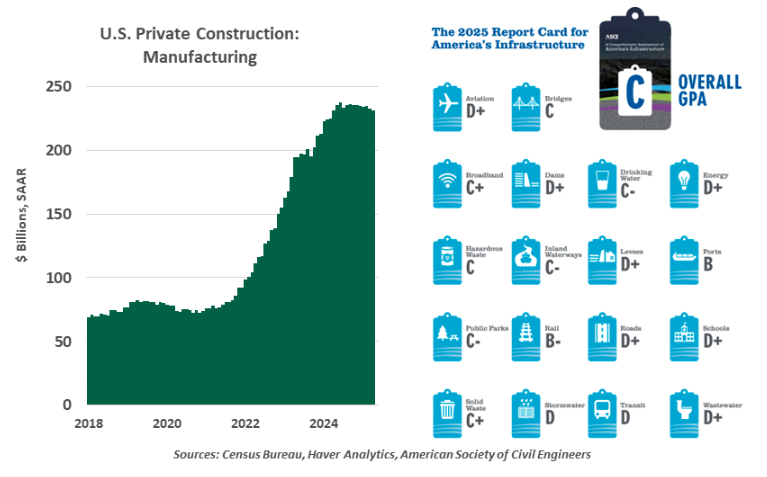
To be successful, public investments need to move at pace and to be supported with reliable funding. This was the aim of the Biden Administration. The Infrastructure Investment and Jobs Act (IIJA) of 2021 allocated $1.2 trillion for conventional infrastructure projects like roads, bridges, railways, and broadband. The CHIPS and Science Act of 2022 authorized $280 billion to support semiconductor research and the development of microchip fabricators. And the Inflation Reduction Act (IRA) followed with $783 billion to support renewable energy and climate change mitigation.
The political environment has shifted significantly since those laws were enacted. President Trump’s day one executive orders included halting spending under these bills. But it’s not so easy: the executive order was overturned in an April federal court decision, which ruled that the president does not have power to withhold funds appropriated in legislation. But the issue is being taken up by Congress as it debates the One Big Beautiful Bill Act (OBBBA).

The green subsidies in the IRA are a particular target of the OBBBA, with at least $476 billion to be saved by ending tax credits for electric vehicles, energy production and energy investments. The House version of the Act halts funding for any project that has not commenced within sixty days of the bill’s passage, and all funded projects must be complete by the end of 2028. The Senate version offers more leniency about timing, but either way, a sunset is in sight.
IRA projects are already underway, and money that has been spent cannot be clawed back. More than $132 billion of clean energy projects using IRA funding have been announced. The Environmental Protection Agency reported that, through year-end 2024, 88% of its $78 billion of budget obligations under the IIJA and IRA had been spent. Funding was allocated to all 50 states, with more than $37 billion of the $300 billion in local commitments spent. The IRA was designed to disburse funds gradually, and any reductions will target future commitments not yet spent.
As elected leaders consider cutting back in these areas, they must consider the popularity of infrastructure investment. It creates jobs, improves public safety, and adds to the overall quality of life. Sound infrastructure can facilitate economic development across industries. And many structures are showing their age; maintenance is less exciting than construction, but is still vital.
It is telling that the OBBBA does not jeopardize the funding for conventional infrastructure or semiconductor facilities. And even the green subsidies in the IRA have found defenders in the Republican caucus, as they have supported employment. At passage, the bill was estimated to create a million jobs, half of which were in construction. A majority of IRA funding went to projects in “red” states, with Texas, Iowa, Kansas and Oklahoma leading the nation in wind generation.
Prospects for any new federally-funded infrastructure projects will be limited. The focus of OBBBA negotiations has been on tax rates and healthcare subsidies. Federal web pages that showed project funding have been taken offline. Private dashboards that tracked development projects are now also tracking repeal proposals and litigation against the administration’s efforts to stop construction. More of the cost of building will fall on states, municipalities and private partnerships.
The second phase of the Second Avenue Subway is under construction. Two further future phases are proposed to extend the line 8.5 miles, traversing most of Manhattan. For these and other investments, securing funding will be a challenge, and maintaining patience will be mandatory.
Information is not intended to be and should not be construed as an offer, solicitation or recommendation with respect to any transaction and should not be treated as legal advice, investment advice or tax advice. Under no circumstances should you rely upon this information as a substitute for obtaining specific legal or tax advice from your own professional legal or tax advisors. Information is subject to change based on market or other conditions and is not intended to influence your investment decisions.
© 2025 Northern Trust Corporation. Head Office: 50 South La Salle Street, Chicago, Illinois 60603 U.S.A. Incorporated with limited liability in the U.S. Products and services provided by subsidiaries of Northern Trust Corporation may vary in different markets and are offered in accordance with local regulation. For legal and regulatory information about individual market offices, visit northerntrust.com/terms-and-conditions.
A message from Advisor Perspectives and VettaFi: To learn more about this and other topics, check out some of our webcasts.
© Northern Trust
Read more commentaries by Northern Trust