Key takeaways
- The expected positive forces of the One Big Beautiful Bill Act and future interest rate cuts should soon outweigh the negative forces of tariff actions by the new administration, enabling the economy to reaccelerate into 2026.
- Investors should look past the noise emanating from a potential second-half slowdown and longer-term normalization in the labor market, bolstered by optimism from a Recession Risk Dashboard that remains solidly expansionary.
- While stocks have rallied strongly to new highs, history suggests markets have more room to run. Propelled by a growing fiscal impulse, we believe competing policy push-pull forces are improving, meaning any near-term pullbacks should be viewed as buying opportunities for long-term investors.
Trump policies creating tug of war in markets
In physics, force is an influence that causes an object to speed up, slow down or change direction. It is essentially a push or a pull resulting from the interaction between two objects, as described by Newton’s laws of motion. Sometimes forces oppose one another, creating friction or resistance that holds back the movement of an object. This is apt when considering the impacts of the Trump administration’s policy agenda, which has generated various opposing forces on economic growth this year. An initial tariff force pushed the S&P 500 Index 18.9% below its February peak in the aftermath of Liberation Day. However, different policy forces expected to positively influence economic and earnings growth in the months ahead helped to pull equities back to new all-time highs by late June.
The first of these positive policy forces is the decline of an unfavorable one, with tariff rates coming down from their announced levels on Liberation Day and trade deals beginning to materialize with the United Kingdom, China and Vietnam. Progress toward the passage of the One Big Beautiful Bill Act (OBBB) has represented a second and larger positive policy force, along with a third in the form of renewed prospects of interest rate cuts from the Federal Reserve.
Taken together, the positive forces should outweigh the negative, although the impact from the OBBB and any rate cuts remain future considerations while the tariff headwinds exist today. As a result, the economy could experience a soft patch in the interim, which may already be showing up in housing, business investment and consumption data.
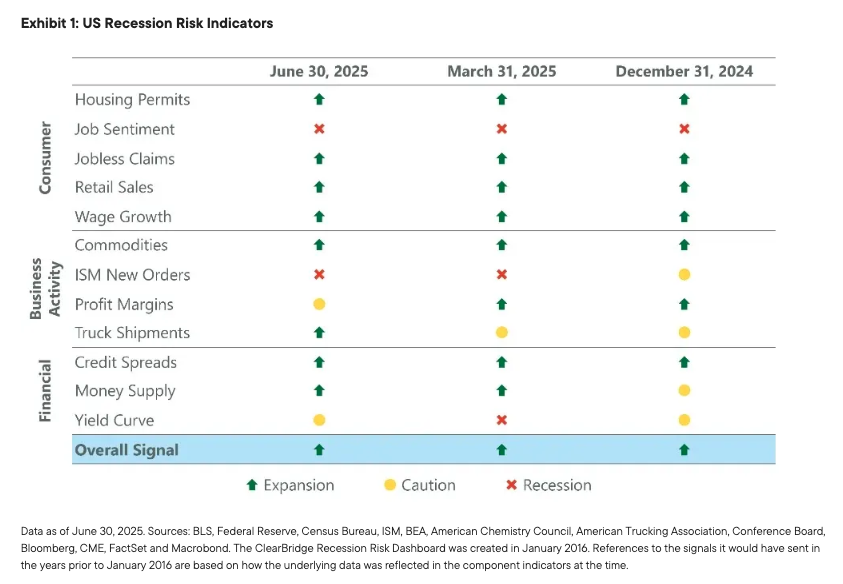
We do not believe this soft patch will metastasize into a recession given the coming positive policy forces, primarily from the passage of the OBBB on July 2. Our optimistic outlook is reinforced by the output from the Clearbridge Recession Risk Dashboard, a group of 12 economic and market indicators that have historically foreshadowed a looming recession. There were no indicator changes in June and the overall dashboard reading remains solidly in green expansionary territory.

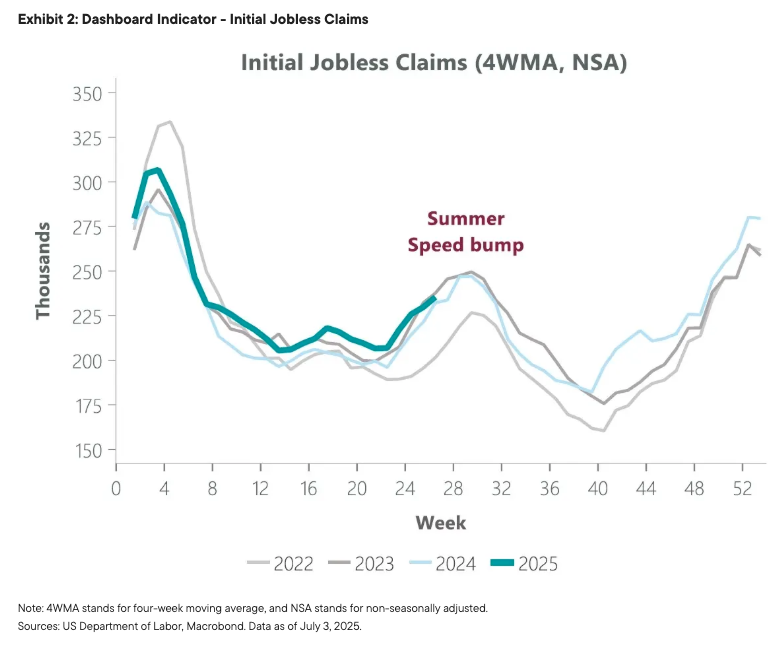
One dashboard indicator in particular focus lately has been initial jobless claims, which measures the number of first-time filers for unemployment benefits and thus provides a good reading on how many job losses may be occurring at any point in time. We place extra emphasis on this specific indicator due to its strong track record, high frequency (weekly release), and the fact that it typically sees only minor revisions, meaning the data can be largely taken at face value. However, initial jobless claims have followed an unusual seasonal pattern in recent years, with an early summer pickup followed by a drop as back-to-school hiring occurs.
A new normal labor market
As a result, we are focusing on the non-seasonally adjusted initial claims data relative to the same week from prior years, which provides better reading than the headline and seasonally adjusted figures in our view. Through this lens, the data looks less concerning, and we believe investors should look past the noise emanating from this typical summer swoon.
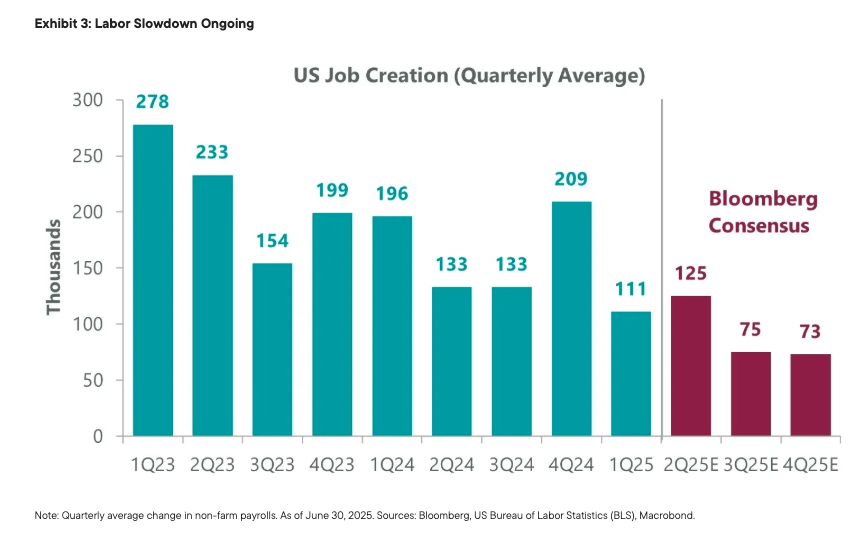
The health of the labor market is likely to remain a key focal point in coming quarters as investors assess the health of the US economy and the prospect for Fed rate cuts. However, the market may need to recalibrate its view regarding the “normal” level of job growth. The pace of job creation has been slowing since the exit from the pandemic, with a monthly average of 216k in 2023, 168k in 2024 and 130k in the first half of 2025. Looking ahead, consensus expectations are for average monthly job growth of 74k in the second half of the year.
A drop below 100k would have been viewed as a negative as recently as a few months ago, but headwinds from DOGE-related layoffs, an aging population and reduced immigration flow all suggest that job creation below 100k may become the “new normal.” A slowing pace of job gains isn’t atypical as an economic cycle matures, but at the same time it also doesn’t mean that the cycle has ended.
The combination of a soft patch and a maturing cycle could lead to renewed recession fears. This may be amplified by near-term volatility in economic data that is likely to result from the pull-forward and subsequent “air pocket” in demand that have occurred around tariffs. The primary cause of the negative first-quarter gross domestic product (GDP) reading was a huge surge in imports as companies and individuals rushed to bring goods into the country ahead of Liberation Day. A rise in imports is negative for GDP, and in the first quarter the contribution was an astounding -4.7% to overall economic growth.
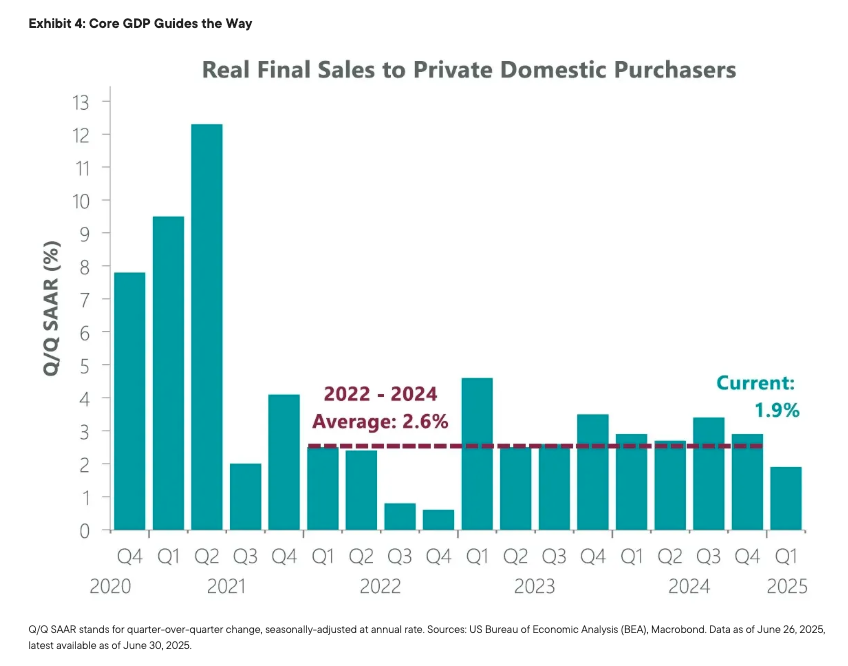
Looking ahead to the second-quarter GDP data that will come out later this month, imports are likely to plummet as businesses and individuals work through the extra stock/inventory they brought in ahead of the increase in tariffs, which should boost measured GDP as the drag from imports declines. Alternative or “core” GDP concepts such as Real Final Sales to Private Domestic Purchasers, which strips out volatile trade (imports and exports) and inventories, along with government spending, which is less relevant to equity markets, are likely to provide a better near-term reading on the underlying health of the US economy. This measure has been running at 2.6% over the past two years and the first-quarter reading was consistent with the lower end of that trend at 1.9%.
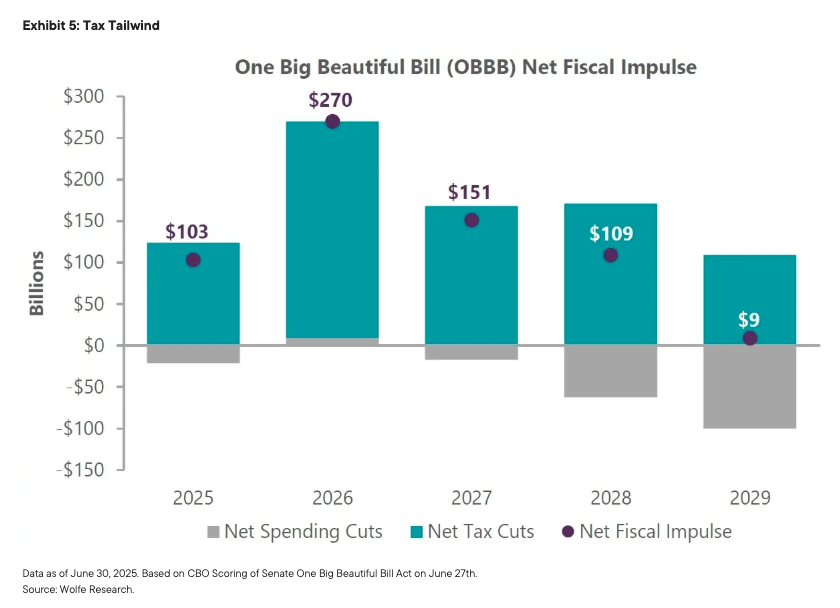
In the coming quarters, tariff distortions should give way to tailwinds from positive policy forces, namely the tax cuts included in the OBBB. The legislation is expected to generate a peak fiscal impulse of approximately 1% of GDP in 2026, on top of the extension of the 2017 Tax Cuts and Jobs Act tax cuts. Individual tax cuts should begin to be felt by early fall as withholding tables are adjusted for no taxes on overtime or tips, while the bulk of the impact will occur in the first half of 2026 when individuals complete their tax returns.
Companies to benefit first from Big Beautiful Bill
However, corporate tax filing season actually occurs in the fall (September 15 corporate deadline) and many of the OBBB corporate tax provisions are retroactive to January 1, meaning the corporate tax impacts are likely to begin appearing this quarter. These include expensing for factories and a larger R&D credit, both of which should help spur economic growth.
It is important to note that the OBBB is not cost free—the Congressional Budget Office (CBO) estimated that the initial version proposed by the Senate would add $3.3 trillion to the deficit over the next 10 years, leading to renewed fears about federal debt sustainability. While the final cost of the bill will be different (it has changed since the CBO scoring occurred, but newer versions were not yet available as of publication), it appears unlikely to be less than the $2.8 trillion in revenue the CBO estimates tariff changes will bring in over the same period. Although the US deficit is on an unsustainable path, we believe the outlook over a five-year investable horizon is manageable, meaning these concerns are likely to flare up but remain secondary in the coming years.
In the interim, other concerns are more likely to drive market choppiness. For financial markets, the possibility of near-term volatility seems higher than usual as many of the potential positives such as the OBBB impacts appear to be largely “priced in” to equity valuations. Put differently, markets may be ahead of the coming good news and reduction in uncertainty, a factor that we highlighted last quarter as being a key driver of upside as clarity emerged. Temporary setbacks that increase uncertainty could cause the market to stumble, even if the longer-term outlook remains healthy.
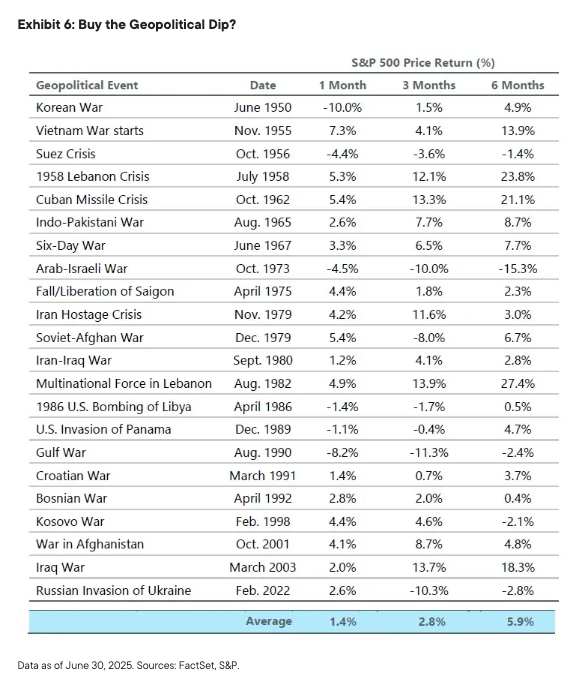
US equities have proven resilient in the face of a different source of uncertainty over the past few weeks: an increase in geopolitical tensions between Iran and Israel. That pressure has already begun to wane, and history shows that such conflicts tend to be short-lived in terms of their market disruption. Since 1950, the S&P 500 has achieved positive returns of 1.4%, 2.8% and 5.9% in the one, three and six months (respectively) following significant geopolitical events.
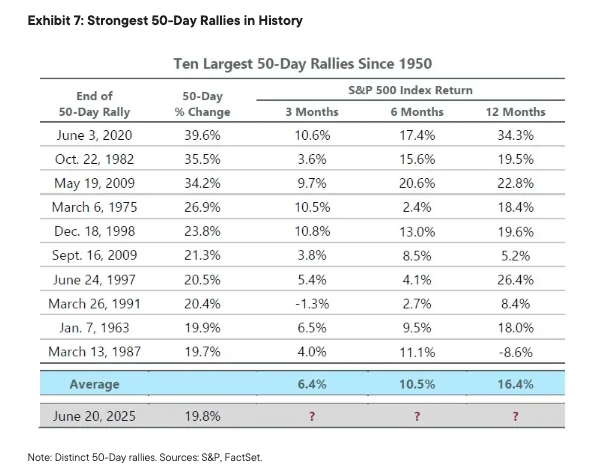
Climbing the latest wall of worry, the S&P 500 recovered to its previous highs in just 55 trading days from the April 8 lows, taking many by surprise and contributing to views that all the good news has already been priced in. While many investors remain on the sidelines waiting for a pullback, history shows the S&P 500 has delivered returns of 6.4%, 10.5% and 16.4% in the three, six and 12 months (respectively) after the previous 10 best 50-day rallies since 1950 (the current rally ranks #10), suggesting further upside in the months to come if history is a guide.
Although the next several months may see a period of consolidation for US equities, the longer-term outlook looks more favorable. The timing distortions and “air pocket” from tariffs should give way to an improved fiscal impulse that should help power economic reacceleration into 2026. We believe these competing policy push-pull forces are on balance improving for equity investors and could be amplified by Fed rate cuts later in the year. As a result, should volatility emerge in the coming months, we believe long-term investors will be best served by buying into any weakness.
Definitions
The ClearBridge Recession Risk Dashboard is a group of 12 indicators that examine the health of the US economy and the likelihood of a downturn.
The S&P 500 Index is an unmanaged index of 500 stocks that is generally representative of the performance of larger companies in the United States.
WHAT ARE THE RISKS?
All investments involve risks, including possible loss of principal. Past performance is no guarantee of future results. Please note that an investor cannot invest directly in an index. Unmanaged index returns do not reflect any fees, expenses or sales charges.
Equity securities are subject to price fluctuation and possible loss of principal. Large-capitalization companies may fall out of favor with investors based on market and economic conditions. Small- and mid-cap stocks involve greater risks and volatility than large-cap stocks.
Commodities and currencies contain heightened risk that include market, political, regulatory, and natural conditions and may not be suitable for all investors.
IMPORTANT LEGAL INFORMATION
This material is intended to be of general interest only and should not be construed as individual investment advice or a recommendation or solicitation to buy, sell or hold any security or to adopt any investment strategy. It does not constitute legal or tax advice. This material may not be reproduced, distributed or published without prior written permission from Franklin Templeton.
The views expressed are those of the investment manager and the comments, opinions and analyses are rendered as at publication date and may change without notice. The underlying assumptions and these views are subject to change based on market and other conditions and may differ from other portfolio managers or of the firm as a whole. The information provided in this material is not intended as a complete analysis of every material fact regarding any country, region or market. There is no assurance that any prediction, projection or forecast on the economy, stock market, bond market or the economic trends of the markets will be realized. The value of investments and the income from them can go down as well as up and you may not get back the full amount that you invested. Past performance is not necessarily indicative nor a guarantee of future performance. All investments involve risks, including possible loss of principal.
Any research and analysis contained in this material has been procured by Franklin Templeton for its own purposes and may be acted upon in that connection and, as such, is provided to you incidentally. Data from third party sources may have been used in the preparation of this material and Franklin Templeton ("FT") has not independently verified, validated or audited such data. Although information has been obtained from sources that Franklin Templeton believes to be reliable, no guarantee can be given as to its accuracy and such information may be incomplete or condensed and may be subject to change at any time without notice. The mention of any individual securities should neither constitute nor be construed as a recommendation to purchase, hold or sell any securities, and the information provided regarding such individual securities (if any) is not a sufficient basis upon which to make an investment decision. FT accepts no liability whatsoever for any loss arising from use of this information and reliance upon the comments, opinions and analyses in the material is at the sole discretion of the user.
Products, services and information may not be available in all jurisdictions and are offered outside the U.S. by other FT affiliates and/or their distributors as local laws and regulation permits. Please consult your own financial professional or Franklin Templeton institutional contact for further information on availability of products and services in your jurisdiction.
Issued in the U.S. by Franklin Templeton, One Franklin Parkway, San Mateo, California 94403-1906, (800) DIAL BEN/342-5236, franklintempleton.com. Investments are not FDIC insured; may lose value; and are not bank guaranteed.
You need Adobe Acrobat Reader to view and print PDF documents. Download a free version from Adobe's website.
CFA® and Chartered Financial Analyst® are trademarks owned by CFA Institute.
A message from Advisor Perspectives and VettaFi: To learn more about this and other topics, check out some of our webcasts.
© ClearBridge Investments
Read more commentaries by ClearBridge Investments