Most of us are not prepared for the incredible degree of change Artificial Intelligence (AI), combined with automation, is bringing to society. The labor force will change in ways that are hard to process. I’ve said before that we are living in a nonlinear world, one that could rip the fabric of our society as change arrives faster than most people can handle.
Consider this: The World Economic Forum (WEF) estimates that 39% of workers will need to change their core skills by 2030—five years from now!—specifically due to AI and automation.
Globally, Goldman Sachs estimates that 300 million full-time jobs could be replaced by automation. Ford’s CEO estimates half of white-collar jobs will be replaced. But this isn’t something that will happen “not here.” Labor markets in developed countries are most at risk of automation, with up to 60% of jobs at stake.
Automation: It’s Not Just Physical.
When I think of automation, an image of a robotic arm on an assembly line comes to mind. But today’s version of automation is not just robotic. Powered by AI, automation is coming for digital and white-collar tasks. And it is coming fast.
Ask any software engineer if their industry is being impacted by AI. Over 60,000 tech employees have been laid off in 2025 by companies like Microsoft, Google, and Amazon. AI is good at programming.
It is (or will soon be) very good at tasks performed by financial analysts, paralegals, transcribers, billing processors, graphic designers, copywriters, and many more white-collar jobs. AI won’t stop there. Think CPAs, lawyers, doctors—any profession that digests and analyzes large bits of data will be affected to some degree.
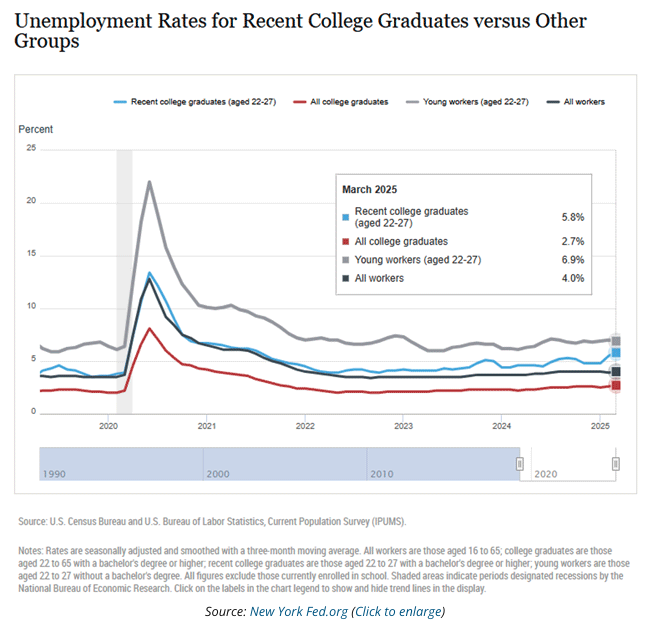
Recent college graduates are experiencing unemployment rates of 5.8%, the highest since 2021. College grads typically enjoy an unemployment rate lower than the general population. That’s not true today.

We are seeing the faint lights of a train far off in the distance. The thing is, it’s a high-speed train, and we are standing on the tracks. We’re accustomed to a more gradual pace of change. The transition from horse-drawn carriages to cars took several decades. Today’s labor force will face a bigger degree of change in the next half decade or less. Change is about to run us over.
Society and government are not equipped to handle what’s coming. How will we address double-digit unemployment? How about a world where the divide between haves vs. have-nots becomes far worse than it is today?
Was Andrew Yang right after all? Do we need Universal Basic Income (UBI)? I know that question will make some of you sick—I hate the idea too. But we have to ask ourselves how, as a society, do we manage this?
The answer is not obvious. Our tax structure is not set up to handle massive unemployment. The Tax Policy Center estimates that 40% of US households will pay no income tax in 2025. If that number grows and no other changes are made to the tax code, how do we pay social benefits of any type, UBI or otherwise?
The US already runs a ridiculously large (in my opinion) federal deficit during an otherwise good economy. New tax policies could keep GDP positive for many more months and quarters, but AI’s impact will eventually swamp all other economic inputs.
We could be entering a temporary, bizarre economy—one that has no name. There is no economic description, at least not one I am aware of, for an economy with a positive GDP, expanding labor productivity, and increasing unemployment. That’s where I see things headed over the next two to three years.
Eventually, something will break. An unemployment threshold will be reached, forcing the economy to stall as discretionary spending drops. And that is the point where things get really serious if we don’t get ahead of what’s coming.
I'm lay-awake-at-night concerned about the risks of AI, including social unrest, which is a polite way to say, a lot of people will be very, very angry and desperate if we don’t help them navigate and benefit from the radical changes coming.
I know this all sounds pessimistic. I try to be a rational optimist, but my prudent pessimist side is winning when it comes to AI. I’m glad I’m closer to the end of my career than the beginning. Getting through the Great Financial Crisis was hard enough. This change will be even bigger.
I’m concerned for my kids, nieces, nephews, and their friends, all in their twenties. I’m encouraging them to learn how to use AI, as those who become proficient stand a better chance of surviving and thriving in the years ahead.
And I’m trying to lead by giving them examples from my regular AI experiments. Yes, I’m forcing myself to work with AI, and I am amazed at the results. For all the doom and gloom from me thus far, I can tell you that AI gets vastly better every month, and you need to be using it. Many of you are way ahead of me in this regard, I know from conversations. But I’d guess that most know a little bit about AI, haven’t knowingly used it yet, and are at risk of being blindsided. This article is for you.
Last week Perplexity Labs completed a research project for me, with impressive results, that would have taken me two uninterrupted weeks to do on my own. Perplexity did it in ten minutes. The results were accurate, polished, replete with charts, and highly professional-looking. I spent about half an hour working on my prompt, but still, it could have been better.
Here’s where I’m still kind of blown away by the experience: Perplexity anticipated some of my follow-up questions and gave me more than I asked for. It had the ability to deduce, “if he asked for A, he most likely wants to know B and C.”
This is a key trait I look for in a new hire. A young person who exhibits this trait will advance rapidly.
Or will they? They might not get the chance. That research project was something I’d normally give to a junior analyst, with some guidance, and see what they come up with. Now it is quicker and easier to do it myself.
I said to my team last month, “We might never hire another person.” I think that took some by surprise, but I meant it as a compliment. We have a great team that works hard to bring you our research, and with AI, they are each able to scale their contributions. Using AI will soon be a job requirement for almost everyone.
AI is incredible. It is a force multiplier and is evolving at light speed. The impacts are only just beginning to be seen, a green shoot today that will turn into Jack’s beanstalk tomorrow.
I’m not the only one concerned. As I was wrapping up this essay, a friend forwarded me this Op-Ed from Paul Tudor Jones, who cites the exact same unemployment statistic I mentioned above.
I received a lot of excellent, detailed feedback from our last Global Macro Update on eVTOLs. Thank you! I’m hoping for the same this week. And I’m hoping I’m wrong on all of this. So, if you are in (or into) AI, reply to this letter with your thoughts. Next week, we’ll dig deeper into AI and automation.
Until then, thanks for reading.
Ed D’Agostino
Publisher & COO
A message from Advisor Perspectives and VettaFi: To learn more about this and other topics, check out some of our webcasts.
© Mauldin Economics
Read more commentaries by Mauldin Economics