Q2-2025 Earnings Season Preview
Membership required
Membership is now required to use this feature. To learn more:
View Membership BenefitsNext week, the Q2-2025 earnings season will begin in earnest as a barrage of S&P 500 companies report, starting with the Wall Street money center banks on Tuesday and Wednesday. Since earnings drive the market by supporting investor expectations, what should investors expect? Let’s dig into the details.
Over the last few months, according to data from S&P Global, the Q2-2025 earnings estimates have declined from $234/share in the original March 2024 estimate to $220/share as of June 15th. That $14 drop in estimates is partially due to the impact of tariff concerns on corporate outlooks.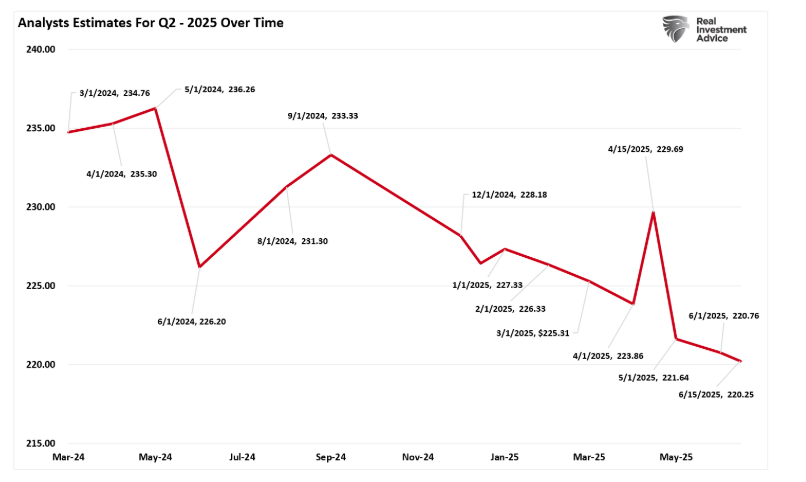
According to FactSet: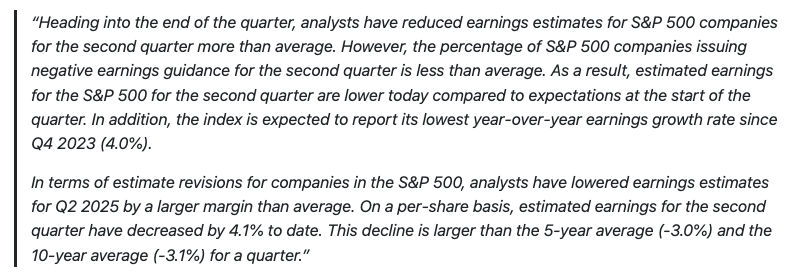
Again, many of those negative revisions are tied to concerns over tariffs under the current Administration, and the lack of finalized “trade deals” keeps forward estimates in flux. However, as we move into Q3 and Q4 of this year, there should be sufficient resolutions to stabilize forecasts.
The macro-tailwinds of easing trade tensions, falling energy prices, and optimism over Fed rate cuts have helped equity markets return to new highs in June. However, some of those advances will be tested in the coming weeks, as there is a risk of earnings disappointment, particularly as we see continued weakness in the economic data. The Economic Composite Index (roughly 100 data points) has decreased sharply in the last two months. Historically, earnings track real economic activity, suggesting a risk of disappointment exists.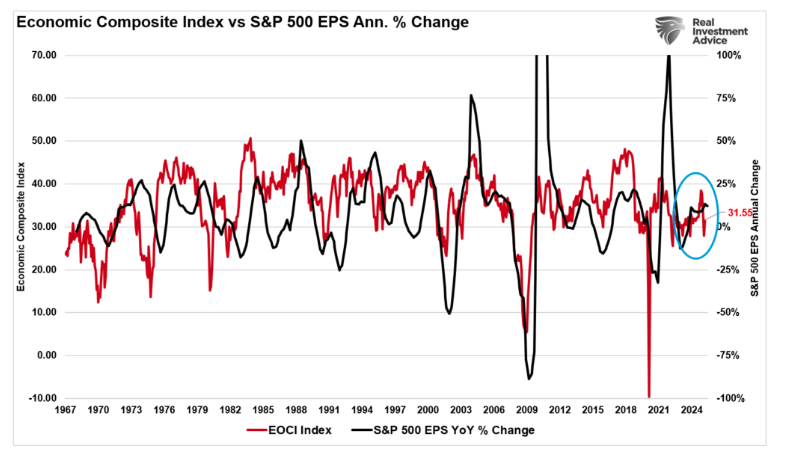
Why Estimates Are Being Cut More Sharply
There are three core drivers to explain the steeper-than-normal downward revisions in Q2-2025 earnings.
Rising trade risks: Trump’s tariff actions renewed mid‑year jitters. Industry groups and strategists at Goldman, Bank of America, and Citi warn tariffs may shave off ~1–2% EPS growth per 5pp increase in effective duty rates. While tariffs are on pause, that “pause” expires July 7th. We fully expect that pause to be extended into Q3, given the Administration has deals currently in progress. However, investors should potentially hedge against unforeseen problems later in the summer.
Weaker consumer spending: Our most significant concern for Q2-2025 earnings and the rest of the year is slowing economic growth, which will spill over into consumer spending. As discussed in “Consumer Spending Drives Earnings,” there is a high correlation between Personal Consumption Expenditures (PCE) and earnings. To wit:
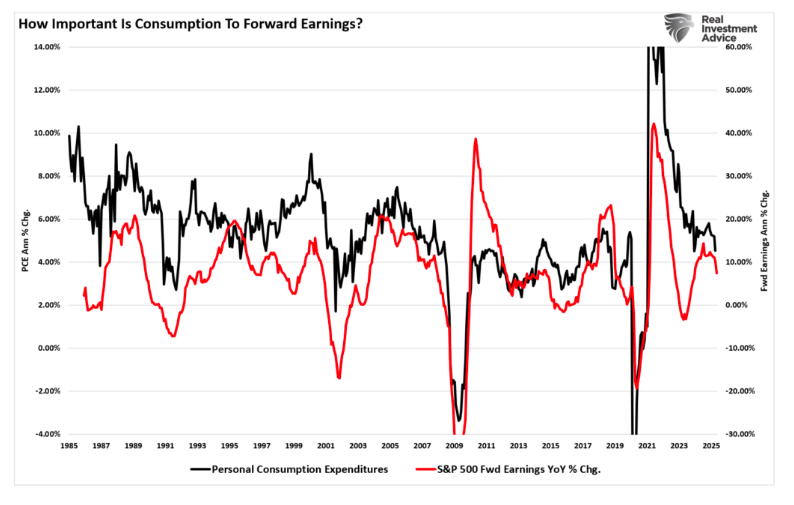
Given the recent softness in the employment data and the downturn in PCE, the risk to earnings is rising.
Lastly, the downturn in energy and materials earnings directly reflects economic weakness. The Q2-2025 earnings for the energy sector declined by ~19%, while materials fell by ~12% year‑over‑year. The decline in those two sectors is essential given their reflection of economic activity.
However, on the optimistic side, the Technology and Communications companies (particularly given their weight in the index) are buoying corporate earnings. Ongoing strong investment in AI and capex, particularly within the “Magnificent 7,” is expected to report strong earnings and revenue growth. As such, their Q2 guidance and commentary will likely offset some of the risk of spillover from trade and consumer dynamics.
Positioning For Earnings Season
At RIA Advisors, here is how we are positioning ahead of Q2 earnings reports.
After the strong run in asset markets from the April lows, markets are technically back to more overbought levels, with sentiment returning to “extreme greed.” Those levels open the door to a higher level of “disappointment” in earnings announcements than would otherwise be the case.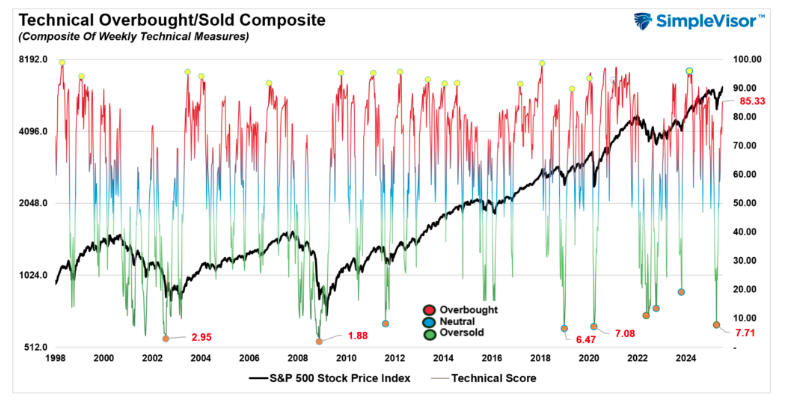
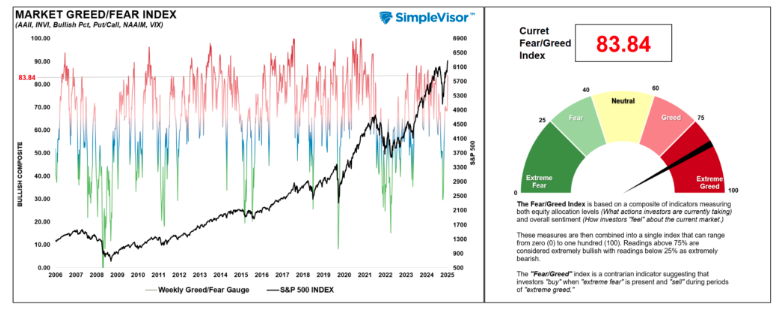
As such, we are looking to rebalance portfolio risk by reducing risk in areas with the highest degree of “disappointment potential” and somewhat raising cash levels. This gives us a hedge against downside risk, and cash to buy earnings “over reactions” in structurally advantaged sectors.
Our primary focus will be to:

- Focus on structurally advantaged sectors: Stick with AI heavyweights like Microsoft, Nvidia, and Alphabet. They carry forward earnings momentum, and guidance around AI spending could prompt positive sentiment . Conversely, avoid high-beta cyclical stocks, which may underperform if tariffs spark volatility.
- Tilt toward defensive, dividend‑paying stocks: As equity valuations remain elevated, despite slowing economic forecasts, adding exposure to low‑volatility and dividend‑generating segments, like consumer staples or utilities, can add ballast. Our primary portfolio includes companies like PG, BRK.B, RTX, and V.
- Watch guidance tone, not just numbers: Companies may retract or express uncertainty. Last quarter, ~4% of S&P 500 firms withdrew forward EPS commentary due to tariff uncertainty. In Q2 calls, examine the economic forecast from cyclical, discretionary, and staple companies for warnings or downward momentum beyond base estimates.
- Expect upside surprises, but remain realistic: Historically, 75–77% of S&P 500 firms top EPS expectations, due to the deep cuts of estimates going into earnings season. However, with consensus estimates already cut deeply, there is a high potential for a higher-than-normal “beat rate,” especially in tech (MSFT, NVDA), healthcare (ABBV, LLY), and communications (META, GOOG).
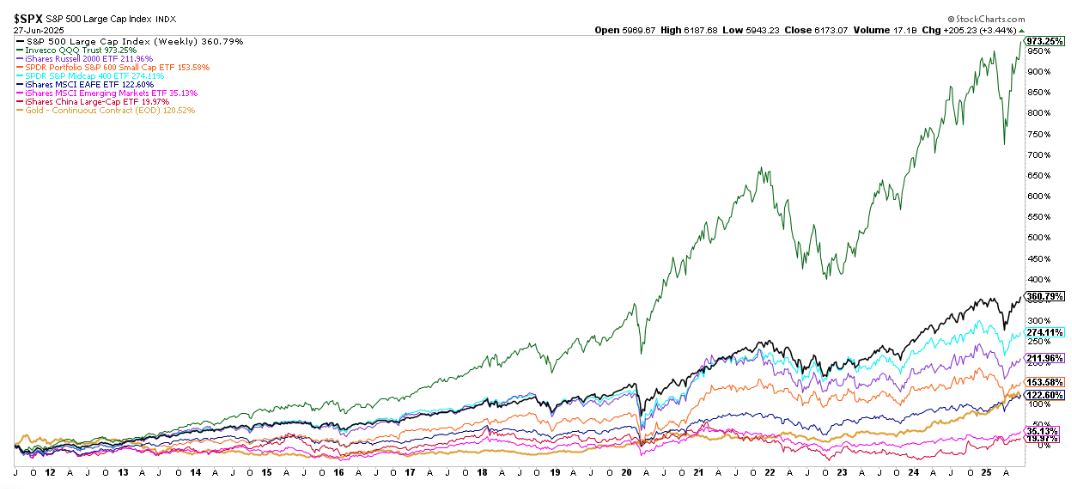
- Retain domestic vs. international exposure: The powerhouse of earnings growth remains the U.S. versus the rest of the world. With Central Banks cutting rates globally to offset sluggish economic growth, the backdrop of U.S. earnings will remain attractive to investors globally. This is why the U.S. has massively outperformed international markets over the last 15 years, and it is unlikely to change soon, given the dominance of AI by U.S. companies.
Conclusion
Q2-2025 earnings season reflects a more cautious narrative: earnings growth is decelerating, estimates have been cut more sharply, and company guidance is likely to follow suit. Yet underlying fundamentals remain solid, especially in the technology, communication, and defensive segments. Historically, positive surprises tend to outpace negativity, offering upside potential if macro headwinds remain stable.
However, our primary concern remains the slowing growth trend in the economic data. That trend, combined with rising delinquency rates, rising defaults, and declining consumption, all suggest that monetary policy is too restrictive and the Federal Reserve is likely behind on cutting rates. As discussed recently:

Next week, as earnings season kicks into high gear, investors should emphasize quality, weigh defensive income options, remain alert to guidance tone, and consider hedged exposure in reports. A well‑balanced approach, with a tilt toward AI‑led growth balanced with conservative positioning, will align risk/reward ahead of potentially market-moving announcements.
Trade accordingly.
A message from Advisor Perspectives and VettaFi: To learn more about this and other topics, check out some of our webcasts.
Lance Roberts is a Chief Portfolio Strategist/Economist for RIA Advisors. He is also the host of “The Lance Roberts Podcast” and Chief Editor of the “Real Investment Advice” website and author of “Real Investment Daily” blog and “Real Investment Report“. Follow Lance on Facebook, Twitter, Linked-In and YouTube Customer Relationship Summary (Form CRS)
Join RIA Advisors and elevate your career within a deeply experienced team focused on innovation. Our collaborative environment is built on a foundation of advanced technology and effective investment models, designed to enhance your ability to serve clients and grow your practice. Benefit from a supportive culture that encourages professional development and fosters a forward-thinking approach. By joining our team, you’ll be part of a group dedicated to excellence and continuous improvement, empowering you to focus on building meaningful client relationships and pursuing your business ambitions. Discover the advantages of working with our accomplished advisory team by starting your conversation today.
Membership required
Membership is now required to use this feature. To learn more:
View Membership BenefitsSponsored Content
Upcoming Virtual Events View All












