Everything that our team publishes has been through peer review. We candidly call out every opportunity we see to improve each other’s writing, from quibbling over word choices to challenging an essay’s entire premise. The end result is work that meets your expectations.
Recently, I suggested Carl should be cautious when using the em-dash—the elongated hyphen for an interjected thought, like so—as it has been associated with content generated by artificial intelligence (AI). We write our own essays and would never want a reader to think otherwise. Flagging this concern made me realize how AI has become an unavoidable consideration, even when it’s not in use.
Artificial intelligence is a broad term for computer systems able to perform tasks that usually require human thought. Advancements in data processing have allowed computers to move to new levels of interaction. They can now respond to questions in a manner that is very similar to what an actual person would offer.
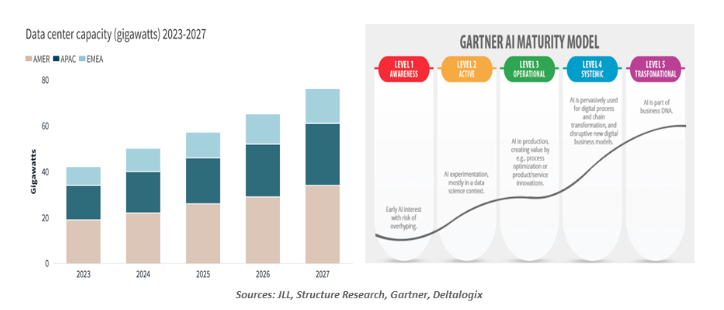
AI has been the core of the technology-led market rally. This is not mere hype: Real chips are being installed into to real computers that are filling real data centers. Model development is progressing briskly. The outcomes of these investments are appearing gradually, not as an overnight change but as a maturing tool that promotes productivity.

Today’s AI tools are ready to support the acceleration, automation and augmentation of existing work. Acceleration can help a worker draft documents, write code and summarize research. Automation can more easily create processes to collect data, prepare reports and monitor activity, requiring human intervention only as needed. Augmentation is a shift to plain-language interactions for fast information retrieval, as if a virtual teammate has come to life.
As systems gain knowledge and capacity, they will move from enhancing human work, to facilitating collaboration between humans and AI, and on to AI taking on self-directed work. Transitions are incomplete, but advancements to date have been rapid.
Adopting AI is becoming easier as the architecture of AI systems improves. Most of us had our first experience with AI as a text box on a public web page; many businesses quickly clamped down on use of these platforms to prevent information leakage. Now, AI can be deployed within a company’s premises or in a private cloud environment, allowing AI models to train on company resources without sharing externally. The open-source Model Context Protocol standardizes the way AI models exchange information with other systems, allowing it to be more readily integrated into workflows.
Some AI skeptics remain unconvinced. At their core, large-language AI models generate output by guessing the next best word to place after each word. They do not have knowledge of their own, but are repeating word patterns found elsewhere. Results are inconsistent, and quality is not assured; fabrications and hallucinations still happen.
Anecdotes abound, like students turning in papers with AI prompt language still included, or legal briefs filed with citations to nonexistent case precedents. But the technology remains young and is continually improving; the models available today will be the worst that we ever use. Above all, managers will demand accountability for their employees’ work. A model cannot be blamed for sloppy or incomplete deliverables.
The technology underpinning AI is not what excites us. We are more intrigued by its potential to add to productivity. Developed markets are facing a demographic crunch: older workers are retiring at a faster rate than young adults are entering the workforce. Immigration is a contentious topic and unlikely to make up the difference in lost workers. An economy’s potential output is simply the product of population and productivity: how many workers it contains, and how much output each of those workers can generate.
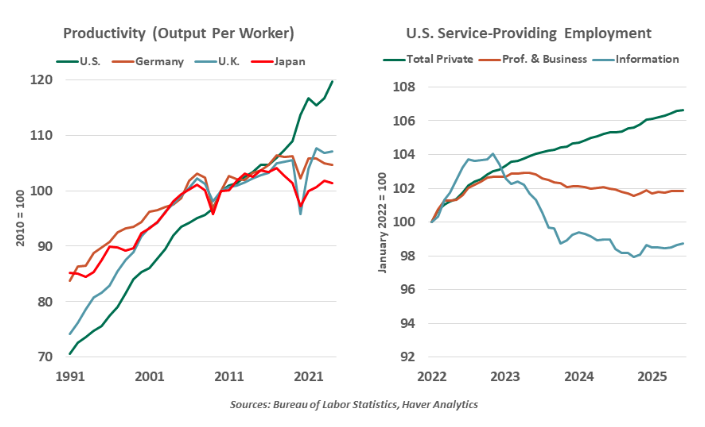
The long-run trend of productivity is not an exciting chart. For decades, output per worker has steadily moved upward. Technology has undoubtedly supported those gains, but launches of new technology have not caused inflections in the trend. Looking back to 1970, a reader could not spot the moments that innovations like desktop computing, the internet or smartphones were launched, but they all contributed to productivity gains.
Technology plays an intuitive role. The U.S. has been the most technology-forward economy, and its productivity gains have outpaced others. AI can be the next technology that continues this trend. Even those who never use it will benefit from noninflationary growth and a rising standard of living.
The effects of AI will be felt differently across sectors. Models are best at automating routine tasks, generating code and summarizing long texts. Employment gains in many professional occupations have stalled; as young entrants consider a career direction, fewer opportunities in these fields may diminish their appeal.
Hands-on professions like healthcare, maintenance and skilled trades will be the hardest to replace, but as AI progresses, more jobs will evolve. In retail, technology is advancing from order fulfillment to dynamic pricing and managing inventories and purchases. AI-enabled vehicles are now driving themselves. And AI interventions in medical specialties like radiology and surgery are helping to improve outcomes.
As AI matures, employers must make plans for its eventual use. Organizations will benefit from considering the risks, business impact, pilot projects and guidelines for its deployment. Use cases for AI will continue to grow, as will workers’ familiarity with its potential.
As a team, we will look forward to AI supporting some of our more routine reporting or improving the quality of our models. However, we have agreed that any work that bears our names will contain only our own words—and em-dashes.
Information is not intended to be and should not be construed as an offer, solicitation or recommendation with respect to any transaction and should not be treated as legal advice, investment advice or tax advice. Under no circumstances should you rely upon this information as a substitute for obtaining specific legal or tax advice from your own professional legal or tax advisors. Information is subject to change based on market or other conditions and is not intended to influence your investment decisions.
© 2025 Northern Trust Corporation. Head Office: 50 South La Salle Street, Chicago, Illinois 60603 U.S.A. Incorporated with limited liability in the U.S. Products and services provided by subsidiaries of Northern Trust Corporation may vary in different markets and are offered in accordance with local regulation. For legal and regulatory information about individual market offices, visit northerntrust.com/terms-and-conditions.
A message from Advisor Perspectives and VettaFi: To learn more about this and other topics, check out some of our webcasts.
© Northern Trust
Read more commentaries by Northern Trust

 Hands-on professions like healthcare, maintenance and skilled trades will be the hardest to replace, but as AI progresses, more jobs will evolve. In retail, technology is advancing from order fulfillment to dynamic pricing and managing inventories and purchases. AI-enabled vehicles are now driving themselves. And AI interventions in medical specialties like radiology and surgery are helping to improve outcomes.