Key Takeaways
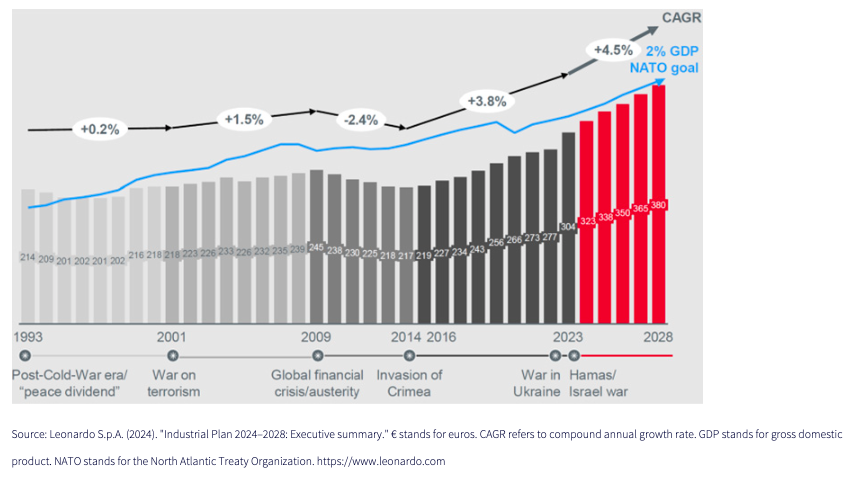
- European defense spending has decisively shifted from austerity to acceleration, with structural commitments driving a projected 4.5% compound annual growth rate (CAGR) through 2028—offering a generational investment opportunity in companies enabling regional sovereignty.
- Dassault Aviation is emerging as a stealth powerhouse in next-gen airpower, combining export momentum with sovereign systems integration that hedges against U.S. defense dependence.
- Leonardo SpA is positioning itself as Europe’s multi-domain enabler—from UAVs to counter-drone systems—anchoring coalition-capable technologies that could define NATO’s future force architecture.
The End of the Peace Dividend
Europe's defense landscape has undergone a paradigm shift—a rearmament cycle unfolding at a velocity unseen since the Cold War. For three decades, the prevailing narrative was defined by the so-called "peace dividend," a period of underinvestment in military capabilities as geopolitical risks were deemed manageable and budgets were redirected elsewhere. But that thesis has cracked. In 2022, military spending in Central and Western Europe surged to €345 billion—finally eclipsing the 1989 peak. This is not just a cyclical response to one war. It's a structural recalibration, driven by a geopolitical regime shift. Frontline states like Poland, Estonia and Finland are no longer debating whether to hit the North Atlantic Treaty Organization's (NATO's) 2% of gross domestic product (GDP) target—they're aiming for 3%–4% and building force postures accordingly. The market doesn't always recognize turning points until they're obvious, but in European defense, the inflection is already behind us.
Strategic Deterrence over Fiscal Discipline
When monetary policy makers start commenting on defense strategy, you know the priorities are shifting. European Central Bank official Olli Rehn has gone on record calling for EU-level funding initiatives for drone production and air defense systems, explicitly acknowledging that treaty-bound fiscal constraints may need to be softened. The logic is compelling: if monetary and fiscal tools were coordinated to fight a pandemic and sustain economic demand, why wouldn't they be deployed to ensure geopolitical sovereignty? Brussels, once a symbol of austerity discipline, is now being reimagined as the financial engine of joint European defense industrial policy. The language of economic stimulus is being replaced with that of deterrence, resiliency and kinetic readiness.6 That's not just political rhetoric—it's a reordering of priorities that investors cannot ignore.
Toward a 5% Defense Paradigm
The 2% GDP spending target—once aspirational, often missed—is quickly becoming a floor, not a ceiling. We're now seeing credible conversations, particularly in U.S.- and NATO-aligned think tanks, about the need for European countries to spend as much as 4%–5% of GDP if they are to deter both conventional and gray-zone threats in a multipolar world. The underlying logic? Defense inflation is real, platforms are more complex, the cost of deterrence is rising faster than the cost of confrontation, and peer adversaries aren't standing still. The compound annual growth rate (CAGR) of European defense spending, already tracking 4.5% from 2023–2028 based on current commitments, could accelerate further if joint procurement programs, industrial subsidies and public-private defense tech partnerships scale.7 For investors, that's not just a policy signal—it's a generational capital expenditure (capex) evolution unfolding in real time.
Figure 1: Total Defense Expenditure in NATO Europe, € billions

Two Integral Stocks in Europe's Strategic Autonomy Thesis
Dassault Aviation: Stealth, Sovereignty and Systems Thinking
Dassault Aviation is not just a French aerospace champion—it is the architect of Europe's vision for independent airpower. Known globally for the Rafale, Dassault's real strategic significance lies in how it pushes the frontier of sovereignty-enabling technologies. Nowhere is this more evident than in its leadership of the nEUROn unmanned combat air vehicle (UCAV) program—a stealth demonstrator that predates many U.S. and Chinese efforts in the same domain.8 Developed alongside firms like Leonardo (then Alenia), Saab and EADS, nEUROn is more than a platform; it's a European answer to the question of 21st-century air dominance. Stealth shaping, autonomous mission execution and collaborative weapons integration are all baked into the DNA of the project.
Dassault is also deeply entangled in Europe's next-generation airpower initiative—GCAP (Global Combat Air Programme)—through its experience in the still-contentious FCAS (Future Combat Air System) partnership with Airbus and Indra.9 While political friction among France, Germany and Spain occasionally clouds the FCAS timeline, Dassault remains the indispensable systems integrator. Its decades-long ability to shepherd complex aircraft from blueprint to battlespace gives it a central role as European air forces rethink survivability, data fusion and combat cloud architectures. In the language of capital markets: few firms offer such asymmetric upside tied to geopolitical hardening and intra-European industrial sovereignty.
Even as the UCAV and sixth-generation fighter programs command headlines, Dassault's broader value lies in its end-to-end integration model—something that appeals to customers who want sovereign control over design, intellectual property (IP) and lifecycle. In an era when European nations are questioning the strategic cost of U.S. platform dependence, Dassault's business model is effectively a hedge against American primacy in the defense aerospace sector. Its potential revenue streams span from export Rafale contracts (India, United Arab Emirates (UAE), Egypt) to eventual scaled programs in high-autonomy drone swarms and AI-assisted pilot-vehicle teaming. This is not a legacy aerospace firm—it's a sovereign systems house in stealth mode.
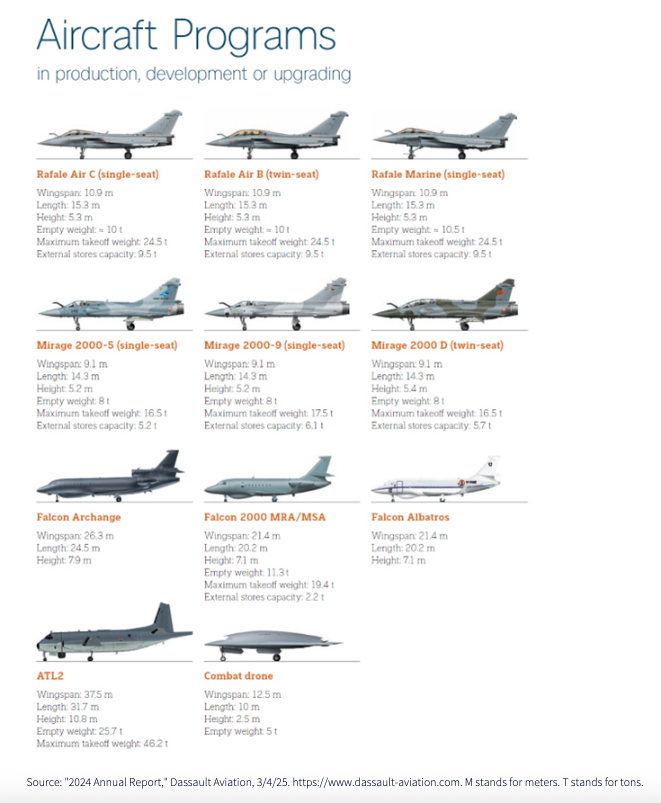
Sometimes, it's helpful to see some of this in a picture, which we have in figure 2:
- Broad Combat Aircraft Portfolio: Dassault offers three configurations of its flagship Rafale fighter jet—Air C (single-seat), Air B (twin-seat) and Marine (naval)—all with identical airframe specs but mission-tailored variants. This modularity demonstrates Dassault's ability to scale a base platform across air force and carrier-based deployments.
- Legacy Strength, Export Adaptation: The Mirage 2000 series—available in five-seat configurations across four sub-models (2000-5, -9, D)—continues to serve numerous countries. Notably, the Mirage 2000-9 has higher external stores capacity (6.1 tons (t)) and maximum takeoff weight (17.5 t), pointing to its export-optimized enhancements, likely for customers like the UAE.
- Deep Diversification beyond Fighters: Dassault operates across surveillance (Falcon 2000 MRA/MSA, Falcon Albatros), strategic intelligence (Falcon Archange) and maritime patrol (ATL2) segments. With wingspans ranging from 21 meters to 37.5 meters, these platforms reflect a robust defense offering well beyond classic fast-jet capabilities.
- Combat Drone Investment Signals Future Orientation: The stealthy-looking Combat drone (12.5-m wingspan, 5-t empty weight) reveals Dassault's pivot toward unmanned systems—likely linked to France's FCAS ambitions—highlighting its readiness for sixth-generation warfare architectures.
Figure 2: The French Defense Powerhouse Hiding in Plain Sight
Leonardo SpA: Multi-Domain Depth Meets Modular European Relevance
Leonardo SpA is arguably the most underappreciated systems integrator in the European defense ecosystem. Born from a national champion mentality but evolving into a multi-domain industrial platform, Leonardo is touching every layer of Europe's strategic autonomy stack—from air and cyber to space and EW (electronic warfare). Its industrial plan for 2024–2028 signals a clear transformation: digitalized manufacturing, platform rationalization and targeted global alliances are converging into a streamlined—but diversified—machine. The company isn't just participating in programs like Global Combat Air Programme and Eurofighter Typhoon; it's helping define the standards and enabling architectures across platforms.
In the UAV space, Leonardo complements Dassault's stealth-first focus with operational versatility. Its Falco series has long been deployed in surveillance missions across NATO and UN theaters, and its ongoing development of heavier, more autonomous variants suggests a clear path toward expanded mission profiles, including target acquisition and ISR11-strike integration. Meanwhile, Leonardo's role in Proteus and other rotary-wing UAV projects underscores its ambition to define the European approach to unmanned vertical lift.12 And while it isn't a small-drone manufacturer, that's a feature, not a bug—Leonardo is building into the higher-value layers of the UAV stack: secure communications, command-and-control and layered counter-drone capabilities.
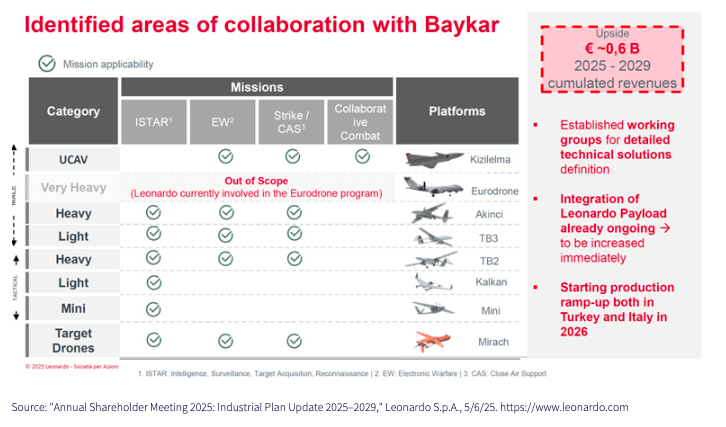
Figure 3 draws out Leonardo's emerging collaboration with Baykar—Turkey's leading UAV manufacturer, and it is a strategically important extension of its unmanned systems strategy, particularly as European defense shifts from platform independence to interoperable coalition capabilities. The partnership spans a wide range of drone categories—from heavy MALE (Medium Altitude Long Endurance) systems like the Akıncı and Tactical Block (TB2) to mini and tactical drones like the Kalkan and Mirach—and covers critical mission domains including ISTAR,13 electronic warfare and close air support. While Leonardo is currently committed to the Eurodrone program and thus excluded from the "very heavy" segment, its payloads are already being integrated into Baykar platforms, with technical working groups established to define deeper joint solutions. The joint production ramp-up planned for 2026 across both Turkey and Italy underscores the seriousness of this industrial axis, with €0.6 billion in cumulative revenue projected through 2029.14 Beyond revenue, the real upside is strategic: this partnership extends Leonardo's sensor, electronic warfare and payload integration footprint into one of the most battle-tested UAV families globally, while offering NATO-aligned modularity across future drone fleets.
Figure 3: Leonardo and Baykar: Building the Drone Arsenal of Tomorrow
Perhaps Leonardo's most strategically leveraged position lies in counter-UAV systems—where it's investing in radar, laser and EW-based neutralization tech. In a post-Ukraine defense environment, where drones are cheap and ubiquitous, the demand for effective counter-drone solutions is set to outstrip even the UAV boom itself. Leonardo's electronics division, with its heritage in airborne and naval radar, is pivoting naturally into this space. Add to this its cyber and space segment growth—areas reinforced by joint ventures like Telespazio—and Leonardo increasingly looks like the glue holding together Europe's fragmented but fast-evolving defense tech map. It is a horizontal enabler of vertical sovereignty—and investors should not underestimate that role.
A message from Advisor Perspectives and VettaFi: To learn more about this and other topics, check out some of our webcasts.
© WisdomTree, Inc.
Read more commentaries by WisdomTree, Inc.