Q2 Earnings Recap: U.S. Large-Cap Strong, Small-Cap Improving
Membership required
Membership is now required to use this feature. To learn more:
View Membership BenefitsSUMMARY
- US large-cap earnings results remain strong, and small-caps improved more than expected.
- European results were mixed, and Japan seems to be struggling.
- The impact of tariffs on US markets is not yet fully evident.
Japan and Europe Still Struggling
With over 90% of S&P companies now having reported, we feel we have enough data to perform our quarterly earnings season ‘checkup’. In order to complete this checkup, we will use our three ‘earnings principles’:
- Earnings/Revenue Surprises: Were corporate results out of alignment with market expectations?
- Analyst Adjustments: What was the direction and magnitude of analysts’ estimate revisions after forward guidance was issued?
- Earnings/Revenue Trends: What is the long-term earnings trend after the announcement?
While it may be too early for tariffs to show their full impact, we are on alert for any deterioration in any of our readings as we examine US large-cap through our earnings framework. Starting with the first principle, we are encouraged that so far tariffs have not put a dent in US earnings relative to expectations; the S&P 500’s earnings were +8% higher than anticipated (source: Bloomberg), with every sector but Materials beating expectations. These results seem to corroborate our view that the combination of stable interest rates and sustained inflation levels between 2-3% percent has created an environment whereby business models with high fixed costs but low variable ones (a feature called ‘operating leverage’) can thrive.
From a revenue perspective, we were also encouraged by sales coming in +2.1% higher than analysts expected, with all 11 sectors showing positive revenue surprises. This also allays our fears that tariff impact might be worse than the analyst community feared.
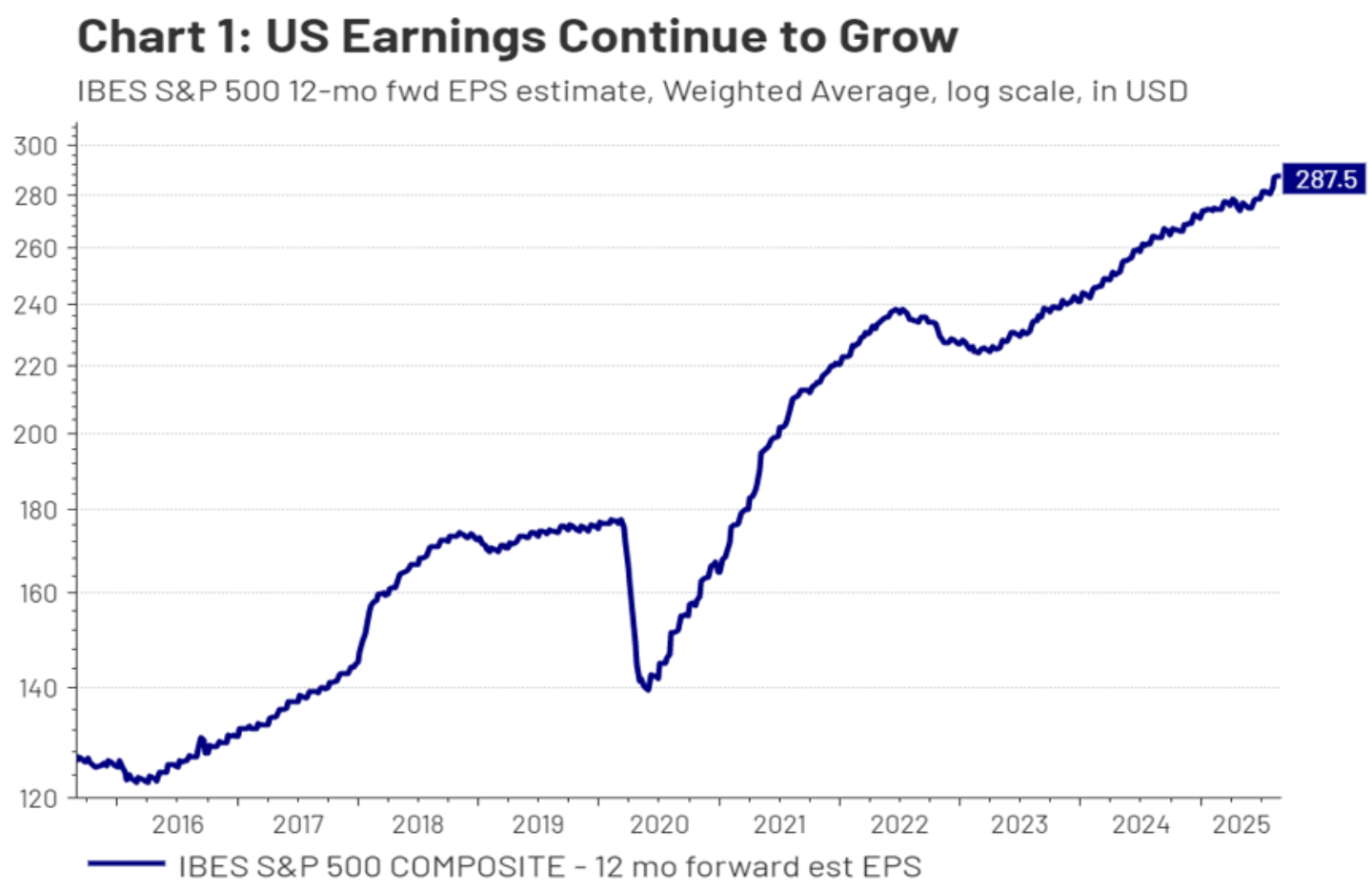
Moving to our second principle, future earnings expectations for the S&P 500 over the next 12 months have ticked upward in response to positive earnings surprises (see Chart 1, above). Similar to our take on surprises, analysts have continued to see a way for US large-cap to continue growing earnings.
Finally, the annualized trend of US large-cap earnings continues to be a positive +12.38% year over year overall, supported by revenue growth of +6.25%. At a sector level, Energy, Materials and Staples all had negative earnings growth over the period, and Energy was the only sector to have negative revenue growth. If we are looking for tariff warning signs in this data, there do not seem to be many we can fully attribute to them. We partially expected this outcome for energy given the decline in oil prices in 2025, and materials to a similar drop in commodity prices. Staples is likely due to higher rates squeezing margins.
This healthy checkup for growth themes is critical for US large-capitalization stocks, as our constructive view of US returns is predicated on a continuation of strong earnings. Given the rebound in US large-cap stocks post “Liberation Day”, we are hopeful earnings can continue on their current pace in the quarters ahead. We view continued earnings growth as necessary to support further returns, given elevated valuations (as discussed in last week’s Weekly View).
Small-Cap Improving, International is Deteriorating
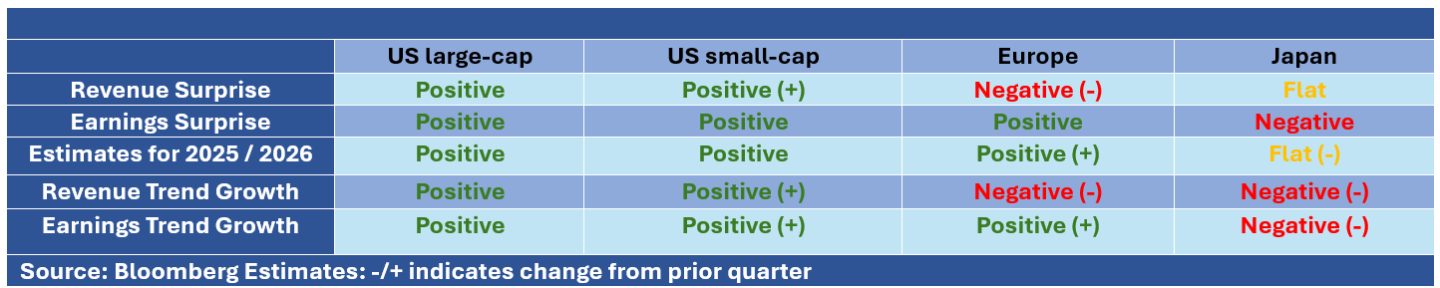
The table above summarizes RiverFront’s view of the earnings picture for four different market segments. Relative to US large-caps – which have a clear growth/technology bias – US small-caps, Europe and Japan all have a greater weighting in the more value-oriented sectors. Again, due to operating leverage, we believe these themes should begin to respond positively to a macro environment of falling short rates and modest (2-3%) US inflation. As such, while we look for continued strength in larger US companies, in these other markets we instead are looking for improvement. In the table above, the “+” and “- “signs indicate our view of how things have changed since the previous quarter.
Beyond Large-Cap: Other ‘Value-Led’ Market Segments Mixed… US Small-Caps Faring Better than Europe or Japan
- US Small-Cap: Small-cap earnings have seen quite a positive turnaround in all of our earnings principles. While the sector-by-sector revenue and earnings story is more mixed versus large-caps, overall small-caps’ improvement is apparent. What is not yet clear is if a single encouraging quarter is an aberration or a start of a new trend. However, taking this improvement in tandem with the increasing potential for interest rate cuts, investors could begin to make a case for small-cap as an investment. Some potentially attractive sectors in our view include technology, industrials and healthcare. Compared to Europe and Japan, there is little evidence of tariffs having a negative impact, at least thus far.
- Europe: Looking through our framework, European equities are somewhat of a mixed bag. Positive trends are emerging in earnings strength and improving analysis revisions. Our primary area of concern with European earnings is that revenue numbers are not faring as well. This is particularly troubling for European indices since their business models tend to have more operating leverage than US companies, in that they tend to require more top-line growth to cover higher fixed costs. A particular concern is that Industrials, Consumer Discretionary and Materials are all weak, which could be early areas impacted by tariffs. Meanwhile European Financials, which are largely immune to tariff impacts, are holding up well on earnings and revenue. While it is premature to draw any conclusions, a hopeful international investor would have liked to see stronger overall results in Europe – we will watch for improvement here as the “re-armament” plans are implemented across the continent.
- Japan: Unfortunately, Japan’s earnings have deteriorated across the board using our analytical framework. While technology and communication services companies in Japan seem to have bucked the general trend of earnings and revenue deterioration, in general Japan experienced a tough earnings quarter. It is also likely that tariffs are having an impact on export-oriented discretionary industries such as automobiles. We will watch in the quarters ahead of either reversals or confirmation of these negative trends.
Conclusion: Still Favoring US Large-Cap Stocks; Want More Data for the Other Segments
The continuation of strong US large-cap earnings is a reminder of our view that American corporate earnings are exceptional – even small-cap companies were able to post improved numbers amidst the myriad of tariff-related and macro challenges. However, this is only one quarter of earnings. For small-caps, the potential combination of rate cuts and another quarter of improvement would likely warrant serious investment consideration, especially in our more risk-tolerant, longer-horizon portfolios. Given the uneven earnings trends, this potential investment would likely be directed towards specific sectors or themes, as opposed to broad vehicles.
RiverFront portfolios are positioned consistently with the takeaways of this analysis, in our view. We are overweight US large-cap stocks across our balanced portfolios, driven by the S&P 500’s demonstrated earnings strength. We have also made selective investments in Europe and Japan, with distinct tilts towards Value and Financials. With the impact of tariffs creating uncertainty, we will be monitoring corporate surveys, business confidence, earnings guidance and analyst revisions to assess whether the risk of recession has increased.
Originally published on September 3, 2025
For more news, information, and strategy, visit the ETF Strategist Content Hub.
A message from Advisor Perspectives and VettaFi: Ready for your next career move? Explore our articles on financial advisor transitions.
Important Disclosure Information
The comments above refer generally to financial markets and not RiverFront portfolios or any related performance. Opinions expressed are current as of the date shown and are subject to change. Past performance is not indicative of future results and diversification does not ensure a profit or protect against loss. All investments carry some level of risk, including loss of principal. An investment cannot be made directly in an index.
Information or data shown or used in this material was received from sources believed to be reliable, but accuracy is not guaranteed.
This report does not provide recipients with information or advice that is sufficient on which to base an investment decision. This report does not take into account the specific investment objectives, financial situation or need of any particular client and may not be suitable for all types of investors. Recipients should consider the contents of this report as a single factor in making an investment decision. Additional fundamental and other analyses would be required to make an investment decision about any individual security identified in this report.
Chartered Financial Analyst is a professional designation given by the CFA Institute (formerly AIMR) that measures the competence and integrity of financial analysts. Candidates are required to pass three levels of exams covering areas such as accounting, economics, ethics, money management and security analysis. Four years of investment/financial career experience are required before one can become a CFA charterholder. Enrollees in the program must hold a bachelor’s degree.
All charts shown for illustrative purposes only. Technical analysis is based on the study of historical price movements and past trend patterns. There are no assurances that movements or trends can or will be duplicated in the future.
Stocks represent partial ownership of a corporation. If the corporation does well, its value increases, and investors share in the appreciation. However, if it goes bankrupt, or performs poorly, investors can lose their entire initial investment (i.e., the stock price can go to zero). Bonds represent a loan made by an investor to a corporation or government. As such, the investor gets a guaranteed interest rate for a specific period of time and expects to get their original investment back at the end of that time period, along with the interest earned. Investment risk is repayment of the principal (amount invested). In the event of a bankruptcy or other corporate disruption, bonds are senior to stocks. Investors should be aware of these differences prior to investing.
In general, the bond market is volatile, and fixed income securities carry interest rate risk. (As interest rates rise, bond prices usually fall, and vice versa). This effect is usually more pronounced for longer-term securities). Fixed income securities also carry inflation risk, liquidity risk, call risk and credit and default risks for both issuers and counterparties. Lower-quality fixed income securities involve greater risk of default or price changes due to potential changes in the credit quality of the issuer. Foreign investments involve greater risks than U.S. investments, and can decline significantly in response to adverse issuer, political, regulatory, market, and economic risks. Any fixed-income security sold or redeemed prior to maturity may be subject to loss.
Investing in foreign companies poses additional risks since political and economic events unique to a country or region may affect those markets and their issuers. In addition to such general international risks, the portfolio may also be exposed to currency fluctuation risks and emerging markets risks as described further below.
Changes in the value of foreign currencies compared to the U.S. dollar may affect (positively or negatively) the value of the portfolio’s investments. Such currency movements may occur separately from, and/or in response to, events that do not otherwise affect the value of the security in the issuer’s home country. Also, the value of the portfolio may be influenced by currency exchange control regulations. The currencies of emerging market countries may experience significant declines against the U.S. dollar, and devaluation may occur subsequent to investments in these currencies by the portfolio.
Foreign investments, especially investments in emerging markets, can be riskier and more volatile than investments in the U.S. and are considered speculative and subject to heightened risks in addition to the general risks of investing in non-U.S. securities. Also, inflation and rapid fluctuations in inflation rates have had, and may continue to have, negative effects on the economies and securities markets of certain emerging market countries.
Technology and Internet-related stocks, especially of smaller, less-seasoned companies, tend to be more volatile than the overall market.
Index Definitions:
Standard & Poor’s (S&P) 500 Index measures the performance of 500 large cap stocks, which together represent about 80% of the total US equities market.
S&P 600 is a benchmark index for small-cap stocks. To be listed on the S&P 600, stocks must have a market cap of $850 million to $3.6 billion, preventing overlap with S&P’s larger cap indices.
EURO STOXX 50 is a stock index of Eurozone stocks designed by STOXX, an index provider owned by Deutsche Börse Group. The index is composed of 50 stocks from 11 countries in the Eurozone. EURO STOXX 50 represents Eurozone blue-chip companies considered as leaders in their respective sectors.
The Tokyo Price Index, known as TOPIX, is a Japanese stock market index calculated and published by the Tokyo Stock Exchange (TSE). TOPIX tracks domestic companies in the exchange’s first section, which represents Japan’s largest firms by market capitalization.
Definitions:
Operating leverage is a financial ratio that, using a company’s fixed costs relative to its variable costs, measures the degree to which a firm can increase operating income by increasing revenue.
A recession is a significant, widespread, and prolonged downturn in economic activity. A common rule of thumb is that two consecutive quarters of negative gross domestic product (GDP) growth indicate a recession. However, more complex formulas are also used to determine recessions.
Inflation is a gradual loss of purchasing power, reflected in a broad rise in prices for goods and services over time.
The energy sector is a category of stocks that relate to producing or supplying energy. The energy sector or industry includes companies involved in the exploration and development of oil or gas reserves, oil and gas drilling, and refining. The energy industry also includes integrated power utility companies such as renewable energy and coal.
US Equities include stocks listed in the United States. Stocks represent partial ownership of a corporation. If the corporation does well, its value can increase, and investors can share in the appreciation. However, if it goes bankrupt, or performs poorly, investors can lose their entire initial investment (i.e., the stock price can go to zero). Small/mid-cap equities, MLPs, REITS and alternatives equities are types of US Equities and assume further risks described below.
The Institutional Brokers’ Estimate System (IBES) is a database used by brokers and active investors to access the estimates made by stock analysts regarding the future earnings of publicly traded American companies.
Earnings per share (EPS) is calculated as a company’s profit divided by the outstanding shares of its common stock. The resulting number serves as an indicator of a company’s profitability.
US large cap equities include equities of companies with a market capitalization of over $10 billion. Although large cap equities are generally considered to be safer securities, large cap equities are still subject to the risks associated with stocks.
Small-, mid- and micro-cap companies may be hindered as a result of limited resources or less diverse products or services and have therefore historically been more volatile than the stocks of larger, more established companies.
When referring to being “overweight” or “underweight” relative to a market or asset class, RiverFront is referring to our current portfolios’ weightings compared to the composite benchmarks for each portfolio. Asset class weighting discussion refers to our Advantage portfolios.
RiverFront Investment Group, LLC (“RiverFront”), is a registered investment adviser with the Securities and Exchange Commission. Registration as an investment adviser does not imply any level of skill or expertise. Any discussion of specific securities is provided for informational purposes only and should not be deemed as investment advice or a recommendation to buy or sell any individual security mentioned. RiverFront is affiliated with Robert W. Baird & Co. Incorporated (“Baird”), member FINRA/SIPC, from its minority ownership interest in RiverFront. RiverFront is owned primarily by its employees through RiverFront Investment Holding Group, LLC, the holding company for RiverFront. Baird Financial Corporation (BFC) is a minority owner of RiverFront Investment Holding Group, LLC and therefore an indirect owner of RiverFront. BFC is the parent company of Robert W. Baird & Co. Incorporated, a registered broker/dealer and investment adviser.
To review other risks and more information about RiverFront, please visit the website at riverfrontig.com and the Form ADV, Part 2A. Copyright ©2025 RiverFront Investment Group. All Rights Reserved. ID 4789203
Membership required
Membership is now required to use this feature. To learn more:
View Membership BenefitsSponsored Content
Upcoming Virtual Events View All












