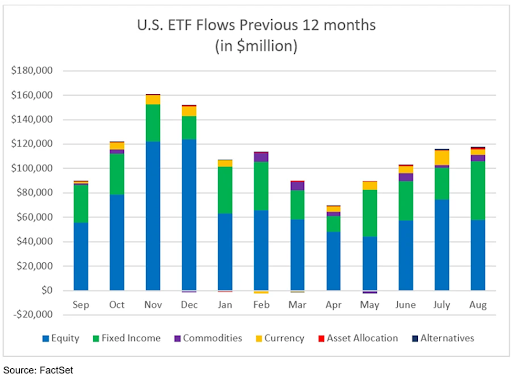
August brought with it a slowing in ETF launches from the summer spree while inflows continued. With last year’s $1.1 trillion record ETF inflows in clear sight, the second half continues to prove promising for ETF investors. Of the seventy-plus ETFs launched last month, a few stand out for innovative strategies.
In August, 74 ETFs launched, a slight pullback from June and July’s 111 launches each, according to FactSet data. Equity ETF launches dominated at 64% of all ETFs launched (47 funds), followed by fixed income at 29.7% (22 funds). Notably, active strategies continue to rule the roost this year. Of the 74 ETFs launched in August, 78% were actively managed.
U.S. ETF AUM reached $12.25 trillion in August, with inflows of $117.8 billion, up slightly from July’s $116 billion. Thus far this year, U.S. ETFs netted $796.3 billion in inflows, well on pace to outstrip last year’s record $1.1 trillion. Equities continue to shine, bringing in $57.7 billion inflows in August, followed relatively closely by fixed income at $48.4 billion. The increase in flows into fixed income could be the beginning of a new trend to watch, as the category gained 85.5% month-over-month.

Factor Investing Internationally, With a Twist
Factor investing is well-trodden territory in regards to strategies. However, BlackRock launched a timely extension to their factor funds with the iShares International Equity Factor Rotation Active ETF (IDYN). The fund seeks to outperform the broad international developed equity market and invests in six factors. These include quality, value, momentum, size, low volatility, and growth.
In an environment of ongoing uncertainty and volatility in U.S. markets, international exposures appear increasingly attractive. In addition, with the dynamic nature of current markets, active management may offer further benefits. IDYN offers both international exposure as well as an actively managed strategy that seeks to remain responsive to markets. The strategy relies on BlackRock Systematic Investing which, uses AI and LLMs as well as a 200-person team to find alpha opportunities across enormous data sets. The data is comprised of over 1.5 million analyst reports and 40,000 earnings calls annually as well as mobile app data and more.
IDYN’s strategy uses this systematic approach to identify near-term forecasted alpha opportunities within specific factors. It also weighs long-term return potential when analyzing factor cycles. The strategy considers these inputs as well as the economic cycle, valuations, and recent performance trends for the factors. It then identifies the factors that appear favorable in the near-term, tilting towards them and away from unfavorable factors. It makes the fund a potential one-stop-shop for factor investing internationally, at least on the developed market side.
Bringing Laddered Strategies to Munis, Inflation-Linked Bond ETFs
Northern Trust announced its entry into the ETF industry with three suites of funds mid-August. Of the three, two focus on their patent pending distributing ladder strategy. The funds seek to keep clients invested across market environments while solving for their need for reliable cash flow. One suite focuses on tax-efficiency through municipal bonds, while the other offers inflation protection through its investment in Treasury-inflation protected securities (TIPS).
Both ETF suites provide a range of maturities for investors that align with a variety of time horizons. Every fund is comprised of a portfolio of bonds with staggered maturities, with different maturity bonds making up each “rung” of the ladder. This creates easy and affordable access to laddered bond strategies for investors. However, the funds differ significantly from most existing laddered bond strategies in that they offer annual distributions.
More traditional bond laddered strategies take what is earned from the most recent bond rung to mature and reinvest it into future rungs. With Northern Trust’s distributing ladder ETFs, investors retain control over their return of principal. Each bond rung is held to maturity and then the fund seeks to pay investors the principal back in full. This provides reliable tax-efficient or inflation-protected income for investors looking to optimize their cash flow.
Seizing Opportunity In Emerging Market Bonds With Hard Currency
The Neuberger Berman Emerging Market Debt Hard Currency ETF (NEMD) launched August 11. The fund is a conversion from the firm’s pre-existing open-ended mutual fund. As such, it relies on a management team with an average of three decades of industry experience.
While other hard currency EM ETFs exist, NEMD comes to market at a time when fixed income interest and flows are surging. It makes it a notable launch, particularly on the bond side. The strategy relies on active management to navigate and capitalize on inefficiencies and opportunities within emerging market debt, using fundamental analysis.
The strategy covers over 90 emerging market countries with more than 500 corporate issuers. It invests in debt instruments from sovereign, quasi-sovereign, supranational, and corporate issuers that transact in hard currencies. These are defined as currencies from industrial countries (those in the G-7) as well as the euro. The strategy is not constrained by credit rating, duration, or maturity and can invest significantly in one geographic region or country.
When constructing the portfolio, the managers combine top-down and bottom-up analysis. They consider the global macro environment alongside individual country fundamentals, as well as market pricing and supply/demand trends. Each issuer is measured for their credit worthiness and fundamentals, and each debt instrument is assessed individually. In addition to this analysis, the team employs risk management strategies in portfolio construction.
A message from Advisor Perspectives and VettaFi: To learn more about this and other topics, check out our most recent market outlooks.
Read more commentaries by VettaFi