Debt and Deficits: Not Just a U.S. Thing
While much has (rightfully) been made of the ongoing debt and deficit spending here in the U.S., the fiscal positions of major developed economies reveal profound disparities in debt management and long-term trend sustainability. Mounting government obligations could have significant implications on economic stability and monetary policy flexibility if not remedied.
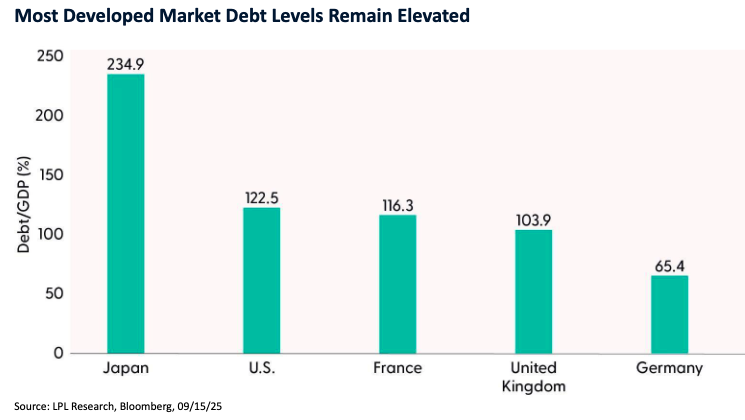
Japan maintains the most precarious position among developed nations, with government debt reaching nearly 235% of gross domestic product (GDP) although net of the Bank of Japan’s bond ownership programs, debt/GDP is a more manageable 134%. This extraordinary burden has accumulated through decades of economic stagnation beginning in the 1990s, compounded by extensive government interventions including bank bailouts, insurance company rescues, and stimulus measures following the 2008 financial crisis, 2011 Fukushima disaster, and COVID- 19 pandemic. Projections indicate Japan’s debt-to-GDP ratio will remain near 250% through 2029, demonstrating the persistent challenges of fiscal consolidation under such extreme leverage.
The United States presents a different but equally significant concern, holding $37 trillion in government debt that constitutes roughly 30% of total global government obligations. At 122% of GDP, American debt levels reflect substantial military expenditures, tax reductions, pandemic response measures, and structurally underfunded entitlement programs including Medicare. The current trajectory is on pace to be the largest projected debt increase among G7 nations over the next five years, though the dollar’s reserve currency status provides certain financing advantages unavailable to other sovereigns.
France registers concerning levels at 116.3% of GDP, positioning it among the Eurozone’s most heavily indebted members alongside Greece and Italy. The 3.2 percentage point increase in French debt ratios during 2024 signals accelerating fiscal pressures that may constrain future policy options. Moreover, with budget deficits close to 6%, debt levels are expected to continue to climb.
The United Kingdom maintains debt levels above 100% of GDP as well, representing the highest ratio since the early 1960s following extensive pandemic-related borrowing. These levels present ongoing challenges for fiscal policy coordination and economic management in the post-Brexit environment.
Germany demonstrates the most sustainable fiscal position among these major economies, with debt representing 65.4% of GDP. Despite adding €57 billion in absolute debt during 2024, Germany’s debt-to-GDP ratio declined by 0.4 percentage points due to strong economic growth, illustrating how productivity and expansion can mitigate borrowing concerns when properly managed.
These divergent debt trajectories reflect fundamentally different approaches to fiscal policy, varying historical pressures, and distinct structural economic characteristics. The sustainability implications are important, particularly as elevated global interest rates increase servicing costs and potentially limit policy responses to future economic shocks. The management of these debt burdens will substantially influence global financial stability and long-term economic growth prospects across developed markets.

When Political Instability Meets Fiscal Profligacy
Elevated debt levels and political instability is a toxic cocktail that usually results in higher borrowing costs through an increase in sovereign term premiums. Term premiums represent the additional compensation investors demand to hold longer maturity bonds irrespective of growth and inflation expectations. And after years of negative term premiums, yield curve dynamics have shifted in many developed markets to reflect these growing concerns.
In Japan, the political landscape was rattled when Prime Minister Shigeru Ishiba announced his resignation. His departure has triggered a leadership contest within the ruling Liberal Democratic Party (LDP), with internal elections anticipated to take place on October 4. However, the implications extend beyond party politics. The incoming LDP leader will need to secure a majority in the lower house of the Japanese Diet to form a stable government. The new prime minister would then need to either form a broad coalition or call snap elections. The LDP is generally considered the more long-term-rates-friendly party by the markets, so failure to form a government could usher in a period of heightened political uncertainty, undermining investor confidence and amplifying volatility in Japanese government bonds. The Bank of Japan, already navigating a complex policy environment with inflation at the highest levels in the developed world, could also be forced into a bit of a holding pattern until greater political certainty is achieved.
Meanwhile, in France, political tensions have also escalated. Last week, François Bayrou lost a critical vote of no confidence and stepped down as prime minister after his government’s proposed austerity budget failed to gain sufficient support in the National Assembly. French President Emmanuel Macron has since appointed Defense Minister Sebastien Lecornu to become the new prime minister. This new appointment avoids snap elections, but it remains to be seen whether the incoming leader will be able to form a viable coalition capable of governing effectively. Odds in the betting markets of new elections before the end of the year are still around 35%.
France is grappling with a €3 trillion debt burden, and the rising cost of servicing that debt amid higher interest rates. Under European Union (EU) rules, they need to reduce their deficit to 4.6% by 2026. Political fragmentation and policy paralysis could severely hinder efforts to implement credible fiscal consolidation. Should markets begin to perceive that political dysfunction is impeding necessary reforms, the risk of a sovereign credit rating downgrade becomes very real — potentially exacerbating the sell-off in French government bonds and causing further spread widening.
Less Instability, More Spending
The U.K. faces similar strains. Thirty-year gilt yields recently surged to roughly 5.7%, their highest since 1998, as stubborn inflation may limit the Bank of England’s (BoE) room to maneuver. Investors remain divided on whether the BoE will cut again this year or stay on hold if inflation drifts higher. Markets are currently pricing in a BOE pause until March 2026. Higher interest rates and sluggish growth have combined to keep pressures on public finances, with the Chancellor expected to have to take further action to restore headroom against her self-imposed fiscal rules.
Finally, while Germany’s fiscal situation is better than most other developed countries, the recent determination to increase spending will most likely increase debt burdens as well. In early March 2025, Friedrich Merz, Germany’s Chancellor, announced a historic shift in fiscal policy, vowing to do "whatever it takes" to bolster defense and revitalize the economy. Facing a weakening transatlantic alliance under U.S. President Donald Trump — who effectively pushed Europe to take on more of its own security responsibility — Merz and his prospective coalition partners, the Social Democrats (SPD), proposed loosening Germany’s strict constitutional "debt brake." This rule, enacted in 2009, had limited borrowing to 0.35% of GDP annually.
The plan, finalized in mid-March, involved two key components: exempting defense spending above 1% of GDP from debt restrictions and creating a €500 billion fund over ten years for infrastructure investment. This marked a dramatic departure from Germany’s decades-long fiscal conservatism, driven by the need to meet NATO’s 2% GDP defense target, support Ukraine, and address economic stagnation after two years of contraction. To secure the required two-thirds parliamentary majority, Merz gained crucial support from the Greens by redirecting €50 billion to climate initiatives alongside defense and infrastructure priorities.
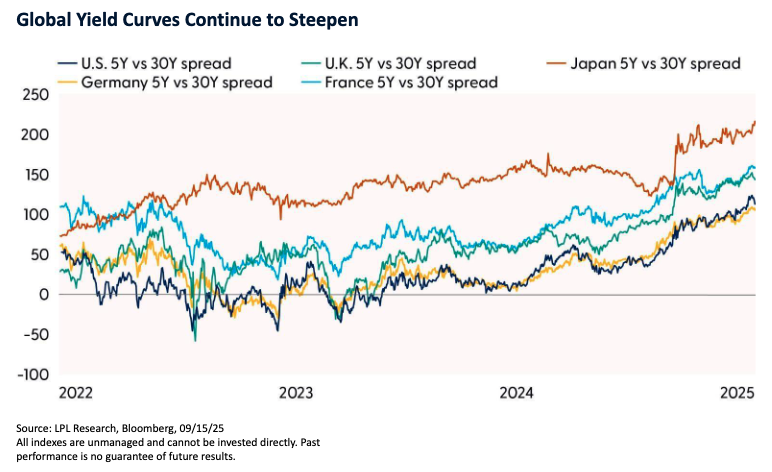
The combination of political instability and increased fiscal spending is showing up in global bond market yield curves. Investors are increasingly demanding higher term premiums to hold long-dated government debt in jurisdictions where political uncertainty threatens to derail fiscal discipline and economic stability. As such, while most short and intermediate term bond yields have fallen this year, 30-year yields have increased (or in the case of the U.S., not fallen as much as shorter maturity bond yields) causing yield curves to steepen to the highest levels in years. While inflation dynamics and central bank policy remain important, the recent steepening of yield curves underscores the budding influence of governance risk in shaping global fixed income markets.
What’s This Have to Do with U.S. Markets?
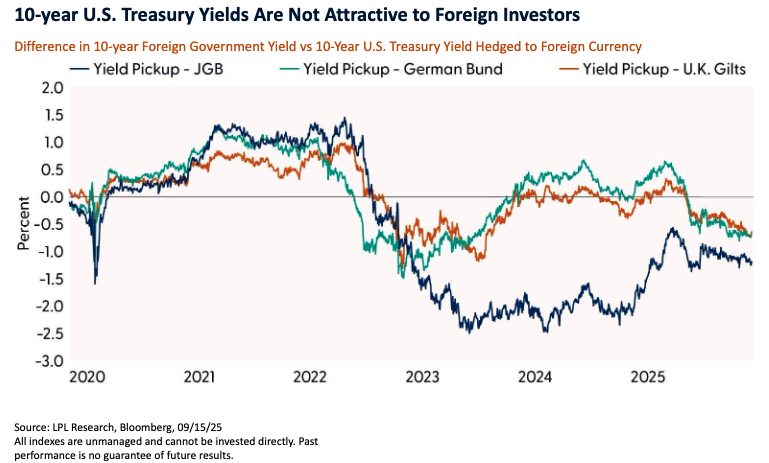
As noted, long-term interest rates have surged globally, pushing U.K. Gilts, Japanese Government Bond (JGBs) and German Bund yields to multi-year highs. And with the recent global selloff, longer-term interest rates are higher in many non-U.S. markets, which may mean foreign investors (which make up 30% of U.S. Treasury ownership) may not be as willing to invest in U.S. Treasury securities.
Non-U.S. investors, particularly from Europe and Japan, are increasingly dis-incentivized to own U.S. Treasuries on a currency-hedged basis due to rising home-market yields and high hedging costs. The yield differential between U.S. 10-year Treasuries (4.0%) and 10-year German Bunds (2.25%) or 10-year JGBs (1.10%) has narrowed as global yields have surged recently. For Eurozone investors, hedging via currency swaps involves costs tied to interest rate differentials, which reduces the effective Treasury yield below that of Bunds or even UK Gilts. Japanese investors face similar challenges, with yen volatility and JGB yields at 1.1%, making domestic bonds more competitive after hedging costs are factored in.
The potential reduction in foreign buyers, at the same time Treasury issuance is expected to remain elevated, may mean long-term bond yields remain elevated to attract buyers. But Treasury yields are primarily a function of growth and inflation expectations so as the economic data goes so goes Treasury yields. With the Fed set to cut interest rates this week due to a softening labor market, Treasury yields may be past cycle highs. Indeed, recent Treasury auctions have been supportive of bond prices with some of the best end user statistics ever recorded, suggesting investors are eager to lock in current Treasury yields. But with developed market debt levels expected to continue to increase with seemingly little appetite to reduce budget deficits, long-term bond yields may need to remain elevated to attract buyers. We remain neutral duration relative to benchmarks and think the best risk/reward in the Treasury market remains in the two- to five-year parts of the Treasury curve.
Asset Allocation Insights
LPL’s Strategic and Tactical Asset Allocation Committee (STAAC) maintains its tactical neutral stance on equities. Investors may be well served by bracing for occasional bouts of volatility given how much optimism is reflected in stock valuations, lingering tariff and inflation risks, and historical seasonal weakness. LPL Research advises against increasing portfolio risk beyond benchmark targets currently and continues to monitor trade negotiations, economic data, earnings, the bond market, and various technical indicators to identify a potentially more attractive entry point to consider adding equities on weakness.
STAAC’s regional preferences across the U.S., developed international, and emerging markets (EM) are aligned with benchmarks. The Committee still favors growth over value, large caps over small caps, and the communication services and financials sectors.
Within fixed income, the STAAC holds a neutral weight in core bonds, with a slight preference for mortgage-backed securities (MBS) over investment-grade corporates. The Committee believes the risk-reward for core bond sectors (U.S. Treasury, agency MBS, investment-grade corporates) is more attractive than plus sectors. The Committee does not believe adding duration (interest rate sensitivity) at current levels is attractive and remains neutral relative to benchmarks.
A message from Advisor Perspectives and VettaFi: Discover something new! Click here to register for our upcoming webcasts.
Important Disclosures
This material is for general information only and is not intended to provide specific advice or recommendations for any individual. There is no assurance that the views or strategies discussed are suitable for all investors or will yield positive outcomes. Investing involves risks including possible loss of principal. Any economic forecasts set forth may not develop as predicted and are subject to change.
References to markets, asset classes, and sectors are generally regarding the corresponding market index. Indexes are unmanaged statistical composites and cannot be invested into directly. Index performance is not indicative of the performance of any investment and do not reflect fees, expenses, or sales charges. All performance referenced is historical and is no guarantee of future results.
Any company names noted herein are for educational purposes only and not an indication of trading intent or a solicitation of their products or services. LPL Financial doesn’t provide research on individual equities.
All information is believed to be from reliable sources; however, LPL Financial makes no representation as to its completeness or accuracy. All investing involves risk, including possible loss of principal.
US Treasuries may be considered “safe haven” investments but do carry some degree of risk including interest rate, credit, and market risk. Bonds are subject to market and interest rate risk if sold prior to maturity. Bond values will decline as interest rates rise and bonds are subject to availability and change in price.
The Standard & Poor’s 500 Index (S&P500) is a capitalization-weighted index of 500 stocks designed to measure performance of the broad domestic economy through changes in the aggregate market value of 500 stocks representing all major industries.
The PE ratio (price-to-earnings ratio) is a measure of the price paid for a share relative to the annual net income or profit earned by the firm per share. It is a financial ratio used for valuation: a higher PE ratio means that investors are paying more for each unit of net income, so the stock is more expensive compared to one with lower PE ratio.
Earnings per share (EPS) is the portion of a company’s profit allocated to each outstanding share of common stock. EPS serves as an indicator of a company’s profitability. Earnings per share is generally considered to be the single most important variable in determining a share’s price. It is also a major component used to calculate the price-to-earnings valuation ratio.
All index data from FactSet or Bloomberg.
Read more commentaries by LPL Financial