Policy changes around the world are redefining how infrastructure projects are being funded, affecting capital flows and having an impact on the growth rates of infrastructure assets.
Accelerating policy-driven investment and AI-driven data center growth are unlocking a multi-decade growth opportunity for listed utilities globally.
Listed infrastructure companies with ready access to capital, strong management teams and credibility with regulators and customers should perform well in this environment.
New legislation in the United States and an ongoing shift in policy focus in Europe are combining to create one of the most significant periods of change for infrastructure policy in decades, in our view. These changes are redefining—sometimes subtly, sometimes dramatically—both how infrastructure projects are funded and how fast their assets are growing.
Accelerating global policy changes are also intersecting with rapid technological advancements, particularly in AI and cloud computing, which we believe presents a multi-decade growth opportunity for listed infrastructure globally, in particular utilities.
Policy implications for listed infrastructure
Across the globe, governments are redefining their priorities. In the United States, parts of the Inflation Reduction Act (IRA) of 2022—arguably the most ambitious clean energy policy in recent memory—have been rolled back or reshaped under the One Big Beautiful Bill (OBBB), passed in July 2025. In Europe, largely as a result of continued conflict between Ukraine and Russia, the policy focus is shifting toward defense spending, although this includes tailwinds for infrastructure. Germany has also enacted significant infrastructure fiscal stimulus. Changing tariff policies around the world are also resulting in changing trade flows, which are altering the competitive landscape for infrastructure companies.
Thus, the backdrop is changing for infrastructure, and investors will need to assess which companies will thrive in this new environment.
One net result is that corporate and financial sectors are being increasingly relied upon to provide capital for infrastructure investments, taking over from governments. With private capital driving projects, infrastructure companies are seeing their asset bases grow at faster rates.
With the key driver of long-term returns for infrastructure being the growth of the underlying asset base, we think this is a positive. Further, with the capital shift likely entailing some capital rationing, we expect this to further increase return profiles as infrastructure companies prioritize high-return projects and improve capital efficiency.
The One Big Beautiful Bill
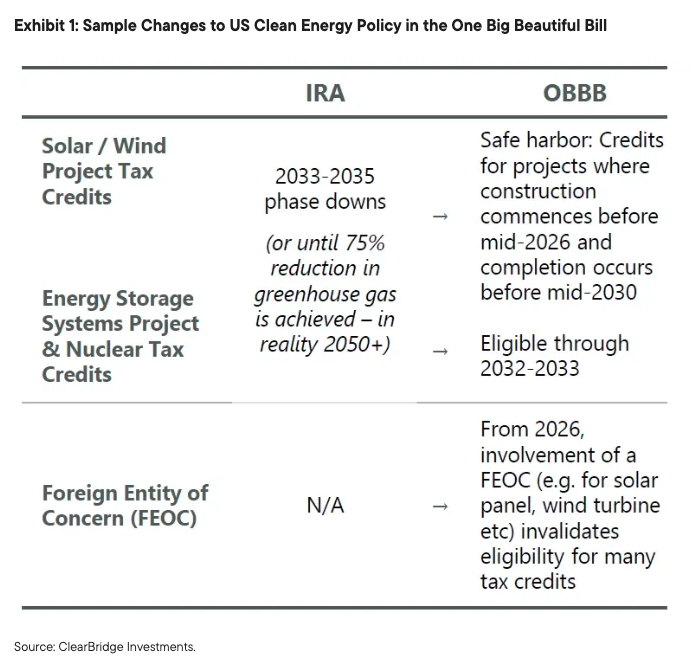
As expected, the Trump administration has delivered significant changes to clean energy policy. The OBBB, for example, accelerates the phase-down of tax credits for solar and wind projects established in the IRA, in effect making many renewable energy projects less profitable. It also introduces a restriction on the involvement of foreign companies (foreign entities of concern, or FEOCs), invalidating the eligibility for many tax credits of projects in which they are involved (Exhibit 1).
In general, however, while the stimulus from the OBBB is more limited than the IRA, we believe the new legislation still offers a manageable policy environment and avoids major setbacks for renewables. What it lacks in scale, it makes up for in stability. Key takeaways for investors include:
A front-loaded development window: Developers have a clear runway to commence projects by 2026 and secure tax benefits through safe harbor completion (the ability to lock in eligibility for tax credits for projects already begun) by 2030.
Supply chain alignment is critical: FEOC restrictions will require onshoring or diversified sourcing to maintain eligibility. Companies with established supply chain resilience gain a competitive edge.
Focus on quality operators: Companies with capital strength, regulatory credibility and execution capability are best positioned to navigate the policy shift without meaningful disruption.
An important corollary is that while the government steps back from funding infrastructure, it enables the private sector to step up.
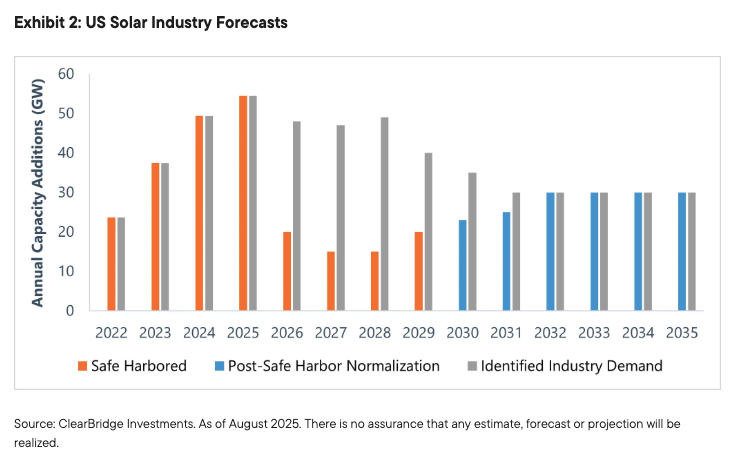
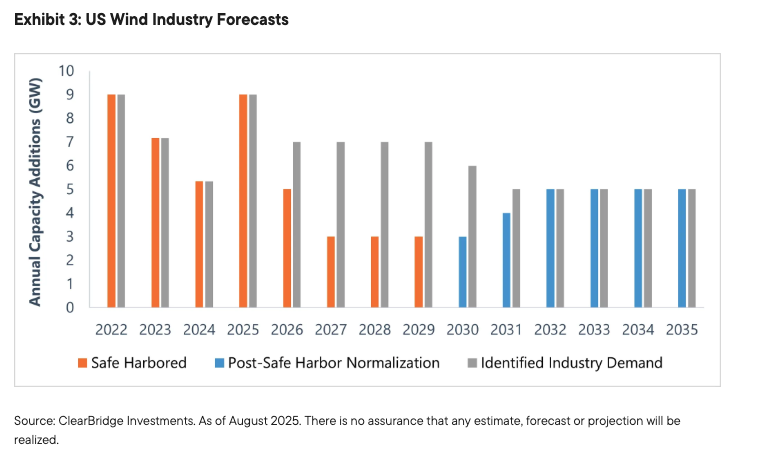
We believe regulated utilities and contracted renewables operators with strong balance sheets and established track records are well-positioned to navigate the changes from the OBBB. Changes to the IRA may moderate some growth for these companies, for example, but there are reasonable offsets (Exhibits 2 and 3). Some companies have renewables backlogs that are protected under safe harbor provisions, enabling long-term visibility to renewables growth. They may also have repositioned supply chains to mitigate FEOC concerns when the safe-harbor period expires. While executive orders remain a key risk for the industry, long-term industry demand for renewables appears to remain intact.
Europe increases fiscal support for infrastructure
At a 2025 summit, NATO member states agreed to a 2035 target of 5% of gross domestic product (GDP) spending on a broad category of defense and security-related spending. Listed infrastructure is expected to get a substantial boost in spending, potentially €2 trillion of new investment over the next 10–15 years, driven by the need for infrastructure resiliency to support defense and security in Europe. In particular, opportunities include resilient power supply for military and strategic facilities as well as strategic transport links including rail, airports, roads and ports.
At the same time, Germany has approved a €500 billion investment fund over a 12-year period to revitalize the country’s infrastructure.1 The fund is designed to accelerate the energy transition and support long-term economic growth as well as address decades of underinvestment in critical sectors like transportation, utilities and energy.
The main implications of the German fiscal stimulus for listed infrastructure are:
A greater potential to attract private investment into a wide range of infrastructure projects (as projects attract private capital to co-invest alongside public funds).
Potential knock-on effects across the European Union could further boost infrastructure spending elsewhere on the continent via the need for energy interconnectors and transport corridors.
Conclusions
Increasing role of private capital: While policies differ by region, one common thread is a greater reliance on private capital and infrastructure operators with proven execution capability. Corporate balance sheets and institutional investors are becoming the main funding source for infrastructure. We are also seeing the first steps to add households to the private sector funding pool, as evidenced by US President Trump’s executive order in August 2025 that would loosen decades-old rules for US 401(k)s to allow private equity investment, including “direct and indirect interests in projects financing infrastructure development.”2
Asset bases in regulated and contracted markets are expanding rapidly, helped also by AI growth. In addition to fiscal stimulus to support infrastructure spending in Europe, rapid technological advancements, particularly in AI and cloud computing, are driving explosive growth in capital expenditures globally. A single hyperscale data center can consume as much electricity as 80,000 homes—running 24/7, its power draw rivals that of a small city. AI and digital transformation are fueling an unprecedented surge in data center electricity demand globally, reshaping the utility sector and infrastructure investment landscape and requiring massive capital deployment to expand and modernize grids, build new generation capacity and integrate emerging technologies. A decade ago, a high-growth utility was growing its asset base (and earnings, cash flows and dividends) at 4%–5% per year. Today, that’s more like 8%–10%. By the early 2030s that could be in the 12%–15% range and will likely need to stay there for a decade.3 We believe listed utilities and infrastructure players could benefit significantly, provided they can navigate regulatory complexities and evolving customer dynamics effectively.
Greater policy stability creates greater visibility on returns, particularly for renewables.
As current policy shifts settle, we believe the winners will be companies with the financial strength, operational capability and the strategic foresight to move ahead of the policy curve—whether in the United States, Europe or elsewhere.
Endnotes
1.Source: Clean Energy Wire. As of March 21, 2025.
2. “Democratizing Access to Alternative Assets For 401(K) Investors,” White House Executive Order, August 7, 2025.
3. Source: S&P Global. As of April 3, 2025.
DEFINITIONS
The Inflation Reduction Act of 2022 was a United States federal law which aimed to reduce the federal government budget deficit, lower prescription drug prices, and invest in domestic energy production while promoting clean energy.
The One Big Beautiful Bill Act, or the Big Beautiful Bill, is a US federal statute passed by the 119th United States Congress containing tax and spending policies that form the core of President Donald Trump's second-term agenda. The bill was signed into law by President Trump on July 4, 2025.
A Foreign Entity of Concern (FEOC) is a foreign entity subject to the jurisdiction, direction, ownership, or control of governments of "covered nations” that faces restrictions under United States laws, such as the Inflation Reduction Act (IRA) and the CHIPS and Science Act.
A 401(k) is an employer-sponsored, tax-advantaged retirement savings plan in the United States, allowing employees to contribute pre-tax or after-tax income into an investment account.
A message from Advisor Perspectives and VettaFi: Discover something new! Click here to register for our upcoming webcasts.
WHAT ARE THE RISKS?
All investments involve risks, including possible loss of principal. Please note that an investor cannot invest directly in an index. Unmanaged index returns do not reflect any fees, expenses or sales charges. Past performance is no guarantee of future results.
Equity securities are subject to price fluctuation and possible loss of principal.
International investments are subject to special risks including currency fluctuations, social, economic and political uncertainties, which could increase volatility. These risks are magnified in emerging markets.
Commodities and currencies contain heightened risk that include market, political, regulatory, and natural conditions and may not be suitable for all investors.
Diversification does not guarantee a profit or protect against a loss. Dividends may fluctuate and are not guaranteed, and a company may reduce or eliminate its dividend at any time.
Companies in the infrastructure industry may be subject to a variety of factors, including high interest costs, high degrees of leverage, effects of economic slowdowns, increased competition, and impact resulting from government and regulatory policies and practices.
Investment strategies which incorporate the identification of thematic investment opportunities, and their performance, may be negatively impacted if the investment manager does not correctly identify such opportunities or if the theme develops in an unexpected manner. Focusing investments in information technology (IT) and technology-related industries carries much greater risks of adverse developments and price movements in such industries than a strategy that invests in a wider variety of industries.
WF: 6734608
IMPORTANT LEGAL INFORMATION
This material is intended to be of general interest only and should not be construed as individual investment advice or a recommendation or solicitation to buy, sell or hold any security or to adopt any investment strategy. It does not constitute legal or tax advice. This material may not be reproduced, distributed or published without prior written permission from Franklin Templeton.
The views expressed are those of the investment manager and the comments, opinions and analyses are rendered as at publication date and may change without notice. The underlying assumptions and these views are subject to change based on market and other conditions and may differ from other portfolio managers or of the firm as a whole. The information provided in this material is not intended as a complete analysis of every material fact regarding any country, region or market. There is no assurance that any prediction, projection or forecast on the economy, stock market, bond market or the economic trends of the markets will be realized. The value of investments and the income from them can go down as well as up and you may not get back the full amount that you invested. Past performance is not necessarily indicative nor a guarantee of future performance. All investments involve risks, including possible loss of principal.
Any research and analysis contained in this material has been procured by Franklin Templeton for its own purposes and may be acted upon in that connection and, as such, is provided to you incidentally. Data from third party sources may have been used in the preparation of this material and Franklin Templeton ("FT") has not independently verified, validated or audited such data. Although information has been obtained from sources that Franklin Templeton believes to be reliable, no guarantee can be given as to its accuracy and such information may be incomplete or condensed and may be subject to change at any time without notice. The mention of any individual securities should neither constitute nor be construed as a recommendation to purchase, hold or sell any securities, and the information provided regarding such individual securities (if any) is not a sufficient basis upon which to make an investment decision. FT accepts no liability whatsoever for any loss arising from use of this information and reliance upon the comments, opinions and analyses in the material is at the sole discretion of the user.
Franklin Templeton has environmental, social and governance (ESG) capabilities; however, not all strategies or products for a strategy consider “ESG” as part of their investment process.
Products, services and information may not be available in all jurisdictions and are offered outside the U.S. by other FT affiliates and/or their distributors as local laws and regulation permits. Please consult your own financial professional or Franklin Templeton institutional contact for further information on availability of products and services in your jurisdiction.
Issued in the U.S. by Franklin Templeton, One Franklin Parkway, San Mateo, California 94403-1906, (800) DIAL BEN/342-5236, franklintempleton.com. Investments are not FDIC insured; may lose value; and are not bank guaranteed.