As regional misalignments risk significant performance deviations amid trade uncertainty, let’s look at how overlay management can potentially help to guide global equity portfolios.
While many tariff deals have now been struck, a recent ruling by the US Court of Appeals for the Federal Circuit puts the longevity of these agreements into question. Whether tariffs remain in place, or are revoked or implemented in another form, the ultimate impact to the global economy is still uncertain. This reshaping of global trade policy may affect individual economies unevenly. We believe that illuminates the importance of managing risks in investors’ asset allocations.
Overlay programs can help to monitor global exposures, aim to fill in necessary gaps through portfolio completion and ultimately seek to mitigate unintended risks.
Take, for example, a global equity portfolio that is benchmarked to the MSCI All Country World Index (ACWI). Some investors may simply choose to fill this allocation using managers benchmarked to MSCI ACWI, while others might further subdivide their managers into regional exposures: US, international developed and emerging markets. Investors who choose the second approach are likely to need more prudent monitoring across these suballocations. These regional allocations may be historically correlated over the long term, but they can experience wildly different returns in discrete periods.
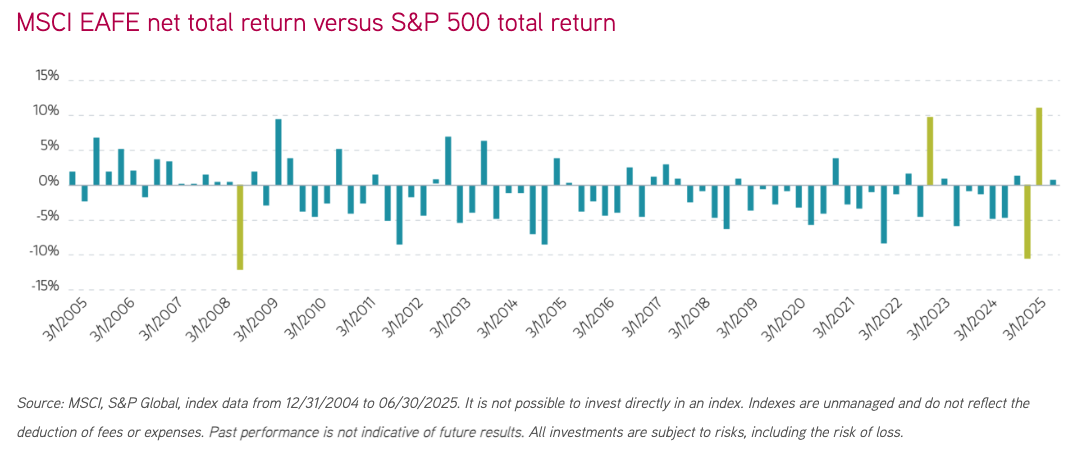
Isolating an example of the S&P 500® Index relative to the MSCI EAFE Index, let’s consider the quarterly performance differential over the past 20 years, with events in the 95th percentile highlighted in green.

In the fourth quarter of 2024 and the first quarter of 2025, the market experienced two 95th percentile events happening back-to-back, when uncertainty surrounding tariffs early this year offset a period of significant US outperformance relative to international developed markets late last year. Such an unlikely occurrence vividly illustrates the potential impact that regionally misaligned portfolios can have.
Although the overall global equity allocation may be on target, small discrepancies within regional allocations may leave the portfolio susceptible to significant tracking error relative to the benchmark.
In a world where the performance differentials can be +/-10% in a given quarter, seemingly small differences in allocation can matter a lot, and investors can’t afford to take unintended bets. To avoid these inadvertent risks and performance gaps, we think it’s imperative for investors to monitor their allocations.
This is where overlay programs come in. Commonly, overlay programs are used between or inter asset classes—for example, rebalancing between equities and fixed income. A more tailored use of overlay programs focuses on more granular allocations within or intra asset classes, aiming to control for risks such as regional misalignments. By analyzing global equity holdings at this level, an overlay manager can help to identify and create solutions for unintentional portfolio tilts in specific asset classes.
The bottom line
Customized overlay solutions like managing regional equity allocations may help to maintain a portfolio’s desired risk and return characteristics and reduce the potential risks presented by uncertain market environments.
The views expressed in these posts are those of the authors and are current only through the date stated. These views are subject to change at any time based upon market or other conditions, and Parametric and its affiliates disclaim any responsibility to update such views. These views may not be relied upon as investment advice and, because investment decisions for Parametric are based on many factors, may not be relied upon as an indication of trading intent on behalf of any Parametric strategy. The discussion herein is general in nature and is provided for informational purposes only. There is no guarantee as to its accuracy or completeness. Past performance is no guarantee of future results. All investments are subject to the risk of loss. Prospective investors should consult with a tax or legal advisor before making any investment decision. Please refer to the Disclosure page on our website for important information about investments and risks.
A message from Advisor Perspectives and VettaFi: Discover something new! Click here to register for our upcoming webcasts.
© Parametric
Read more commentaries by Parametric