Last week’s Fed meeting resulted in a much-anticipated interest rate reduction of 25 bps, to a range of 4 percent to 4.25 percent. This move followed a nine-month pause in its rate-cutting cycle, which began a year ago. Historically, equity markets have responded favorably to rate cuts after a pause of six months or more. But it’s been a while since we last saw this pattern. The Fed has not resumed a reduction cycle after a lag of that duration since July 2003. Markets have changed a lot since then.
We have long thought the Fed would be the key focus of investors between now and the end of the year. So, let’s see what the Fed is looking at and where it is likely to go from here.
Fed Focus Is on the Labor Market
The Fed has a dual mandate focused on employment and inflation. Currently, there is weakness in job growth at a time when inflation has been ticking up, mainly due to the impact of tariffs. But as highlighted in Chairman Jerome Powell’s speech at Jackson Hole at the end of August, the Fed is now clearly focused on the labor market.
In his post-meeting press conference, Powell commented that this cut was designed to keep the labor market from softening further. This approach is similar to what the Fed did last year, cutting rates in September and December by a combined 75 bps when job growth began to slow.
The inflation picture is different than it was a year ago. So far, however, the Fed has seen less of an impact from tariffs on prices than it anticipated, as companies don’t appear to be passing on the full amount to consumers. This should lead to a more muted inflation picture and allow the Fed to continue to focus on the labor market as needed.
More Rate Cuts Ahead?
Going into Wednesday’s meeting, there was some potential that the Fed might not be aligned on its view of the economic backdrop and what it meant given opinions on both sides of the rate cut debate. Still, the final decision had broad support. Newly confirmed Governor Stephen Miran dissented in favor of a 50 bp reduction. But the rest of the voting members supported the decision, including Governors Waller and Bowman, who had dissented in July in favor of cutting rates at that point.
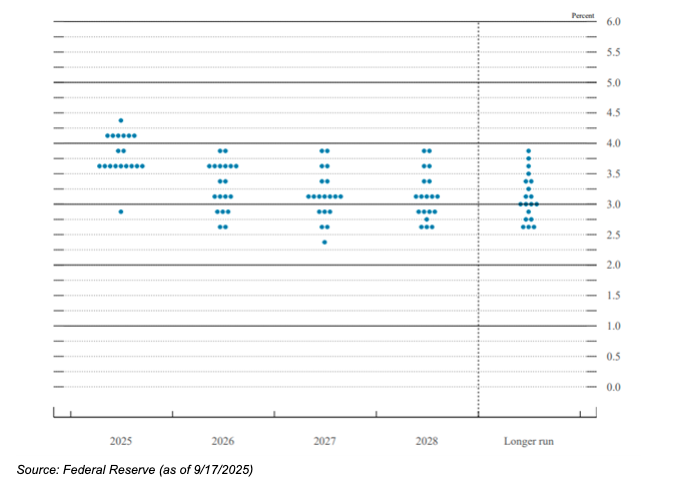
Although there seemed to be a consensus on Wednesday’s decision, that might not be true as we look ahead. As seen in the updated dot plot illustrating each individual’s view of where rates are headed, other than the outlier, there is a fairly even split on the committee about the need for further rate cuts between now and the end of the year.
FOMC Participants’ Assessments of Appropriate Monetary Policy: Midpoint of Target Range or Target Level for the Federal Funds Rate

Chairman Powell’s comments about the labor market can certainly be seen as dovish for the future path of interest rates; however, he did address the lack of consensus seen in the members’ projections by saying that it is “not incredibly obvious what to do next.”
Do Markets Agree?
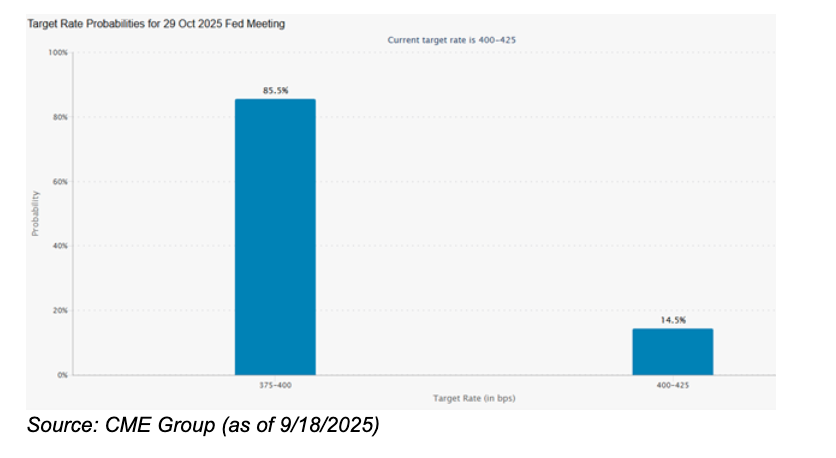
The chairman wouldn’t commit the Fed to a path forward on rates, and the updated dot plot indicates that further decisions could garner more debate. Despite that, the market quickly concluded the Fed will reduce interest rates at both the October and December meetings—and they don’t think the October meeting will be particularly controversial.
According to market participants, the chance the Fed will cut rates at its October meeting is roughly 85 percent. We also believe that another 25 bp rate reduction is the likely outcome of the October meeting. There is only one update to the employment outlook between now and then, which will come on October 3. We don’t think that report will change the overall picture of a slowing jobs market, and the Fed will want to make sure it doesn’t continue to deteriorate by easing further.
What Does It Mean for the Markets?
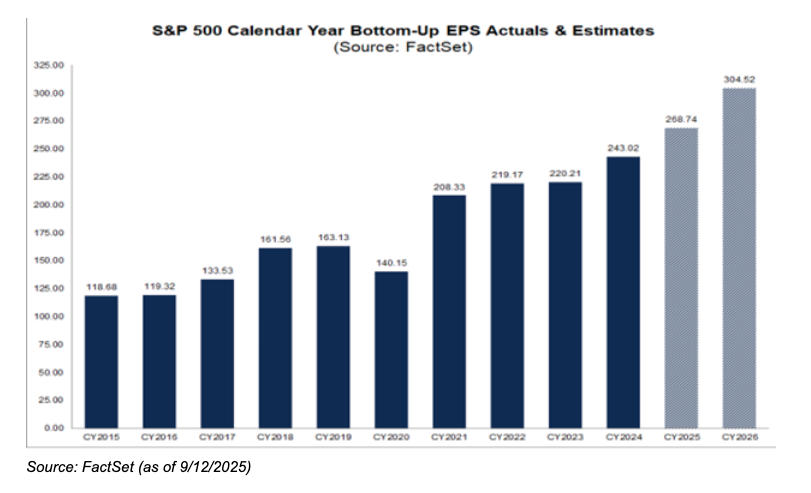
There are two main drivers of stock market valuations: interest rates and corporate earnings. Interest rates are moving lower. Corporate earnings expectations have been moving higher.
While we can certainly experience volatility in the short term (we saw that during the post-meeting press conference), this combination should be supportive of equity markets as we move through the end of the year. We continue to believe that the market should experience more breadth as rates move lower. Given that, our view continues to be that diversification across asset classes is the best approach to portfolio construction.
A message from Advisor Perspectives and VettaFi: Discover something new! Click here to register for our upcoming webcasts.
Disclosure
The information on this website is intended for informational/educational purposes only and should not be construed as investment advice, a solicitation, or a recommendation to buy or sell any security or investment product. Please contact your financial professional for more information specific to your situation.
Certain sections of this commentary contain forward-looking statements that are based on our reasonable expectations, estimates, projections, and assumptions. Forward-looking statements are not guarantees of future performance and involve certain risks and uncertainties, which are difficult to predict. Past performance is not indicative of future results. Diversification does not assure a profit or protect against loss in declining markets.
The S&P 500 Index is a broad-based measurement of changes in stock market conditions based on the average performance of 500 widely held common stocks. All indices are unmanaged and investors cannot invest directly in an index.
The MSCI EAFE (Europe, Australia, Far East) Index is a free float‐adjusted market capitalization index that is designed to measure the equity market performance of developed markets, excluding the U.S. and Canada. The MSCI EAFE Index consists of 21 developed market country indices.
One basis point (bp) is equal to 1/100th of 1 percent, or 0.01 percent.
The VIX (CBOE Volatility Index) measures the market’s expectation of 30-day volatility across a wide range of S&P 500 options.
The forward price-to-earnings (P/E) ratio divides the current share price of the index by its estimated future earnings.
Third-party links are provided to you as a courtesy. We make no representation as to the completeness or accuracy of information provided on these websites. Information on such sites, including third-party links contained within, should not be construed as an endorsement or adoption by Commonwealth of any kind. You should consult with a financial advisor regarding your specific situation.
Member FINRA, SIPC
Please review our Terms of Use.
Commonwealth Financial Network®
© Commonwealth Financial Network
Read more commentaries by Commonwealth Financial Network