The Federal Reserve (Fed) has reverted to type. For a few months, it agonized over the tension between the two sides of its dual mandate of maximum employment and price stability, with the feared stagflation risk now a possibility. Tariffs pose an upside risk to inflation and a downside risk to growth, and we’ve been seeing evidence that both are beginning to feed through.
It didn’t take that long for the Fed to decide which objective should take precedence: employment. That’s always been the case, and that’s why generations of financial investors have grown up with the “Fed put” (the idea the Fed will step in whenever growth slows or financial markets weaken) in the back of their minds—when not top of mind.
This time though, dare I say it…this time it’s different.
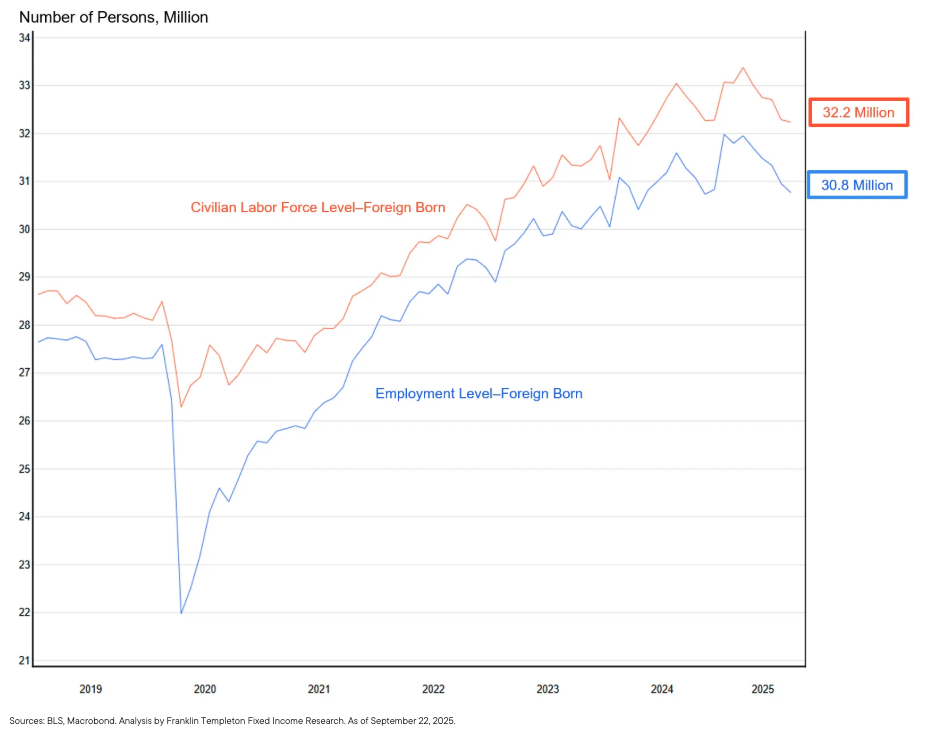
Let me take one step back. The Fed’s job is especially hard this time around. The US economy faces at least two major shocks. First, tariffs of a magnitude, breadth and uncertainty that we have not seen in decades. Second, a drastic sudden tightening in immigration policy after years of extremely permissive border controls.
Growth in Foreign-Born Labor Supply and Employment Peaked in March, but Down 1.2 Million Since Then
2019–2025

My working assumption on tariffs—and the Fed seems to agree—is that they will cause a moderate one-off burst of inflation, possibly in the order of around 1-1.5 percentage points, and that they will act largely as a tax on US consumers. I have also maintained that the overall impact should be limited because imports make up a relatively small share of the US economy (14%), and, so far, the resilience of the US economy sems to bear that out.1
However, there is significant uncertainty on how US businesses might be hurt through complex supply chain effects, and a material risk that the inflation shock will be prolonged and magnified by second round effects.
In turn, the squeeze of immigration makes it hard to understand what’s happening to the labor market, especially when factoring in the much-worsened quality of labor market data, routinely subject to major revisions.
Against this background, the awkward reality is that the labor market is still in line with the Fed’s target, whereas inflation is not even close, and shows no signs of getting there. At 4.3%, unemployment is still within the Fed’s estimated full-employment range; inflation instead has been stuck at 3% for over a year.
On the other hand, to be fair to the Fed, unemployment has been drifting up, whereas inflation has remained stable. Given low hiring rates, this is a cause for concern, and the Fed now judges that risks to employment outweigh risks to inflation. It has delivered the first rate cut this year and indicated more cuts are likely.
So far so normal, but there are a few things that this time are different and that financial investors should keep in mind.
First, after the inflation disaster of 2021-2023, people are at least as worried about inflation as they are about employment. This was clear even in the tone of the Q&A at last week’s Fed press conference; the concern that persistent inflation will keep eroding purchasing power, especially for lower-income households, is palpable. This is very different from the past 20 years, when inflation did not enter people’s mind that much.
Second, the high uncertainty is genuine uncertainty. You can see it in the Fed’s widely scattered economic projections known as the “dots,” which show the Federal Open Market Committee is deeply divided on where policy should go next. Some voting members think many more rate cuts will be needed, others think one more would suffice and one member thinks the Fed has already done enough.
Third, while inflation might not get a permanent lift from tariffs, in my view, it is extremely unlikely to come back to target for the foreseeable future. The US economy continues to show resilience: retail sales surprised to the upside in August with an upward revision for July; and the Philadelphia business confidence index rebounded. Fiscal policy remains supportive, with a budget deficit likely to remain above 6% and new tax cuts likely to start boosting purchasing power early next year. Add looser monetary policy to the mix, and the end result does not in any way resemble a disinflationary environment.
And there is one more important point, one that seems to be strangely absent from the “balance of risks” discussion on monetary policy. As the Fed has also noted, recent policy shifts result in twin adverse supply shocks: immigration shrinks the supply of labor, and trade disruptions hinder the production side of the economy. But if supply is held back by these shocks, any excess stimulus from an already-loose fiscal policy and a relaxation of monetary policy could rapidly result in higher inflation. In other words, the risk that cutting rates too deeply will fuel inflation is much higher today than it was last year.
Which brings me to the market reaction.
Against this very uncertain background, one thing I can say with high confidence is that the Fed is unlikely to hike rates at this stage. Therefore, keeping cash parked in money market funds seems even less attractive, and I think it’s time to consider putting that money to work in fixed income markets.
I do not view being long duration as compelling at current levels, and would instead focus on shorter duration segments of the fixed income market. Investors are widely anticipating deep rate cuts, beyond what I think is realistic, or indeed what the Fed signaled with its dots and its rhetoric. And equity markets do not show any concern about a weaker growth outlook: valuations are up not just for technology stocks, but also for the small-cap stocks, which tend to be much more sensitive to the economic cycle. Tight spreads on riskier fixed income assets signal a similar lack of concern for weaker growth. If a recession is not in the cards, how low can policy rates really go, especially when inflation is unlikely to fall below 3% for the foreseeable future?
I also think that the reduced US Treasury volatility of the past several weeks is unlikely to continue. As we move into the first quarter of 2026, a new wave of tax stimulus from the “Big Beautiful Bill” will likely make for a brighter growth outlook, compounding already very easy financial conditions. In my view, this should more than counter the recent bearish signals from the labor market. Together with persistent uncertainty on tariffs, I believe this should cause volatility to rise again, challenging the current market expectations of deep rate cuts.
Overall, I do think it’s a good time to consider putting cash to work in the shorter duration segments of the market, despite the tightness of spreads and the prospective rise in volatility.
Endnote
1Source: Federal Reserve Bank of St. Louis, US Bureau of Economic Analysis. As of January 30, 2025.
A message from Advisor Perspectives and VettaFi: Discover something new! Click here to register for our upcoming webcasts.
WHAT ARE THE RISKS?
All investments involve risks, including possible loss of principal.
Fixed income securities involve interest rate, credit, inflation and reinvestment risks, and possible loss of principal. As interest rates rise, the value of fixed income securities falls.
Equity securities are subject to price fluctuation and possible loss of principal.
Small- and mid-cap stocks involve greater risks and volatility than large-cap stocks.
There is no assurance that any estimate, forecast or projection will be realized.