Advisors already have a migraine-inducing market environment to navigate with inflation, tariffs, rate cuts, and geopolitical risks. At the same time, advisors deal with the growing pains of scaling their businesses — a common ailment among the advisor community. Thankfully, MassMutual Head of Practice Management Kenton Shirk joined TMX VettaFi Head of Research Todd Rosenbluth to address and offer ways to alleviate these growing pains via practice management in a webinar: Scaling Challenges for Your Practice and How to Solve Them.
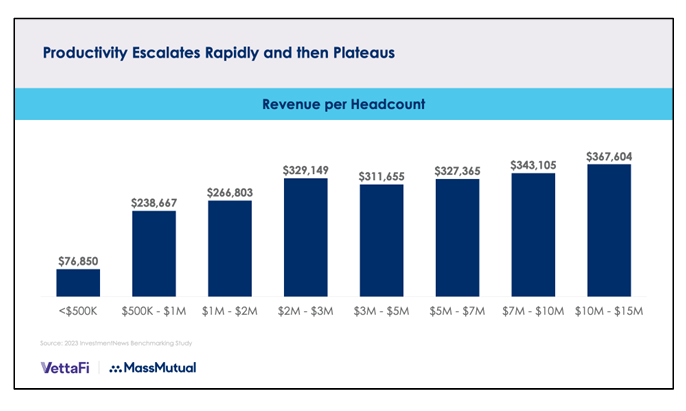
The beginning journey of an advisor business (or any entrepreneurial endeavor) can be a lonely undertaking, particularly if starting out solo. Once advisors start to successfully build their practices, many find that growth comes quickly. However, they may then hit a plateau after attaining higher levels of revenue growth.

"You're starting to see a greater level of complexity in the businesses that advisors are running at these larger sizes," Shirk added. "The types of issues that they're facing: they're nuanced and more complex."
Hitting a plateau often leads them to wonder: How can I continue to grow? This is where practice management comes into play, to break through the proverbial "growth ceiling."
Planning for the Future
As an advisor becomes ensconced in their business practices, it's easy to get tunnel vision amid the daily grind of the present. However, in order to break through the growth barrier, advisors need to think about the future.
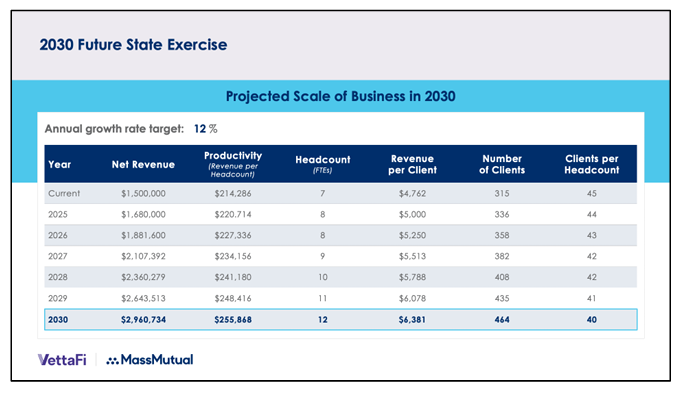
With that, Shirk treated webinar attendants to a financial forecasting exercise that would allow advisors to forecast their future growth within a five-year timeframe. It's much like building a financial model, but less complicated; as Shirk called it, "napkin math." For ease of use, it's downloadable as an Excel sheet replete with calculations in the webinar tools.
Ultimately, the goal-setting exercise answers the question of "Where do I want my business to be five years from today?"
"You're going to have a clear snapshot of what your business is going to look like in 2030, given the financial goals you're setting for the business: growth, productivity, revenue per client, and for the overall scale of the business at that next level," said Shirk.
5 Pillars to Plan for the Next Level
In order to scale an advising business successfully, Shirk offered five pillars for growing to the next level of scale: business structure, financial model, systemization, organization, and growth enablement
1) Business Structure
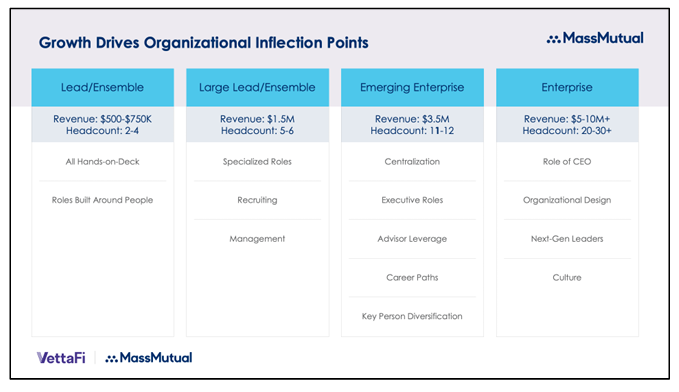
As businesses start to grow, one of the common issues encountered involves the structure of the business and how decisions are made. For example, owners need to know which business model they would like to incorporate: a lead (vertical team with a lead advisor), ensemble (collaborative group), or enterprise (large scale organization).
Businesses can also choose to employ an equity-based business structure where a singular entity exists and all clients are clients of the firm, rather than of individual advisors (via operating agreements or restrictive covenants). This equity-based business allows all members of the firm to be tied to its success.
2) Financial Model
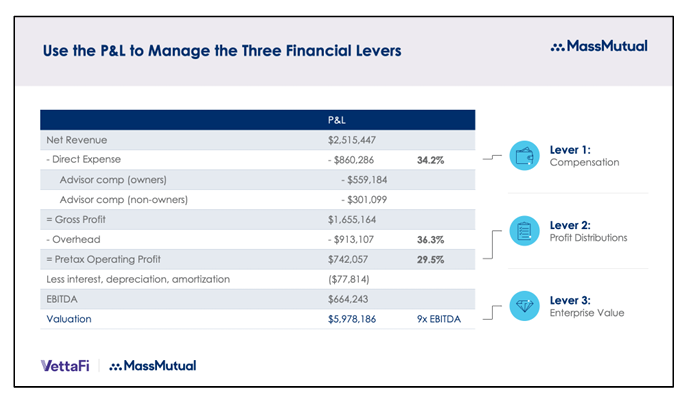
Wealth management firms often use top line revenue as their primary gauge to assess the health of a business. Shirk offered another way: managing proactively to the profit and loss statement. Ultimately, the PNL should be paramount in making business decisions via three financial levers: compensation, profit distributions, and enterprise value.
3) Systemization
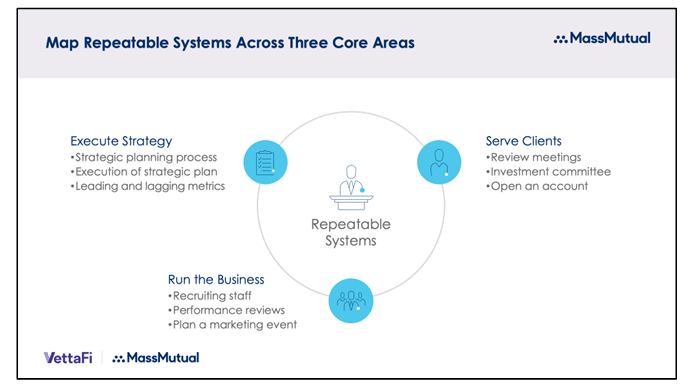
In order to create an advisory that operates with maximum efficiency, systemization (via repeatable systems) is a must. With that, Shirk noted two points of consideration:
- Having a strategic focus: What are advisors prioritizing and what are they going to do or, more importantly, not do? Are business processes aligned with strategic vision?
Furthermore, it's important to map repeatable systems across three specific areas: executing strategy, serving clients, and running the business.
4) Organization
As a wealth management business grows, it tends to have more organizational inflection points to consider for various business models. A common denominator at each of these inflection points is that managing people is paramount to success, even though advisors may not think about that aspect initially.
5) Growth Enablement
Lastly, growth cannot be achieved if the processes are not in place to enable said growth. As advisors grow their businesses in scale, they must think about how the business is growing collectively as opposed to individually. For example, they must view branding as a strategy and not just surface-level elements like a website, logo, or company brochure. Ultimately, day-to-day tactical operations should support the company's overall strategy. That starts with a mindset shift to get to the next level of growth.
"Remember, what got you here won't get you there," Shirk said.
There was a lot of information to unpack, but the webinar is available on demand for viewing.
Learn more: www.massmutual.com/wealth
A message from Advisor Perspectives and VettaFi: To learn more about this and other topics, check out some of our webcasts.
Read more commentaries by VettaFi