Each quarter, we find real-world innovations that run the spectrum from barely prototypes to fully realized products. We do this to capture the full lifecycle of innovation, from invention to commercialization, as each step along the way is equally vital. Sometimes, it can take years for an innovation to reach its full commercial potential. Drone delivery, a high-profile technology that has long been in the public imagination, is an example of this lengthy lifecycle. Right now, for the first time (if you live in Ireland), you can order a coffee from your phone that will be drone-delivered to your backyard in fewer than 15 minutes.
Pollen shows promise as a building material
Materials scientists recently transformed pollen, once called the “diamond of the plant world,” into a flexible building block for sustainable materials like paper, film and sponges.1 The key breakthrough involves reconfiguring the pollen’s rigid outer shell into a jam-like consistency. Future applications range from use as a drug delivery vehicle, to a porous sponge that stems bleeding or absorbs oil spills.
Why it matters:
Although wood is often thought of as a renewable resource, harvesting timber kills the trees, and processing the log into useful products is itself resource intensive—it takes 3.5 gallons of water to make just one page of paper. In contrast, pollen is naturally released from plants and can be harvested from commercial bee hives at low cost. In an increasingly resource-scarce world, pollen could be the sustainable alternative we need.
New artificial intelligence (AI) model simulates entire worlds
Genie 3, a new AI model from Google, can generate a dynamic world from user prompts that the user can then navigate in real time.2 The product displays 24 frames per second and can retain consistency for several minutes at a 720p resolution. Examples on the website show photorealistic worlds, including swimming through the deep sea and climbing a snowy mountain.
Why it matters:
Genie 3 is a milestone in model development because it can create an entire world out of a text prompt, while previous models required explicit 3D representations to be provided in the prompt. While the obvious use case for this technology is for video game graphics, it is also an important steppingstone on the path to artificial generalized intelligence, which refers to a computer with human-like cognition. Later versions of Genie 3 could provide an unlimited curriculum of training worlds for advanced models to learn from.
Drone takeaway deliveries
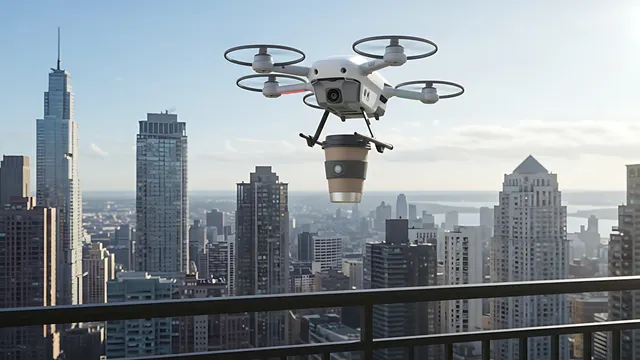
In Dublin, you can now have a cup of coffee delivered by a drone. Orders are picked up by automated drones and flown directly to customers’ locations.
For illustrative purposes only.
Autonomous drones deliver coffee to customers’ backyards
Residents of Dublin, Ireland, can now order a warm beverage to their backyard via autonomous drone.3 After being loaded, the drones rise to 70 feet in the air and fly six minutes, on average, to reach their destination. Once there, the drone lowers a paper bag of warm, unspilled coffee on a biodegradable string. So far, Manna, the drone company responsible for this service, has successfully completed 200,000 flights in and around Dublin.
Why it matters:
Drone technology has been around for a long time, but Manna’s operations in Dublin are the first instance of commercially available drone delivery. This represents a big milestone, with the potential to drive down the cost of delivery dramatically. Each aircraft at Manna completes 80 deliveries a day on average, which is well over double the rate of a human delivery driver. And, because these drones are autonomous, only one drone “pilot” is needed to oversee up to 20 aircraft at once in the case of error.
Power plant in Japan generates electricity by mixing salt and fresh water
Japanese engineers have successfully built the first osmotic power plant, which places freshwater and seawater on either side of a membrane.4 As water flows across the membrane to the saltier side to reach chemical equilibrium, the increasing pressure gradient on one side can be harnessed to produce electricity.
Why it matters:
Because this technology relies only on the mixing of fresh and salt water, the energy flow is steady. This solves the problem of intermittency, a common issue for other renewable energy sources such as wind and solar. The Fukuoka plant will generate 880,000 kilowatt hours of electricity each year, enough to power 220 Japanese households. The challenge will be to continue to scale the technology.
Scientists grow fully functioning human skin
Researchers in Australia have pioneered a new technique to grow human skin in a lab starting with stem cells.5 The resulting skin functions as normal skin would and includes blood vessels, capillaries, hair follicles, multiple layers of tissue, immune cells, pigmentation, appendage patterning, nerves, and even its own blood supply. To achieve this result, researchers placed stem cells into petri dishes and grew them into mini versions of skin, which they called skin organoids.
Why it matters:
The ability to grow human skin provides hope for the 1.8 billion people worldwide with chronic skin conditions.6 Potential use cases include skin grafts, wound healing, and even the study of skin disorders. Further, this artificially grown human skin can be used to study disease without the complexity of clinical trials.
EndNotes
1 Ong, Sandy. “For the Allergy-Ridden, Pollen Can Be a Nuisance. But Scientists Are Using the Powdery Stuff to Make Paper, Sponges and More.” Smithsonian Magazine, August 20, 2025.
2 Google DeepMind. “Genie 3: A New Frontier for World Models.” DeepMind Blog, June 27, 2024.
3 Jolly, Jasper. “‘Amazon Slayer’: The Dublin Minnow Taking On the Giants in Drone Deliveries.” The Guardian, April 11, 2025
4 Ryall, Julian. “Japan Has Opened Its First Osmotic Power Plant – so What Is It and How Does It Work?” The Guardian, August 25, 2025.
5 Attwood, Karen. “Scientists Grow Lab-Made Human Skin with Blood Vessels and Follicles.” Interesting Engineering, September 12, 2024.
6 World Health Organization (WHO). “WHO’s First Global Meeting on Skin NTDs Calls for Greater Efforts to Address Their Burden.” WHO, March 31, 2023.
INVESTMENT POTENTIAL AND RISKS
There are also risks in investing in this or any asset class. The initial potential of any asset class may not carry over to any specific company or the entire asset class chosen for investment, over any investment time period. Any of the investment assumptions may never come to fruition. Investors should be prepared for potential losses as well as the possibility of investment gains. Ideas, products, companies or entire asset classes with positive past performance are not indicative of future results.
WHAT ARE THE RISKS?
All investments involve risks, including possible loss of principal.
Equity securities are subject to price fluctuation and possible loss of principal.
Investments in fast-growing industries like the technology and health care sectors (which have historically been volatile) could result in increased price fluctuation, especially over the short term, due to the rapid pace of product change and development and changes in government regulation of companies emphasizing scientific or technological advancement or regulatory approval for new drugs and medical instruments.
Any companies and/or case studies referenced herein are used solely for illustrative purposes; any investment may or may not be currently held by any portfolio advised by Franklin Templeton. The information provided is not a recommendation or individual investment advice for any particular security, strategy, or investment product and is not an indication of the trading intent of any Franklin Templeton managed portfolio. Past performance does not guarantee future results.
WF: 6768078
A message from Advisor Perspectives and VettaFi: Discover something new! Click here to register for our upcoming webcasts.
IMPORTANT LEGAL INFORMATION
This material is intended to be of general interest only and should not be construed as individual investment advice or a recommendation or solicitation to buy, sell or hold any security or to adopt any investment strategy. It does not constitute legal or tax advice. This material may not be reproduced, distributed or published without prior written permission from Franklin Templeton.
The views expressed are those of the investment manager and the comments, opinions and analyses are rendered as at publication date and may change without notice. The underlying assumptions and these views are subject to change based on market and other conditions and may differ from other portfolio managers or of the firm as a whole. The information provided in this material is not intended as a complete analysis of every material fact regarding any country, region or market. There is no assurance that any prediction, projection or forecast on the economy, stock market, bond market or the economic trends of the markets will be realized. The value of investments and the income from them can go down as well as up and you may not get back the full amount that you invested. Past performance is not necessarily indicative nor a guarantee of future performance. All investments involve risks, including possible loss of principal.
Any research and analysis contained in this material has been procured by Franklin Templeton for its own purposes and may be acted upon in that connection and, as such, is provided to you incidentally. Data from third party sources may have been used in the preparation of this material and Franklin Templeton ("FT") has not independently verified, validated or audited such data. Although information has been obtained from sources that Franklin Templeton believes to be reliable, no guarantee can be given as to its accuracy and such information may be incomplete or condensed and may be subject to change at any time without notice. The mention of any individual securities should neither constitute nor be construed as a recommendation to purchase, hold or sell any securities, and the information provided regarding such individual securities (if any) is not a sufficient basis upon which to make an investment decision. FT accepts no liability whatsoever for any loss arising from use of this information and reliance upon the comments, opinions and analyses in the material is at the sole discretion of the user.
Franklin Templeton has environmental, social and governance (ESG) capabilities; however, not all strategies or products for a strategy consider “ESG” as part of their investment process.
Products, services and information may not be available in all jurisdictions and are offered outside the U.S. by other FT affiliates and/or their distributors as local laws and regulation permits. Please consult your own financial professional or Franklin Templeton institutional contact for further information on availability of products and services in your jurisdiction.
Issued in the U.S. by Franklin Templeton, One Franklin Parkway, San Mateo, California 94403-1906, (800) DIAL BEN/342-5236, franklintempleton.com. Investments are not FDIC insured; may lose value; and are not bank guaranteed.