What a shutdown means
Past government shutdowns paused nonessential activities in various government departments—for example, national parks and museums have closed. Critical federal functions such as the Postal Service, payment of Social Security benefits, and air traffic control staffing generally were not affected. The scope of these pauses can vary across shutdowns, and each government agency within the affected departments and agencies will publish guidance clearly defining the scope of its activities during a shutdown. Federal shutdowns don’t affect state and local government functions that are not dependent on federal funding.
Shutdowns have occurred more than 20 times since 1976. Unlike a U.S. debt default, a shutdown does not affect the government’s ability to pay its obligations, and, as noted, many critical services continue.
Shutdown: A history of mixed results for markets and the economy
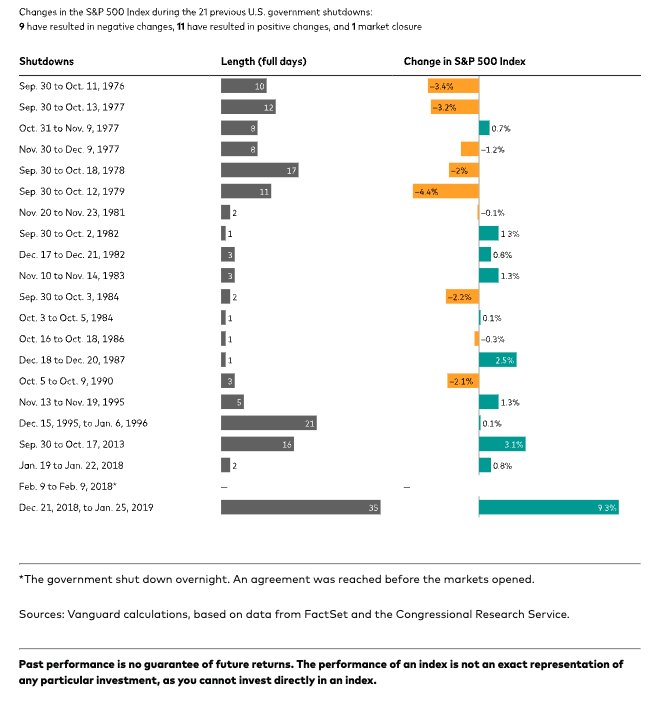
Although there can be market volatility during a shutdown, history reveals no clear relationship between shutdowns and market returns. Markets might experience heightened volatility in response to the uncertainty in Washington. However, markets have historically had mixed reactions to government shutdowns, with equities finishing in positive territory more than half the time (as noted in the accompanying chart). In the seven instances where shutdowns have lasted 10 days or more, the Standard & Poor’s 500 Index fell four times within the shutdown period and rose three times. The worst return, –4.4%, came during a shutdown in 1979.
Government shutdowns

The results are similar for fixed income securities as bond market activity surrounding U.S. government shutdowns since 1976 shows an even split between positive and negative returns for fixed income.1
The economic effects of a shutdown depend largely on its duration. The Congressional Budget Office estimated that the 2018–2019 shutdown, the longest on record, shaved 0.1% off real GDP in the fourth quarter of 2018 and 0.2% in the first quarter of 2019. The shutdown dampened economic activity mainly because of the loss of furloughed federal workers’ contribution to GDP, the delay in federal spending on goods and services, and the reduction in aggregate demand (which then dampened private-sector activity).
Why you should stay focused on long-term results
A government shutdown is only one of many factors, both positive and negative, that affect markets. Too many variables are involved to accurately predict the effects as history shows.
Political divisions in Washington have made the threat of government shutdowns more common in recent years. Although this is not an ideal practice and a prolonged shutdown could have broader short-term market and economic effects, what’s most important is that investors remain disciplined, diversified, and patient during such an event.
1 Vanguard analysis, based on data from Bloomberg.
A message from Advisor Perspectives and VettaFi: Discover something new! Click here to register for our upcoming webcasts.
Notes:
All investing is subject to risk, including the possible loss of principal.
Diversification does not ensure a profit or protect against a loss.
Vanguard funds not held in a brokerage account are held by The Vanguard Group, Inc., and are not protected by SIPC. Brokerage assets are held by Vanguard Brokerage Services, a division of Vanguard Marketing Corporation, member FINRA and SIPC.
For additional financial information on Vanguard Marketing Corporation, see its Statement of Financial Condition: Audited and Unaudited
Broker-Dealer Form Client Relationship Summary (Form CRS) and Investment Advisor Form Client Relationship Summary (Form CRS)
© 1995–2025 The Vanguard Group, Inc. All rights reserved. Vanguard Marketing Corporation, Distributor of the Vanguard Funds. Your use of this site signifies that you accept our terms & conditions of use.
© Vanguard
Read more commentaries by Vanguard