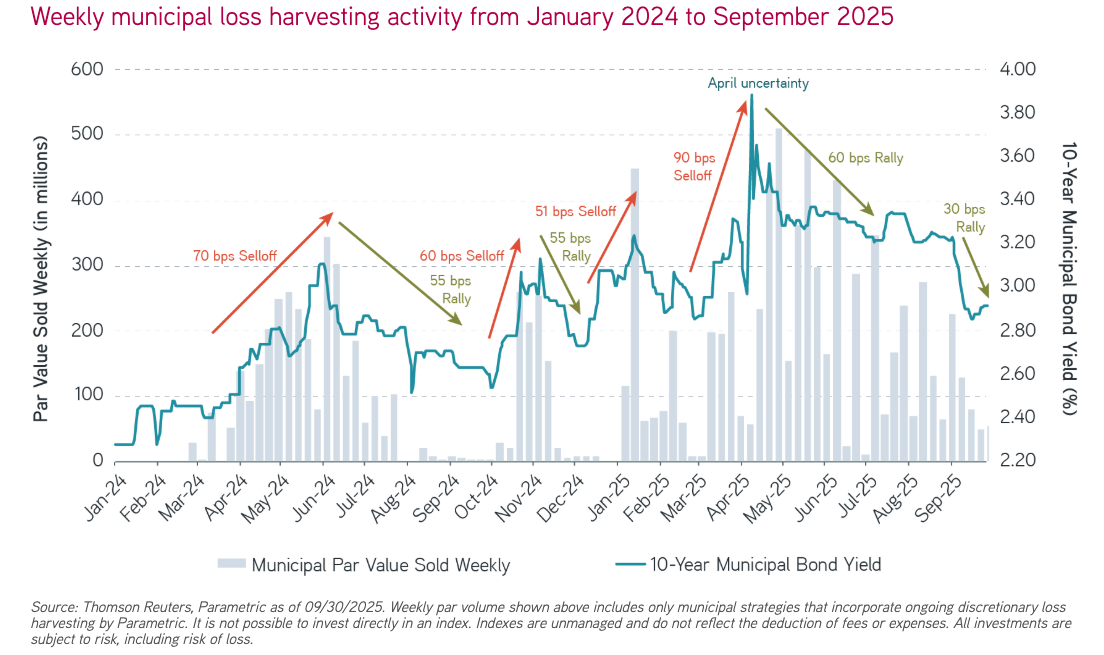
Higher yields earlier in the year opened a window for meaningful tax loss harvesting. Investors who acted captured valuable tax savings, while those who waited saw opportunities diminish as yields retraced lower through the end of the third quarter.
The 10-year US Treasury yield has traced a wide arc this year. After peaking early in the year on strong data and tariff-driven inflation concerns, yields fell during the summer before climbing again as markets recalibrated the outlook for Federal Reserve policy. By September 30, the 10-year yield stood 42 basis points lower, at 4.15%—reflecting shifting expectations for rate cuts, moderating inflation and signs of weakness in the labor market.
Certain areas of fixed income have seen especially compelling opportunities for tax loss harvesting, like the municipal bond market. Elevated issuance—still running well above the five-year average—combined with uneven demand and intermittent mutual fund outflows have weighed on performance. Year to date through September 30, the Bloomberg Municipal Bond Index returned 2.64%, lagging both Bloomberg US Treasury and US Corporate Indexes, which were up 5.36% and 6.88%, respectively.
How can investors take advantage of losses?
Periods of volatility may weigh on portfolio returns, but they also open the door to valuable tax opportunities. A proactive, systematic tax loss harvesting (TLH) strategy can generate realized losses—creating a tax asset that may be able to enhance after-tax returns. These losses can be used to offset gains in the current year or carried forward indefinitely.
Third-party research has shown that tax management can add 1% to 2% in after-tax excess returns—known as tax alpha—for equity and 0.3% for fixed income.1
TLH can be especially beneficial to separately managed accounts (SMAs) that can hold securities directly. Within the fixed income market, interest rate changes and yield curve movements create constant opportunities for tax loss harvesting. Additionally, proceeds from maturing bonds, calls and coupons provide ongoing reinvestment opportunities at prevailing yields—resetting cost basis and book yields higher.
By realizing losses and replacing positions in the market during periods of elevated supply, we’ve already delivered considerable tax benefits.
Year to date through the third quarter of 2025, Parametric sold more than $13 billion in market value to realize $330 million in net losses—delivering a potential tax benefit of more than $119 million for Parametric Fixed Income SMA investors.2
Why harvest fixed income tax losses throughout the year?
A recent Cerulli report highlighted tax management as one of the most valuable priorities in investments for high net worth clients.3 Without a professional manager who can leverage technology and scale to monitor tax losses throughout the year, portfolios may not be reviewed for harvesting trades until late in the calendar.
Yet harvesting losses at that time hasn’t always made sense—especially for fixed income portfolios. When we analyzed Bloomberg monthly yields data from 2001 to 2024, we found that municipal bond and investment grade (IG) corporate bond yields have rarely peaked in December—representing only 8% and 4%, respectively, out of the past 23 years.4
If we compare the 10-year municipal index yield to Parametric’s tax loss harvesting activity within municipal portfolios, we can see that as market yields increased, so did our weekly harvesting activity.

The bottom line
Tax loss harvesting has been a reliable strategy for adding value in various market environments for many years, and it’s not limited to equities. The third quarter has again reminded us why tax awareness has become a critical component of fixed income investing.
This year in particular highlights the risk of delay. With yields substantially lower today than at the start of 2025, many of the most attractive tax loss harvesting opportunities have already passed. Investors who waited for a year-end review may find that the window to realize meaningful losses has narrowed—or closed. For those adopting an “all-weather” approach, systematic TLH continues to be a reliable strategy to enhance after-tax outcomes.
1 Shomesh E. Chaudhuri, Terence C. Burnham, and Andrew W. Lo. 2020. “An Empirical Evaluation of Tax-Loss-Harvesting Alpha.” Financial Analysts Journal 76:3, 99–108, and Andrew Kalotay. 2016. “Tax-Efficient Trading of Municipal Bonds.” Financial Analysts Journal 72:1, 48–57. These studies did not involve Parametric or its clients. There is no guarantee that a tax management strategy will result in increased after-tax returns. Results will differ based on an individual investor’s circumstances.
2 Source: Parametric, 09/30/2025. The information is provided for illustrative purposes only. Values are aggregated across all municipal laddered strategies, managed municipal strategies and municipal total return strategies. Only client positions with unverified cost basis were excluded from calculations. Loss calculation is based on the amortized book price minus the sell price, represents historical information and should not be construed as future results. Loss information illustrates the effect to a portfolio and is not representative of, and should not be construed as, performance. There is no assurance that tax loss harvesting will continue in the future. There is no guarantee that any specific account may engage in tax loss harvesting.
3 Cerulli Associates, Customized at Scale: A Framework for Next-Generation Advisory Platforms, October 2025.
4 Parametric, Boost Bond Potential with Active Management, January 14, 2025.
Parametric and Morgan Stanley do not provide legal, tax, or accounting advice or services. Clients should consult with their own tax or legal advisor prior to entering into any transaction or strategy described herein.
The views expressed in these posts are those of the authors and are current only through the date stated. These views are subject to change at any time based upon market or other conditions, and Parametric and its affiliates disclaim any responsibility to update such views. These views may not be relied upon as investment advice and, because investment decisions for Parametric are based on many factors, may not be relied upon as an indication of trading intent on behalf of any Parametric strategy. The discussion herein is general in nature and is provided for informational purposes only. There is no guarantee as to its accuracy or completeness. Past performance is no guarantee of future results. All investments are subject to the risk of loss. Prospective investors should consult with a tax or legal advisor before making any investment decision. Please refer to the Disclosure page on our website for important information about investments and risks.
10.07.2026 | RO 4874213
A message from Advisor Perspectives and VettaFi: Discover something new! Click here to register for our upcoming webcasts.
© Parametric
Read more commentaries by Parametric