The Strategic Role of Private Equity Secondaries
Membership required
Membership is now required to use this feature. To learn more:
View Membership BenefitsKEY POINTS:
What it is
The Federal Reserve responded to shifting risks by lowering its target range, focusing on employment concerns while monitoring inflation.
Why It Matters
Fed Chair Powell described the current environment as “highly unusual,” with policymakers divided and both sides of the Fed’s dual mandate under pressure.
Where it's going
Powell said decisions will be made “meeting by meeting,” with future rate moves dependent on incoming data and no clear consensus for October.
The private equity secondary market has transformed from a niche outlet for distressed sellers into a central tool for institutional portfolio management. Annual transaction volume (Exhibit 1) in the market reached $160 billion in 2024, a record high, and is on pace to exceed $200 billion in 2025.
The evolution of secondaries reflects more than just market expansion; the role they play in portfolios has also fundamentally shifted. Once seen as a tactical solution to create liquidity in extraordinary circumstances, secondaries now provide a mechanism for institutional investors to rebalance portfolios, maintain pacing commitments, and gain access to proven assets at attractive entry points.
For investors navigating slower distributions and tighter liquidity today, secondaries have become one of the most important levers in the private markets.
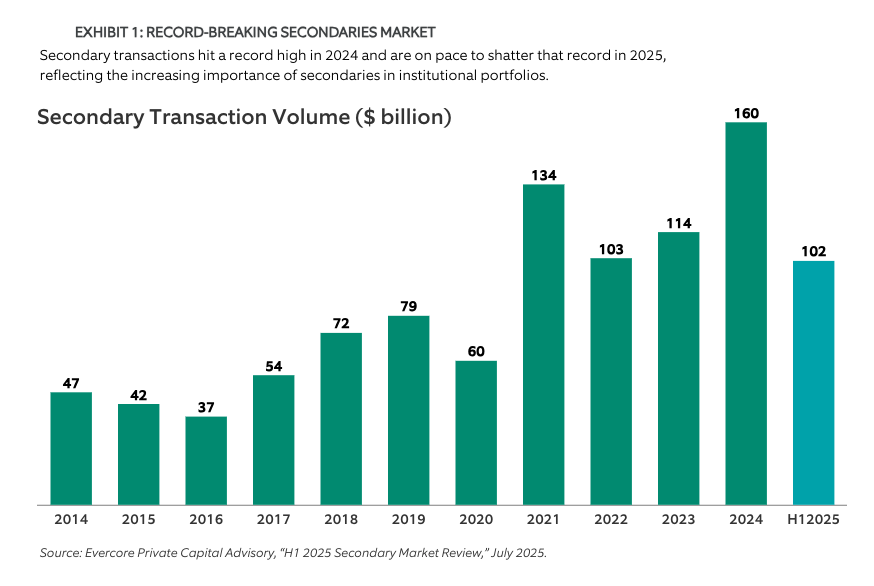
Solving the Liquidity Puzzle
Private equity’s defining feature has always been illiquidity: Investors commit to closed-end funds with 10- to 12-year lives and little flexibility along the way. Secondaries have reshaped this dynamic, giving allocators a way to unlock liquidity and rebalance portfolios without waiting for the traditional exit cycle.
Today, institutional investors use secondaries to manage several recurring challenges:
- Pacing and vintage year diversification: Selling interests in older funds provides liquidity to recommit to new vintages, helping investors maintain programmatic allocation targets. This is particularly relevant during periods of low distributions, such as the current environment in which initial public offerings and acquisition activity has been relatively muted.
- The denominator effect: When public markets decline, stickier private equity allocations often rise above policy targets. Secondaries provide a release valve without requiring a full exit from the asset class.
- Portfolio rebalancing: Allocators may wish to adjust exposures across strategies or geographies. Secondary sales allow them to tilt portfolios without disrupting long-term commitments.
Seller behavior has also evolved. Pensions and endowments often transact due to allocation constraints, while new entrants are increasingly using the market dynamically, rebalancing and optimizing positions much like public equity portfolios.
A Buyer’s Market Where Capital Is Scarce
Even with record secondary volumes, the buy side remains undercapitalized. Global dry powder stood at $171 billion as of the first half 2025, roughly equivalent to one year of secondary deal flow. This imbalance stems from faster deployment and limited distributions in primaries, which leave pensions and endowments with fewer dollars to recycle into secondaries.
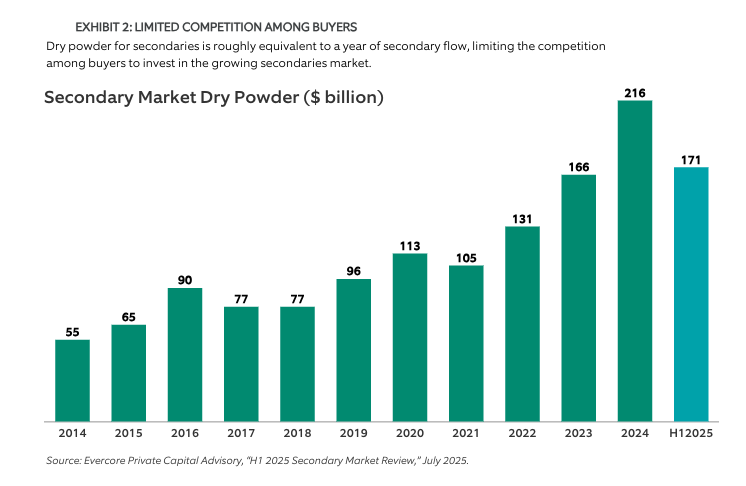
For buyers, this shortfall leads to opportunity. With more sellers than buyers, investors with capital can be selective, focusing on high-quality opportunities at attractive entry points. Lower-quality assets often fail to find bids, while portfolios of top-quartile managers continue to clear the market.
Yet competition is intensifying in some corners of the market. Perpetual retail-oriented funds have driven aggressive bidding in some cases, which narrows discounts and raises concerns of overheating. This bifurcation underscores the importance of disciplined underwriting and differentiated access to relationship-driven investment opportunities.
For allocators, the key takeaway is that while the supply-demand imbalance currently favors buyers, outcomes can vary. Firms with longstanding general partners (GPs) relationships, proprietary information advantages, and the ability to move quickly are best positioned to capture the most attractive opportunities.
GP-Led Continuation Vehicles: Extending Ownership, Unlocking Liquidity
The rise of continuation vehicles (CVs) led by GPs is one of the most important structural shifts in secondaries. From negligible activity before 2019, CVs now account for nearly half of annual secondary deal volume.
CVs allow general partners to transfer one or more portfolio companies into a new vehicle. Existing limited partners can sell for liquidity or roll forward, while new investors may provide fresh capital. For general partners, CVs extend ownership of strong companies in a slow exit environment. For investors, they provide access to high-quality assets with known performance, often underwritten at higher target returns than traditional secondary portfolios.
The market is also evolving. Multi-asset and mid-market CVs are growing, alongside “CV-squared” structures where assets move from one continuation vehicle to another. While innovation broadens access, it raises alignment questions. Investors must ensure sponsors roll meaningful economics and that assets truly merit extended ownership.
For allocators, CVs are no longer a novelty—they are becoming a mainstream tool, potentially even a substitute for traditional buyouts in certain portfolios.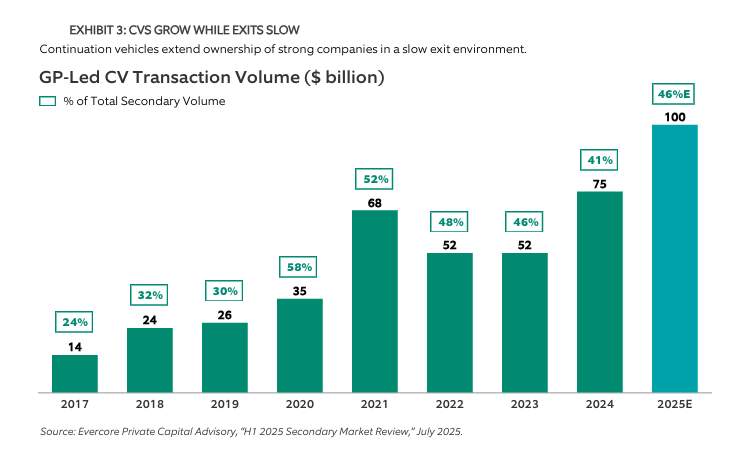
Credit Secondaries: The Next Frontier
Private credit secondaries are following the same early trajectory as private equity secondaries. Volumes have tripled since 2023, from $6 billion to an expected $18 billion in 2025. Turnover (secondary volume as a percentage of total deal volume) remains low, but momentum is strong.
Credit secondaries offer shorter duration, faster cash flows, and generally lower return multiples. They appeal most to investors seeking immediate and diversified exposure to the asset class. Credit secondaries are also particularly well-suited for perpetual fund structures given their attractive cash flow characteristics. Still, credit secondaries remain an adjacent frontier rather than a central driver of the market today.
For investors, credit secondaries represent a promising but still developing tool—one that could become a much larger part of the market in the coming years.
Who Is Buying Secondaries, and Why It Matters
While institutions remain the core buyers of secondaries, the investor base is broadening. Family office activity has increased substantially, reflecting a more sophisticated use of secondaries. They are now both buyers and sellers, using the market dynamically to adjust exposures and manage liquidity rather than transacting solely for cash needs. Retail participation is also rising, largely through evergreen and ‘40 Act structures.
These new entrants introduce challenges. Evergreen funds may struggle to deploy capital during downturns, as retail investors are more likely to redeem than invest in a declining market environment. This could lead to liquidity mismatches between underlying assets and fund structures.
Despite an influx of new participants, competition for deals remains concentrated. We estimate that only about 100 secondary funds are active today globally, and most transactions involve a small handful of approved buyers. Barriers to entry remain high:
- GPs generally must approve secondary transfers.
- Effective underwriting requires longstanding relationships and proprietary data.
- Many top-tier GPs only transact with buyers who also support their primary fundraising.
For allocators, this means the secondary market may be bigger and noisier, but success is still driven by access and specialization.
Secondaries as a Strategic Allocation
The role of secondaries is increasingly defined by two forces: the use of secondaries as a proactive portfolio management tool and the rapid rise of GP-led continuation vehicles. Together, these forces have elevated the secondary market from a niche liquidity tool to a mainstream segment of private equity—one that, in some cases, may deliver returns comparable to traditional buyouts and merit a consistent role in portfolios.
At the same time, the market remains undercapitalized relative to deal flow, favoring disciplined buyers with the relationships and data advantages needed to access the most attractive opportunities. Rising participation from family offices and retail-oriented structures adds new dimensions, but the core of the market continues to be driven by institutions and experienced managers.
As the market continues to evolve, secondaries are poised to remain a vital mechanism for addressing liquidity needs and capturing differentiated opportunities in the private markets.
A message from Advisor Perspectives and VettaFi: Discover something new! Click here to register for our upcoming webcasts.
IMPORTANT INFORMATION
Northern Trust Asset Management (NTAM) is composed of Northern Trust Investments, Inc., Northern Trust Global Investments Limited, Northern Trust Fund Managers (Ireland) Limited, Northern Trust Global Investments Japan, K.K., NT Global Advisors, Inc., 50 South Capital Advisors, LLC, Northern Trust Asset Management Australia Pty Ltd, and investment personnel of The Northern Trust Company of Hong Kong Limited and The Northern Trust Company.
Issued in the United Kingdom by Northern Trust Global Investments Limited, issued in the European Economic Association (“EEA”) by Northern Trust Fund Managers (Ireland) Limited, issued in Australia by Northern Trust Asset Management (Australia) Limited (ACN 648 476 019) which holds an Australian Financial Services Licence (License Number: 529895) and is regulated by the Australian Securities and Investments Commission (ASIC), and issued in Hong Kong by The Northern Trust Company of Hong Kong Limited which is regulated by the Hong Kong Securities and Futures Commission.
For Asia-Pacific (APAC) and Europe, Middle East and Africa (EMEA) markets, this information is directed to institutional, professional and wholesale clients or investors only and should not be relied upon by retail clients or investors. This information may not be edited, altered, revised, paraphrased, or otherwise modified without the prior written permission of NTAM. The information is not intended for distribution or use by any person in any jurisdiction where such distribution would be contrary to local law or regulation. NTAM may have positions in and may effect transactions in the markets, contracts and related investments different than described in this information. This information is obtained from sources believed to be reliable, its accuracy and completeness are not guaranteed, and is subject to change. Information does not constitute a recommendation of any investment strategy, is not intended as investment advice and does not take into account all the circumstances of each investor.
This report is provided for informational purposes only and is not intended to be, and should not be construed as, an offer, solicitation or recommendation with respect to any transaction and should not be treated as legal advice, investment advice or tax advice. Recipients should not rely upon this information as a substitute for obtaining specific legal or tax advice from their own professional legal or tax advisors. References to specific securities and their issuers are for illustrative purposes only and are not intended and should not be interpreted as recommendations to purchase or sell such securities. Indices and trademarks are the property of their respective owners. Information is subject to change based on market or other conditions.
All securities investing and trading activities risk the loss of capital. Each portfolio is subject to substantial risks including market risks, strategy risks, advisor risk, and risks with respect to its investment in other structures. There can be no assurance that any portfolio investment objectives will be achieved, or that any investment will achieve profits or avoid incurring substantial losses. No investment strategy or risk management technique can guarantee returns or eliminate risk in any market environment. Risk controls and models do not promise any level of performance or guarantee against loss of principal. Any discussion of risk management is intended to describe NTAM’s efforts to monitor and manage risk but does not imply low risk.
Past performance is not a guarantee of future results. Performance returns and the principal value of an investment will fluctuate. Performance returns contained herein are subject to revision by NTAM. Comparative indices shown are provided as an indication of the performance of a particular segment of the capital markets and/or alternative strategies in general. Index performance returns do not reflect any management fees, transaction costs or expenses. It is not possible to invest directly in any index. Net performance returns are reduced by investment management fees and other expenses relating to the management of the account. Gross performance returns contained herein include reinvestment of dividends and other earnings, transaction costs, and all fees and expenses other than investment management fees, unless indicated otherwise. For U.S. NTI prospects or clients, please refer to Part 2a of the Form ADV or consult an NTI representative for additional information on fees.
Forward-looking statements and assumptions are NTAM’s current estimates or expectations of future events or future results based upon proprietary research and should not be construed as an estimate or promise of results that a portfolio may achieve. Actual results could differ materially from the results indicated by this information.
Not FDIC insured | May lose value | No bank guarantee
Membership required
Membership is now required to use this feature. To learn more:
View Membership Benefits