It’s early days, but the fourth quarter has brought a change in market leadership at the sector level. Healthcare, one of the year’s big laggards, is now the best performing S&P 500 sector so far in October.
Looking at the Health Care Select Sector SPDR ETF (XLV) vs. the SPDR S&P 500 trust (SPY), healthcare is delivering gains of nearly 4.5% this quarter while the broad benchmark remains largely flat.
The sector is also emerging as the most in-demand S&P 500 sector this quarter. XLV has attracted some $872 million in net new money by Oct. 13, according to our data. That places XLV among top 10 equity ETF asset gatherers this quarter.
That’s not a small accomplishment. In fact, it’s a feat that not only stands in stark contrast to all other S&P 500 sector SPDRs, but also to XLV’s own asset flows tally in 2025. The fund remains net negative year-to-date.
S&P 500 Sectors Seeing Q4 Inflows:
- Health Care Select Sector SPDR (XLV): +$872 million
- Materials Select Sector SPDR (XLB): +$93 million
- Real Estate Select Sector SPDR (XLRE): +$88 million
S&P 500 Sectors Seeing Q4 Outflows:
- Financial Select Sector SPDR (XLF): -$698 million
- Energy Select Sector SPDR (XLE): -$523 million
- Consumer Staples Select Sector SPDR (XLP): -$508 million
- Industrial Select Sector SPDR (XLI): -$271 million
- Utilities Select Sector SPDR (XLU): -$81 million
- Communication Services Select Sector SPDR (XLC): -$78 million
- Technology Select Sector SPDR (XLK): -$66 million
- Consumer Discretionary Select Sector SPDR (XLY): -$42 million
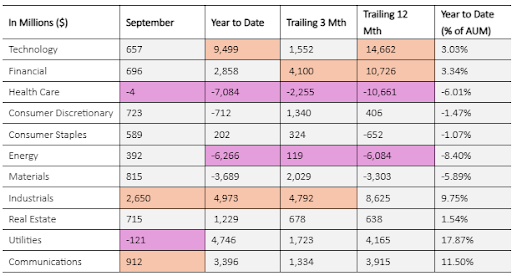
This pick in flows is also significant when we consider how investors had been positioning across sectors this year. The latest State Street commentary on flows through the end of September, authored by Matthew Bartolini, Global Head of Research Strategists, shows that prior to October, healthcare had seen outflows amounting to 6% of its start-of-the-year total assets. The sector had been struggling to capture new money all year.
Sector Flows:

Source: State Street Investment Management
Looking ahead, can this leadership and renewed investor appetite hold? It’s hard to tell. But we are beginning to hear the call for another look at the compelling mix of defensive positioning, growth potential and attractive valuations the healthcare sector is offering.
Healthcare is known as a defensive sector, less vulnerable to cyclical trends given the nature of its must-have-no-matter-what products and services. While regulatory and cost-related pressures have weighed on the sector this year, an ongoing government shutdown, as well as concerns about lofty market valuations and appetite for some portfolio defense have all put healthcare back in focus.
Consider XLV’s key statistics. For example, the portfolio of 60 stocks that represent about 9% of the overall S&P 500 is currently trading at about a 27% discount to the S&P 500. That’s not trivial. What’s more, State Street Investment Management data projects XLV’s 3-5 year earnings growth at 9.3% – a relatively strong number vs. the 12% earnings growth forecast for the S&P 500, which is tech heavy.
This quarter, healthcare performance has benefitted from several factors such as ongoing drug and diagnostic innovation and new FDA approvals; artificial intelligence disruption, especially in healthtech; demographic trends in the form of an aging population that will only need more healthcare; and so on. These are longer-term drivers in a sector that’s known for its stability.
Healthcare at the Stock Level
Some of the biggest healthcare stocks, mostly tied to biotech and pharma, have been delivering quite a punch in October.
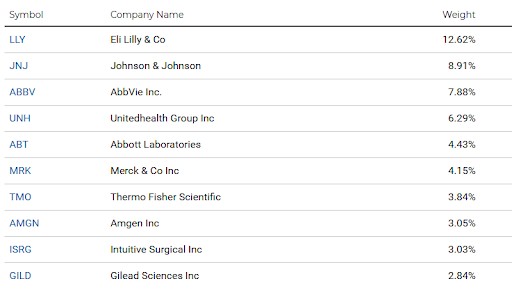
Among XLV’s top 10 holdings, consider that Eli Lilly is up more than 12% in October, rallying on the heels of newly approved diagnostics and stock upgrades. Merck is up 8%. Amgen is up 7.5%. Gilead is up over 5%.
XLV: Top 10 Portfolio Holdings
Source: State Street Data
Healthcare is a massively diverse sector that includes many industries such as pharma, biotech, healthtech, and insurers, among others. And there are ETFs across each category that offer varying degrees of zooming in and zooming out of the opportunity set. XLV, as the largest healthcare ETF with over $36 billion in assets, is a popular catch-all market-cap weighted proxy for the sector, and a good barometer for its performance.
Year-to-date, the fund’s results remain underwhelming, lagging the S&P 500 by some 10 percentage points this year. However, the sector has kicked off Q4 on a strong note, claiming leadership vs. its sector peers, and investors are taking notice.
If macro uncertainty – and a government shutdown – persist, it could that its unique valuation-meets-growth-meets-defense profile continue to find traction into the end of the year.
For the many flavors of healthcare ETFs, check out our Healthcare ETF list.
Originally published on ETF Trends
For more news, information, and analysis, visit VettaFi | ETF Trends,
A message from Advisor Perspectives and VettaFi: Are you backed by institutional quality bond funds? Click here to learn more.
Read more commentaries by VettaFi