Investing Beyond the AI Bubble
Membership required
Membership is now required to use this feature. To learn more:
View Membership BenefitsAs the market concerns itself with a potential artificial intelligence (AI) bubble, there is a clearer and more practical approach that can be taken by investing in companies that could potentially benefit as AI technology progresses. We see AI moving in one direction—one that leads to its costs falling, its speed accelerating, and its growing complexity widening what the technology can do. We believe that the economics of business that are best able to harness AI should improve as the technology scales.
Many still dismiss the AI trend, overlook its compounding gains, and ignore the multiple ways those gains have the potential to shift competitive moats.
Investment Process: Progress, Probabilities, and Patience
Beyond aligning with AI’s progress, two further principles belong in the investment-process drawer.
First, think probabilistically. Investment decisions should resemble branching decision trees, not single-point forecasts, as we discussed earlier in this series. Each AI breakthrough creates multiple future states: on one axis, the march of time; on another, the firm’s competitive position. Shareholders, to invoke Warren Buffett’s instruction to “think like owners,” must ask how every branch reshapes the moat over successive years, not just the next quarter, and compare to the expectations embedded in market valuations.
Second, exploit time arbitrage. As legendary investor Phil Fisher said, “It is easier to know what will happen than when it will happen.”[1] Pinpointing the exact moment AI reshapes an industry is futile; grasping the direction is not. We believe markets routinely underrate long-run technological shifts. The patient investor collects the spread between early insight and eventual consensus. As quarters pass, the odds that reality converges with informed expectation on AI only grow.
In sum, three Ps capture the investment process:
-
Progress. Assume AI’s capability curve keeps steepening and back the firms that gain as costs fall and performance rises.
-
Probabilities. Model outcomes branch by branch and invest where the odds and payoffs skew in your favor.
-
Patience. Profit from the gap between early insights into AI and the market’s slow recognition—focus on if, not when.
Stock-Picking Strikes Back
As our introductory AI Alpha blog noted, AI works on probabilities, and as our second blog noted, AI is a general-purpose technology. We believe in combination, those traits mean AI is no plug-and-play panacea. Its value diffuses unevenly and must be tailored to each task, then knitted tightly to the right complementary assets.
If AI’s imprint escapes you, you are surveying at 10,000 feet while the disruption is playing out at street level.
That makes stock selection indispensable. Our earlier discussion reminds us that managers plot strategy against the grain of their own industry. From a distance everything appears calm; at ground level each firm is fighting a distinct battle, evident to anyone who listens to operators and management commentary. If AI’s imprint escapes you, you are surveying at 10,000 feet while the disruption is playing out at street level.
The blunt, 10,000-foot approach is to buy suppliers of raw compute: silicon is the common dominator beneath every AI workload. Yet the richer, more uneven rewards sit in the specifics of what those workloads actually do and in the complements that surround the chips, which call for firm-by-firm scrutiny. The exercise is harder, but tracking AI’s shifting frontier has the potential to pay by uncovering tomorrow’s champions and helping you sidestep those companies the technology will leave behind, as we noted previously.
Single-Stock Considerations
Where, then, should stock-pickers focus? Here is an indicative (but not exhaustive) set of checks.
Multi-Order Effects
A general-purpose technology reaches full stride only after products, infrastructure, and an ecosystem take shape—a process that unfolds in waves. Expect concentric ripples. First-order change is raw capability—the compute and the models. Second-order change comes from the complements that channel that capability. Further multi-order change follows when those complements reorder incumbents and spawn entirely new markets, producing third- and fourth-order shifts.
Skepticism and hazy understanding about AI’s promise drains the will to think further, leaving those analysts’ research reactive.
Tracing the knock-on effects takes discipline. Many analysts stop at the first round; skepticism and hazy understanding about AI’s promise drains the will to think further, often leaving these analysts’ research reactive.
It is often the second-order complements, such as autonomous vehicles and humanoid robots, that give code a physical face and thus finally persuade the doubters, even though the technical case for adoption is robust, as we explained here. By then, however, prices may have moved. I believe it’s better to begin with the technology’s fundamentals and project ahead: picture those AI applications and machines now and sketch the multi-order shocks those inventions will trigger. Anticipating those ripples is where the alpha lies, in my opinion.
A complete catalogue of exponential knock-on effects is impossible; the table below sketches some of the most salient.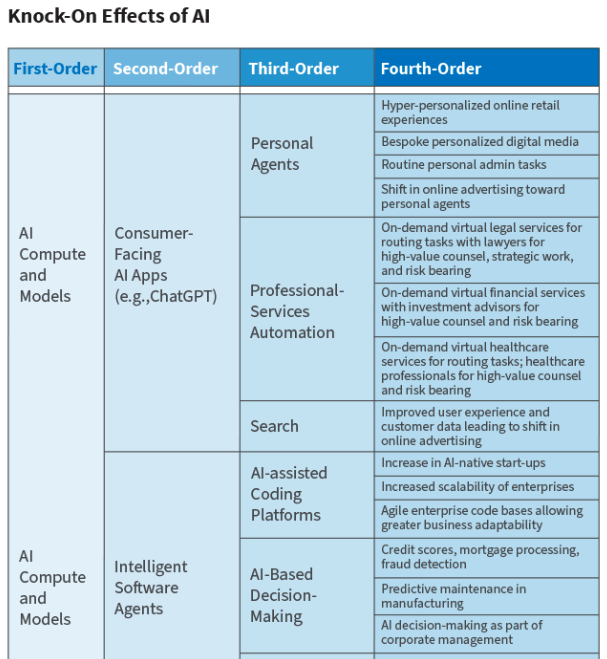
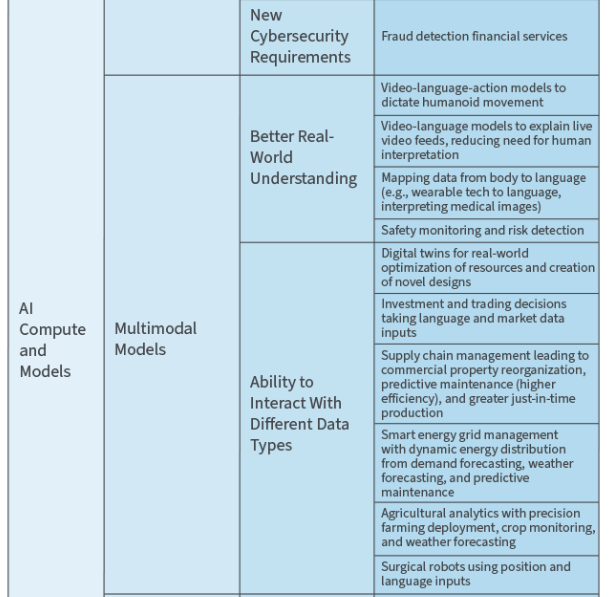
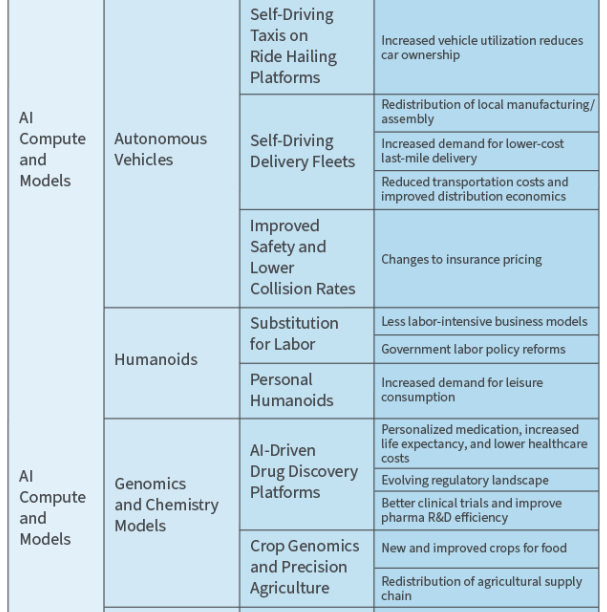
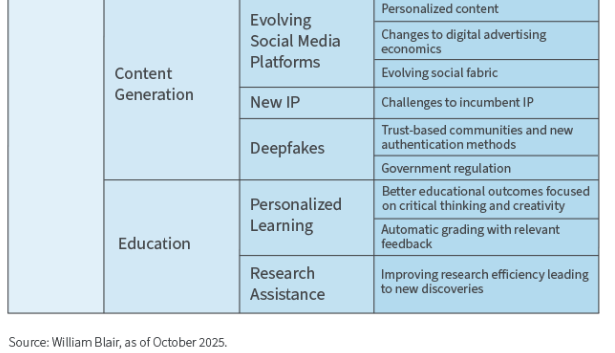
The analysis must run firm by firm, all the way to the ultimate end-market. Sitting upstream in the supply chain offers no refuge if AI’s new profit currents divert cash elsewhere. The challenge deepens because many ripple effects strike both sides of the ledger: a company’s products may be transformed, and so may the inputs it relies on. Gauging how it will compete when inputs and outputs are recast is therefore vital, in my opinion.
Evolving Competitive Frontiers
Every business’s competitive edge is a stone arch: countless blocks press together in silent complexity, yet one keystone converts weight into stability. How the introduction of AI affects the structure is uncertain. Nudge a peripheral block and little shifts; jar the keystone and the arch collapses. This is proof that complexity, whether in a stone arch or competitive moat, conceals nonlinear chokepoints. Whether AI has negligible or seismic effect on a business depends entirely on where it strikes the true source of advantage.
Technological change can deepen a moat, wash it away, or bypass it altogether. Warren Buffett, often caricatured as a technophobe, follows it closely enough to warn that only two newspapers would retain pricing power in the internet era (The Wall Street Journal and The New York Times),[2] yet hailed Amazon for folding web technologies, logistics, and online payments into a formidable new franchise.[3] Deciding the fate that awaits a firm among technological change is work for stock-pickers, not screeners.
That task begins with first principles. AI alters how every firm ingests, parses, and acts on information. One should analyze, therefore, how those new flows reshape the organization’s innards (costs, efficiency, error-rates, product improvement, R&D) and outward stance (customer intimacy, pricing, competition against rivals).
Nor are businesses anchored in the physical world automatically safe. Railroads may not enjoy the same economics when competing against autonomous trucks.
Nor are businesses anchored in the physical world automatically safe. Their competitive arches rest on many blocks: plants, supply chains, warehouse networks, distribution, information networks, and, increasingly, code. Moreover, multi-order effects matter, affecting moats that AI may stretch or shrink. For example, a physical industry such as railroads may not enjoy the same economics when competing against autonomous trucks. Similarly, insuring motor vehicles may appear sheltered until third-order ripples from AI turns drivers into algorithms and pulls premiums down while repair costs for sensor-laden vehicles soar.[4] The industry’s risk pool, underwriting math, and capital needs could all shift, as could existing competitive advantages. Similar questions may arise across logistics, mining, retail, and beyond.
Timing and scale add another layer of fog. First movers may reap data loops; fast followers may dodge early missteps. Precision is elusive, but stock-pickers can earn their keep by tracing these firm-by-firm dynamics. Are the moats widening or narrowing as the technology marches on? Is management using AI to buttress the keystone or is the stone starting to crack?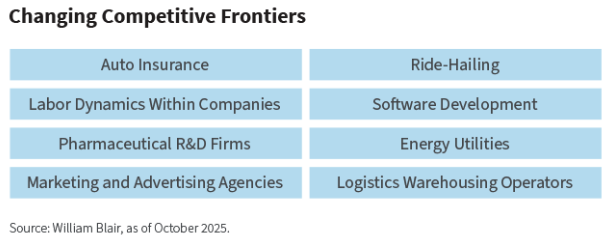
Incumbents vs. Disruptors, Old vs. New Ecosystems
As AI pushes out the competitive frontier, investors face the perennial choice: back the incumbents or side with the insurgents. Clay Christensen’s The Innovator’s Dilemma ponders the decision.[5]
Outcomes are rarely binary. Old and new technologies habitually overlap—diesel engines still haul cargo even as batteries power cars; streaming thrives without killing the cinema; and mainframes still hum beside cloud servers. Expect a spectrum: Some firms may disappear, others shrink, a few grow larger. Japanese quartz moved the technological frontier to silicon and humbled many Swiss watchmakers, yet the stone-arch of advantage held for the likes of Patek Philippe and Rolex. When quartz turned accuracy into a commodity, the competitive frontier leapt to what remained scarce—hand-crafted artistry and the quiet prestige it signals.
In markets, I believe what happens at the margins and what is priced in matters most. The incremental shareholder value may migrate to an AI-native ecosystem at the expense of today’s infrastructure, even if it doesn’t get disrupted entirely—an asymmetry seen in every major technological shift. Equally, a misunderstanding of AI and mispricing of incumbent competitive advantages will likely provide alpha opportunities too.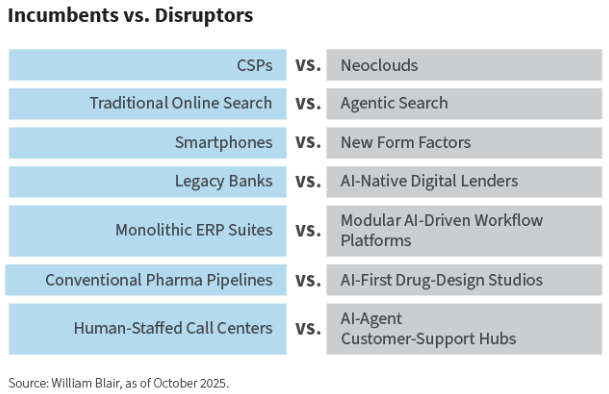
Customers: Proximity and Personalization
Because AI is probabilistic, and inherently fuzzy, it never ships as a one-size-fits-all package; every deployment may need tailoring.
That reality puts a premium on proximity to the customer. With direct access to user data, businesses can potentially fine-tune models, sharpen personalization, and, in the process, gain bargaining power over upstream suppliers. The further a business sits from the consumer, the greater its risk of being squeezed out by a tighter, AI-mediated relationship.
Thanks to the democratization of AI tools, many businesses can now train their own models, especially when their proprietary data are the key input. The classic buy-versus-build debate may tilt steadily toward DIY, especially in software, where an AI layer atop proprietary data could offer the best output for the lowest cost and posing a risk for traditional software vendors.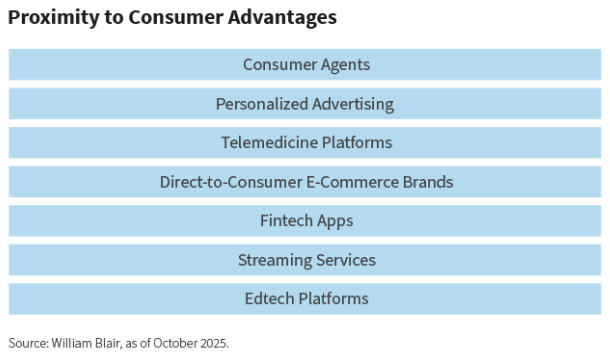
Data: Is It Important?
The notion that mere ownership of vast amounts of data guarantees safety or competitive advantages from AI is naïve. A forthcoming post will probe these conditions in depth, but the breezy notion that “he who holds the data wins” glosses over hard realities.
Vast datasets confer no moat if they are duplicated elsewhere, poorly labelled, or irrelevant to the decisions that create value. Data also ages. Moreover, much of the critical context and insight is absorbed into models during pre-training, as we explained previously, leaving datasets less defensible than they appear.
Data matters most only when it is both proprietary and highly specific/non-fungible—for example, patient records in healthcare or bespoke risk profiles in finance—or when it feeds differentiated models tightly integrated with frontline operations. In both of those cases, exclusivity and proximity to the end‐user combine to create high switching costs for the customer or differentiated models that competitors cannot easily replicate.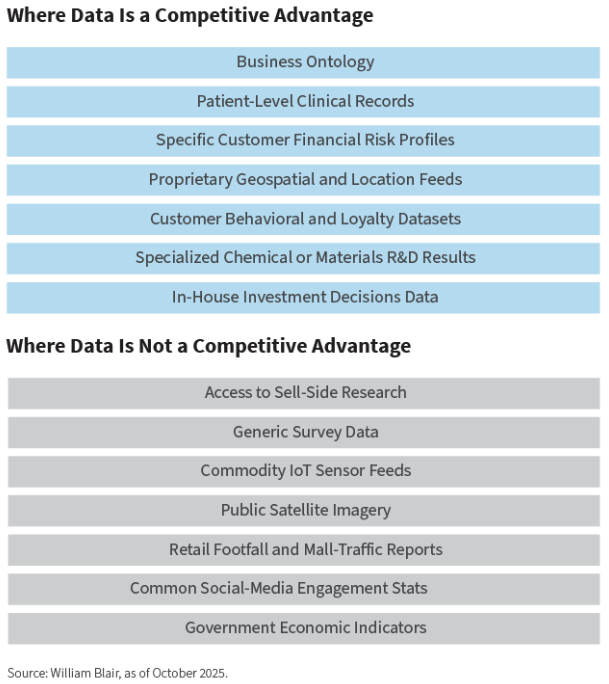
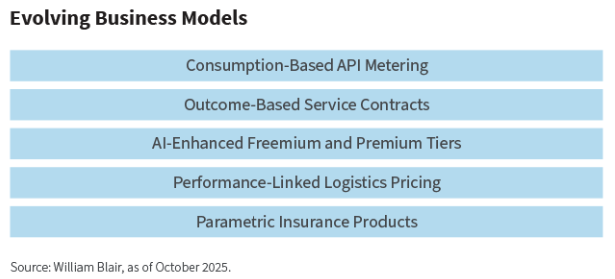
Evolving Business Models
The new compute paradigm brings a marked rise in variable costs. We have moved from an era of near-zero marginal costs to one in which running AI workloads incurs meaningful expense. Even if inferencing ultimately approaches negligible cost, that hinges on the level of capability delivered at that price point. Whether incremental marginal costs settle lower remains an open question.
In response, many firms are abandoning traditional pricing. Software-as-a-service vendors have shifted from seat-based subscriptions to consumption- or outcome-based billing, and even premium-tier pricing where higher-value features carry heftier fees. These appear better aligned with pay-as-you-go compute economics, letting customers scale costs in lockstep with value derived.
Beyond pricing tweaks, entirely new digital and physical products could emerge, spun out of AI’s multi-order effects. Each fresh innovation arrives with its own unit economics and structure: automated workflows reduce labor costs, altered distribution channels, and so on. Such shifts will force companies to rethink how they compete, scale and organize around a new cost structure.

Management and Culture
Qualitative factors, chief among them management and culture, may prove the single biggest determinant of success or failure. A business honed for stability often stumbles when disruption arrives, whereas one built for change can pivot swiftly as AI reshapes the field. Scale can cut both ways, either creating an inertia of bureaucracy and bogging down decision-making or supplying the data critical for seizing AI’s promise.
Incentives matter. If executives are rewarded for preserving the status quo, they may resist upheaval; if bonuses hinge on innovation, they may lean into AI’s disruptions. Similarly, lengthy reporting hierarchies can stifle responsiveness, whereas flatter chains of command allow leadership to pivot quickly as the landscape shifts.
Ultimately, culture underpins both. A boardroom that celebrates experimentation and tolerates early failures will likely spot AI advantages before peers do. Even the best resources can falter if employees resist change. AI’s adoption is not just a technical project but a test of corporate DNA.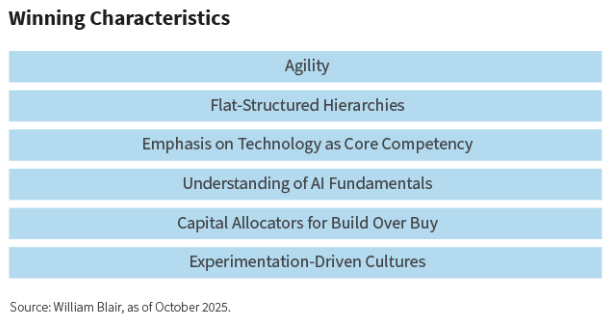
Conclusion
AI is reshaping industries beyond what any single metric can capture. Progress demands that we assume AI’s capabilities will keep compounding; probabilities require that we map the branching outcomes with cold realism; patience insists that we let insights mature while the market chases noise. None of this can be captured by a factor screen. I believe the exercise is, and will remain, one of stock-picking company by company, moat by moat, culture by culture. This is the only way, in my opinion, to separate the businesses that harness AI from those that are humbled by it.
Gurvir Grewal is a global research analyst on William Blair’s global equity team.
A message from Advisor Perspectives and VettaFi: Discover something new! Click here to register for our upcoming webcasts.
1 https://www.hbs.edu/faculty/Pages/item.aspx?num=46
5https://givernycapital.com/wp-content/uploads/2022/07/giverny-capital-annual-letter-2002.pdf
This content is for informational and educational purposes only and not intended as investment advice or a recommendation to buy or sell any security. Investment advice and recommendations can be provided only after careful consideration of an investor’s objectives, guidelines, and restrictions.
Information and opinions expressed are those of the authors and may not reflect the opinions of other investment teams within William Blair Investment Management, LLC, or affiliates. Factual information has been taken from sources we believe to be reliable, but its accuracy, completeness or interpretation cannot be guaranteed. Information is current as of the date appearing in this material only and subject to change without notice. Statements concerning financial market trends are based on current market conditions, which will fluctuate. This material may include estimates, outlooks, projections, and other forward-looking statements. Due to a variety of factors, actual events may differ significantly from those presented.
Investing involves risks, including the possible loss of principal. Equity securities may decline in value due to both real and perceived general market, economic, and industry conditions. The securities of smaller companies may be more volatile and less liquid than securities of larger companies. Investing in foreign denominated and/or domiciled securities may involve heightened risk due to currency fluctuations, and economic and political risks. These risks may be enhanced in emerging markets and frontier markets. Different investment styles may shift in and out of favor depending on market conditions. Individual securities may not perform as expected or a strategy used by the Adviser may fail to produce its intended result.
Investing in the bond market is subject to certain risks including market, interest rate, issuer, credit, and inflation risk. Rising interest rates generally cause bond prices to fall. High-yield, lower-rated, securities involve greater risk than higher-rated securities. Sovereign debt securities are subject to the risk that an entity may delay or refuse to pay interest or principal on its sovereign debt because of cash flow problems, insufficient foreign reserves, or political or other considerations. Derivatives may involve certain risks such as counterparty, liquidity, interest rate, market, credit, management, and the risk that a position could not be closed when most advantageous. Diversification does not ensure against loss. The inclusion of Environmental, Social and Governance (ESG) factors beyond traditional financial information in the selection of securities could result in a strategy's performance deviating from other strategies or benchmarks, depending on whether such factors are in or out of favor. ESG analysis may rely on certain values based criteria to eliminate exposures found in similar strategies or benchmarks, which could result in performance deviating.
Collective Investment Trusts (CITs) are available to qualified retirement plans. For non-U.S. citizens or residents, William Blair offers a series of Luxembourg-domiciled SICAV products.
There can be no assurance that investment objectives will be met. Any investment or strategy mentioned herein may not be appropriate for every investor. References to specific companies are for illustrative purposes only and should not be construed as investment advice or a recommendation to buy or sell any security. Past performance is not indicative of future returns.
Privacy & Security | Cookie Policy | Social Media Disclaimer | FINRA’s BrokerCheck | Glossary
Membership required
Membership is now required to use this feature. To learn more:
View Membership Benefits