Rare Earth Stocks Explode as China Clamps Down on Exports
Membership required
Membership is now required to use this feature. To learn more:
View Membership BenefitsEarlier this week, several of my friends texted me in frustration, letting me know that they couldn’t place trades on Coinbase or Robinhood. The culprit wasn’t market volatility or government regulation, but something far more mundane: a cloud outage.
When Amazon Web Services (AWS) went down in its Northern Virginia region on Monday, it briefly took a huge chunk of the internet with it. Everything from crypto exchanges to streaming platforms went dark, reminding us just how centralized the digital economy really is.
It made me wonder: if Bitcoin and gold are decentralized by design—mostly immune to the failure of a single server or company—shouldn’t the same principle apply to our financial markets?
Perhaps a more distributed trading infrastructure could help prevent a repeat of this week’s disruption. I think it’s a question worth asking as technology and finance become ever more inextricable.
China: A Rare Earth Powerhouse
Two weeks ago, when I wrote that China’s Belt and Road Initiative (BRI) had become a Trojan Horse, I meant it figuratively. But Beijing’s latest move to tighten control over rare earth elements (REEs) makes that metaphor feel almost literal.
The 17 REEs—with obscure names like neodymium, dysprosium, samarium and terbium—act as the sinews of the modern world. They can be found in the motor of your electric vehicle (EV), the guidance systems of an F-35 fighter jet, the lenses of your iPhone and even the hospital MRI that scans your heart. Without them, the 21st-century economy simply wouldn’t run.
For decades, China has played the long game. Beginning in the 1990s, it poured capital into mining and refining rare earths while Western nations, distracted by environmental concerns and short-term cost pressures, turned the other way.
The result? China now controls roughly 70% of global mining, 92% of refining and an astonishing 98% of magnet production, according to Goldman Sachs.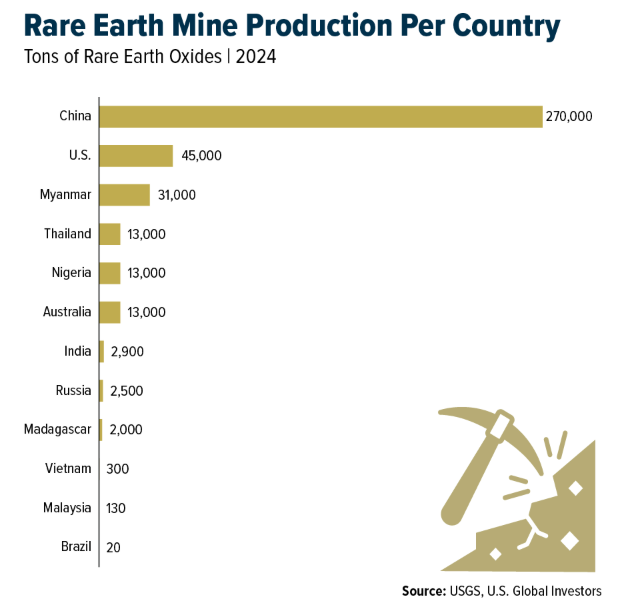
Three state-run companies dominate the field. China Northern Rare Earth Group, headquartered in Baotou, Inner Mongolia, is responsible for around 70% of China’s annual production. Its peer, China Rare Earth Group, was formed in 2021 by merging several state-owned conglomerates to consolidate heavy-rare-earth output and enhance Beijing’s pricing power. Together with Xiamen Tungsten Co., which accounts for 1% of the country’s mining output, these firms make China the OPEC of strategic metals.
Economic Statecraft
Beijing has a history of restricting exports of REEs, but this month, it rolled out the most sweeping ban in its history. Starting December 1, any company seeking to export goods containing more than 0.1% of their value from Chinese-sourced rare earths must apply for a government license.
Even more consequential, any product using Chinese rare-earth technology—whether mining methods, refining equipment or magnet fabrication—will now fall under the same restrictions.
The new rules also effectively block any supply chain linked to foreign defense contractors. In other words, Beijing can now veto the flow of materials that go into America’s most advanced weapons systems.
Consider the F-35, which requires over 900 pounds of rare earths. That means America’s flagship aircraft relies, in part, on materials that Washington’s chief rival now controls.
By tightening its grip, China can squeeze strategic industries without firing a single shot. It’s the same playbook it used in 2010, when it halted rare earth exports to Japan after a maritime dispute.
MP Materials: America’s Rare Earth Miner
Goldman Sachs recently warned that a 10% disruption in REE supply could wipe out $150 billion in global output, sending shockwaves through everything from semiconductors to EVs. Samarium, terbium and lutetium were singled out as particularly vulnerable.
Investors have taken note. Since China’s announcement, rare earth stocks have rallied sharply in Sydney and New York, led by Lynas Rare Earths, Iluka Resources and MP Materials, the latter being America’s sole large-scale rare earth miner.
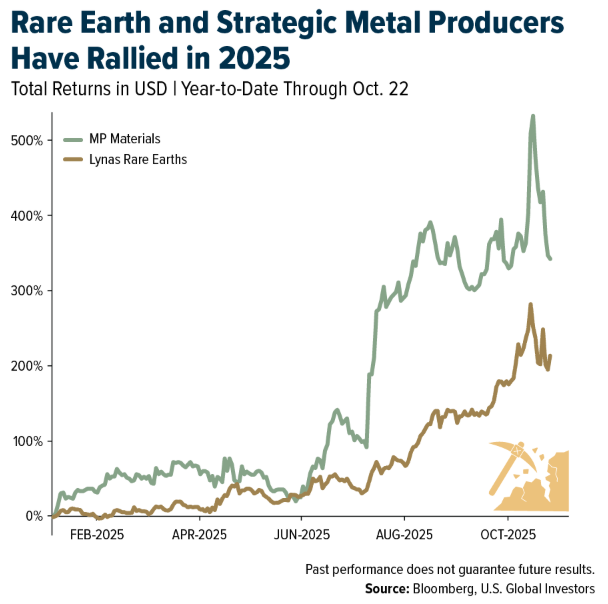
Fortunately, Washington isn’t asleep at the wheel this time. In July, the Department of Defense (DoD)—recently renamed the Department of War—made a $400 million equity investment in MP Materials, establishing a price floor for neodymium-praseodymium (NdPr) magnets and guaranteeing offtake for defense supply chains. The DoD is now the company’s largest shareholder.
Government Policy Is a Precursor to Change
Just this month, President Trump and Australian Prime Minister Anthony Albanese signed the U.S.-Australia Critical Minerals Framework Agreement, pledging at least $1 billion in near-term financing to build processing capacity and reduce dependence on Chinese supply.
Australia is already a natural partner. Home to the Mount Weld mine, one of the world’s richest deposits, the country ranks fourth globally in rare earth production. Its producer, Lynas, achieved a milestone this May be becoming the first company outside China to produce commercial quantities of dysprosium oxide, a heavy rare earth essential for defense magnets.
What’s more, the Export-Import Bank of the U.S. is reviewing a $300 million financing package for Arafura Rare Earths’ Nolans project in Australia, while Canberra itself pledged another $100 million. The two nations plan to co-fund an $8.5 billion pipeline of critical minerals projects over the coming decade.
Lessons from Reagan
Skeptics may argue that the West can’t catch up with China, that processing capacity and environmental approvals take too long. I’d remind readers that we’ve seen this movie before.
In the early 1980s, the U.S. semiconductor industry faced intense competition from Japan, whose government-backed chipmakers were rapidly gaining market share. To counter what was viewed as unfair trade practices and dumping of underpriced semiconductors, President Ronald Reagan imposed 100% tariffs on selected Japanese chips in 1987.
In announcing the tariffs, Reagan stated that the “health and volatility of the U.S. semiconductor industry are essential to America’s future competitiveness.” He also expressed regret that the action was necessary and promised to remove the tariffs “as soon as we have firm and continuing evidence that the dumping has stopped.”
The policy, combined with the 1986 U.S.-Japan Semiconductor Agreement, helped stabilize the industry and protect domestic production. By the 1990s, Silicon Valley had regained global leadership.
I believe the same could happen with rare earths if the U.S. stays the course.
A 21st Century Gold Rush
For the patient investor, this could be an opportunity. History shows that supply disruptions can often breed attractive returns. With bipartisan support for reshoring and billions in new capital flowing into critical minerals projects, we may be witnessing the dawn on a new resource supercycle, driven by the elements that make technology itself possible.
As President Trump recently put it, this is the “gold rush of the 21st century.” The difference is that the new gold isn’t yellow but magnetic.
Index Summary
- The major market indices finished up this week. The Dow Jones Industrial Average gained 2.20%. The S&P 500 Stock Index rose 1.92%, while the Nasdaq Composite climbed 2.31%. The Russell 2000 small capitalization index gained 2.50% this week.
- The Hang Seng Composite gained 3.62% this week; while Taiwan was up 0.84% and the KOSPI rose 5.14%.
- The 10-year Treasury bond yield fell 1 basis point to 3.99%.
Airlines and Shipping
Strengths
- The best-performing airline stock for the week was Sabre, up 19.1%. According to J.P. Morgan, Embraer reported a third-quarter 2025 backlog of US$31.3 billion, up 38% year-over-year. The Commercial Aviation segment reached a record US$15.2 billion backlog (up 37% year-over-year), driven by major orders of 50 E195-E2 aircraft from Avelo and 24 from LATAM.
- The Shanghai Containerized Freight Index (SCFI), a key shipping indicator, rose sharply this week — +31.9% on West Coast routes and +16.4% on East Coast routes. Morgan Stanley noted the surge reflects the General Rate Increase implemented on October 15 across Asia–North America and Asia–Europe lanes.
- According to Goldman Sachs, American Airlines reported a third-quarter 2025 adjusted net loss per share of ($0.17), beating the FactSet consensus of ($0.28). The improvement was driven by stronger-than-expected revenue, with unit revenue (RASM) down 1.9% year-over-year. For the fourth quarter, the company guided earnings per share of $0.45–$0.75, above the $0.30 consensus, expecting revenue growth of 3–5% on similar capacity expansion, implying flat unit revenue versus expectations of –1.4%.
Weaknesses
- The worst-performing airline stock for the week was Alaska Air, down 7.5%. According to Bank of America, Grupo Aeropuerto del Pacífico reported third-quarter 2025 EBITDA of 5.1 billion pesos, reflecting 13% year-over-year growth but missing consensus by 7%. This was due to lower-than-expected revenue and higher maintenance costs and concession taxes.
- The dry bulk outlook is becoming less constructive, according to J.P. Morgan, as supply revisions are now outpacing demand upgrades. Clarkson’s latest data show dry bulk demand for 2025 and 2026 rising to 1.3% and 1.6% year-over-year, respectively, but Handysize and Handymax fleet growth is being revised higher to 4.4% and 4.0% year-over-year, indicating net fleet expansion will exceed demand through 2026.
- In Europe, compared to the three-month outlook, the one-month outlook for October fares shows a significant softening, according to J.P. Morgan. Estimated average low-cost carrier fares for October are down 4% one month out, compared to a 1% increase at the three-month mark. Ryanair and easyJet show the largest declines.
Opportunities
- In China, domestic demand growth accelerated to 4% year-over-year in September, while supply growth remained tight at 1% year-over-year. This boosted both load factor and unit revenue by 2.5 percentage points and 2% year-over-year, respectively. Yield finally approached positive growth. Bank of America attributes this to improving business travel demand and early activity ahead of Golden Week.
- Clarkson has raised very large crude carrier (VLCC) trade volume demand forecasts to 2.6% and 1.7% year-over-year for 2025 and 2026, respectively, while fleet additions remain limited at -0.1% and +2.6% year-over-year. This creates a widening near-term supply–demand gap, even before considering trade rerouting effects, according to J.P. Morgan.
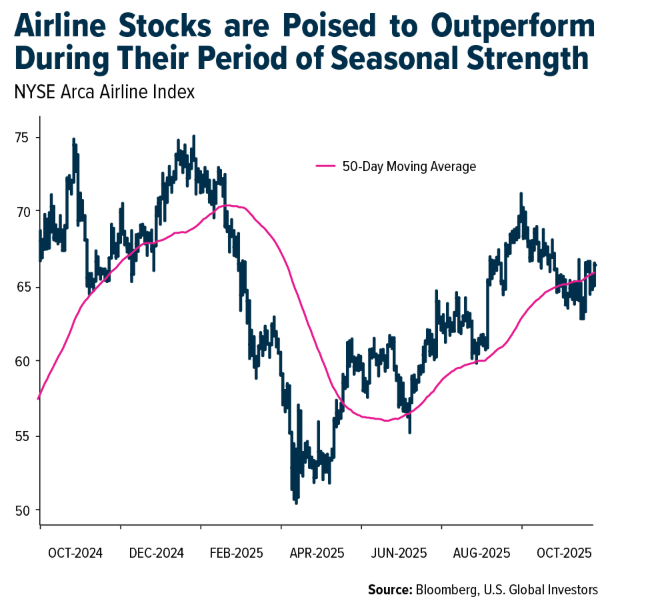
- Historically, the second half of the year is stronger for airlines, with stocks typically outperforming from September through December. This year, September bucked the trend as airline stocks underperformed the S&P 500 by 10.7%, following strong gains in July and August. So far, October has seen a return to the historical pattern of outperformance, according to Bank of America.
Threats
- Air traffic control staffing issues are causing delays at airports in Dallas, Chicago, Atlanta, and Newark as the government shutdown continues. According to Reuters, the FAA is currently about 3,500 air traffic controllers short of target staffing levels. The FAA also reported that flights could be delayed in Las Vegas and Phoenix. Over 5,800 flights were delayed recently, with American Airlines and Southwest Airlines seeing more than 20% of their flights affected.
- According to UBS, major liners have moved their China-linked vessels away from China–U.S. routes to avoid U.S. port fees, leaving only COSCO Shipping subject to such fees. On the other hand, UBS noted that Matson and ZIM are subject to fees charged by China’s ports.
- Wizz is looking to defer about 100 Airbus SE aircraft deliveries into the next decade, according to people familiar with the discussions, as the low-cost carrier retrenches from rapid expansion. The planes were originally due between now and 2030, but Wizz aims to push deliveries beyond 2030.
Luxury Goods and International Markets
Strengths
- Hilton reported strong third-quarter results with better earnings and revenue than expected. Although overall room revenue per available room was slightly down, the company added many new rooms and launched a new lifestyle brand, showing growth. Hilton also raised its outlook for the rest of 2025, expecting steady revenue and profit growth supported by strong demand and a solid development pipeline.
- Tesla has officially entered Africa by opening its first office in Casablanca, Morocco, and announced plans to build a large factory near Kenitra, starting production by 2027 as part of its broader continental expansion.
- Las Vegas Sands, the hotel and casino operator, led the S&P Global Luxury Index with a 18.67% gain. The compny reported strong third quarter revenue of $3.33 billion, beating expectations and driven by improving traffic in its key markets of Macau and Singapore.
Weaknesses
- Hermès reported third quarter sales rising 9.6% at constant exchange rates, reaching €3.88 billion, slightly missing analyst expectations of 10% growth. While leather goods remained strong with 13.3% growth, other categories like perfumes and watches declined, and sales in the Asia-Pacific region showed signs of slowing.
- The ongoing U.S. government shutdown, which began on October 1, 2025, has now lasted about three weeks and continues to weaken the economy. It disrupts federal operations, delays pay for workers, and lowers consumer and business confidence. The shutdown also stalls public projects, reduces spending, and creates uncertainty in financial markets, slowing overall economic growth.
- Laopu Gold, a jewelry retailer in China, was the worst-performing stock in the S&P Global Luxury Index this week, falling 16.23%. The sell-off followed a drop in gold prices from $4,252 to $4,107 per ounce—the largest weekly decline since August 2020.
Opportunities
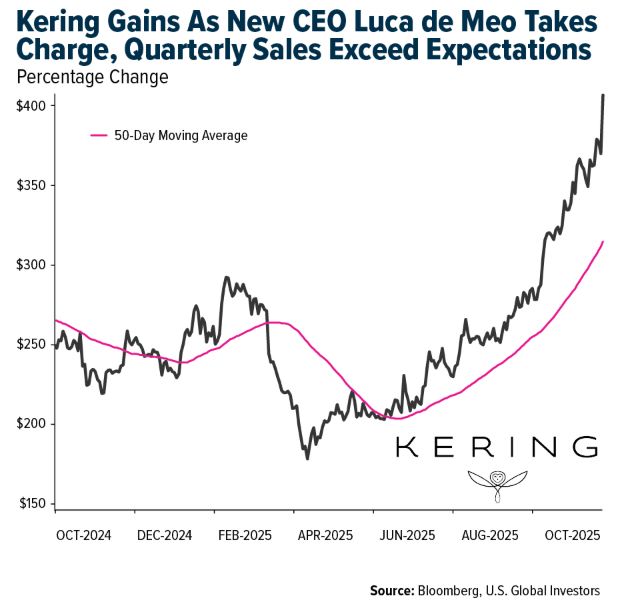
- Last week, LVMH reported organic revenue growth, driven by improvements in Asia, stable demand in Europe and the U.S., and solid performances from brands like Sephora and Dior. This week, Kering reported smaller-than-expected loss, signaling resilience amid challenges. Kering’s new CEO Luca de Meo is selling the beauty division to L’Oréal for 4 billion euros to cut the company’s debt by nearly half.
- Las Vegas Sands reported strong Q3 revenue of $3.33 billion, beating expectations and driven by improving traffic in its key markets of Macau and Singapore. This robust performance signals a promising opportunity for the resorts and casino sector as visitors demand rebounds. With continued investments and expansion plans in these regions, the company is well positioned to capitalize on growing gaming and tourism activity.
- American Automotive Association (AAA) projects a record 21.7 million Americans will cruise in 2026, up from 20.7 million in 2025, driven by strong demand and more ship capacity. This year, Royal Caribbean is up about 38%, Carnival around 18% and Viking roughly 38%. These cruise companies have performed well and are positioned to continue benefiting from growing travel trends.
Threats
- Tesla’s third quarter revenue rose 12% to $28.1 billion, beating expectations. But earnings per share missed estimates at $0.50 versus $0.54 expected. Despite strong sales, profits fell due to lower margins and fewer regulatory credits. This shows Tesla faces pressure on profitability despite growing revenue.
- The latest data shows that U.S. consumer confidence remains low, with the sentiment index around 55 points and only about one-third of Americans holding a positive view of the economy. Concerns about high prices and weak job prospects continue to weigh on consumers’ outlooks. The holiday season of 2025 is expected to be one of the most challenging shopping seasons in years, with consumers planning to trim holiday spending by 5% compared to prior year.
- The U.S. and China will meet this weekend in Malaysia to discuss tariffs and trade tensions. The outcome of these talks is uncertain, which poses a threat as it could lead to increased market volatility. Investors will watch closely as the results may impact global economic and trade conditions.
Energy and Natural Resources
Strengths
- Natural gas was the best-performing commodity of the week, rising approximately 11.5%, while crude oil gained around 7.58%. Prices were supported by new sanctions on Russian crude and forecasts for cooler weather across North America and Europe. Goldman Sachs maintained its forecast for Brent crude to average ~$56 per barrel in 2026, while highlighting upside risks if Russian exports fall sharply under sanctions. However, the bank cautioned that rising global inventories, weak demand, and high spare capacity could push Brent prices into the low $50s per barrel by late 2026 in the absence of major supply disruptions.
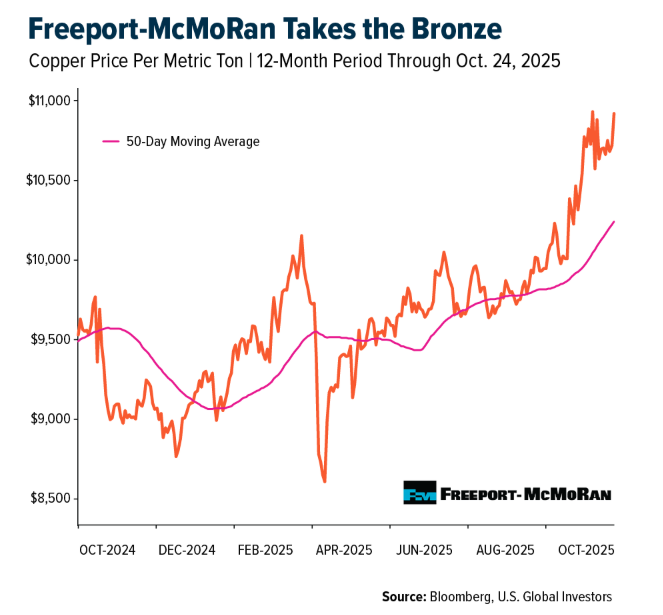
- Freeport-McMoRan shares climbed as much as 3.6% after reporting third-quarter earnings above expectations, supported by higher copper and gold prices and lower operating costs. The results came despite production challenges following the September mud-rush incident at its Grasberg mine in Indonesia. Analysts from BMO Capital Markets and Citi highlighted stronger-than-expected EBITDA and solid free cash flow, while CIBC noted optimism around a potential Grasberg contract extension, reinforcing Indonesia’s long-term commitment to partnership with Freeport.
- BMO Capital Markets also commented on Sunrise Energy Metals, whose supply agreement with Lockheed Martin marks a key milestone in securing Western supply chains for critical minerals, particularly scandium, used in advanced aerospace and defense applications. The deal gives Lockheed the option to purchase up to 15 tons of scandium oxide annually—about 25% of Sunrise’s projected output—supported by the updated Syerston Scandium Project, according to BMO.
Weaknesses
- Sugar was the worst-performing commodity of the week, falling roughly 3.53%. Brazil’s surge in corn ethanol production has flooded the market with cheaper biofuel, forcing sugar-cane mills to increase sugar output. This has pushed global sugar prices to a four-year low, pressuring margins for higher-cost producers worldwide and threatening prolonged weakness amid record global supplies.
- China’s LNG imports dropped approximately 15% year-over-year in September, marking the 11th consecutive monthly decline, as the country relied more on cheaper pipeline gas, domestic output and renewable energy sources. Analysts said this sustained weakness gives Chinese buyers greater pricing leverage in future LNG contract negotiations, even as Beijing expands LNG infrastructure toward 250 million tons per year of capacity by 2030.
- Yoji Muto, Japan’s Trade Minister, stated that while Japan is working to reduce dependence on Russian LNG, it cannot immediately halt imports since supplies from the Sakhalin-2 project account for roughly 10% of Japan’s total LNG purchases. He emphasized that replacing this volume would be costly and could raise electricity prices in an already tight Asian LNG market.
Opportunities
- Aclara Resources announced plans to build a $277 million heavy rare-earth separation plant in Louisiana—the first of its kind in the U.S. The facility will process material from the company’s Brazilian and Chilean deposits to produce dysprosium and terbium for EV and wind-turbine magnets, helping to reduce Western dependence on China. Supported by U.S. tax incentives and prior government funding, the project could eventually supply about 14% of China’s official dysprosium and terbium output, marking a major milestone in reshoring critical-mineral supply chains.
- BMO Capital Markets highlighted the newly announced U.S.-Australia Critical Minerals Partnership as a key driver of investment in defense and clean-energy supply chains. Both nations have pledged $1 billion each toward mining and processing projects, while the U.S. Export–Import Bank has issued $2.2 billion in preliminary financing offers. BMO noted that the agreement could accelerate funding and permitting across key minerals such as rare earths, graphite and scandium, while strengthening shared national-security frameworks.
- Copper traded near $10,600 per ton after President Trump struck a softer tone on China and Beijing reaffirmed its 5% growth target, boosting investor sentiment. BMO said optimism was reinforced by a bullish tone at LME Week, where traders cited tight inventories, record trading profits, and ongoing supply disruptions. Copper was consistently ranked the top bullish call in LME Week polls, with aluminum seen as a logical beneficiary if copper prices move higher. Additionally, rare earths and minor metals like tin, antimony and tungsten drew renewed attention due to defense-related demand and ongoing questions about how quickly the West can reduce reliance on China’s rare-earth dominance.
Threats
- Kimmeridge Energy’s Ben Dell warned that U.S. natural gas assets are being aggressively bid up as companies race to capture growth from rising LNG exports and AI-driven electricity demand. He cautioned that investors may be overpaying based on speculative forecasts for data-center power use, risking oversupply if export facilities or new power plants are delayed.
- President Trump announced an immediate halt to all trade negotiations with Canada after the province of Ontario aired an anti-tariff advertisement using the voice of former President Ronald Reagan to criticize U.S. tariff policy. The ad—funded by the Ontario government—warned that tariffs harm American workers and was aimed at swaying Republican voters by invoking Reagan’s legacy.
- The Chinese yuan’s share of global payments rose to 3.17% in September, up from 2.93% in August, according to SWIFT data. This reflects ongoing internationalization of the yuan as more cross-border trade moves away from the U.S. dollar. Analysts attribute this shift to geopolitical realignment, U.S. trade policies, and rising adoption in emerging markets across Asia, Africa, and the Middle East, signaling the yuan’s growing importance in a diversified global monetary system.
Bitcoin and Digital Assets
Strengths
- Among the cryptocurrencies tracked by CoinMarketCap, the top performer for the week was Virtuals Protocol, rising 19.60%.
- Shares of CleanSpark surged up to 13% after the Bitcoin miner announced its expansion into data center infrastructure and the hiring of Jeffrey Thomas. Thomas joined CleanSpark as senior vice president of AI data centers and will lead efforts to develop and operate AI and high-performance computing data centers, according to Bloomberg.
- Japan’s financial regulator is considering allowing commercial banks to invest in cryptocurrencies, provided they have proper risk management frameworks in place. The regulator is also exploring the option for banking groups to apply for licenses to operate crypto exchanges, Bloomberg reports.
Weaknesses
- Among the cryptocurrencies tracked by CoinMarketCap, the worst performer for the week was Plasma, down 10.0%.
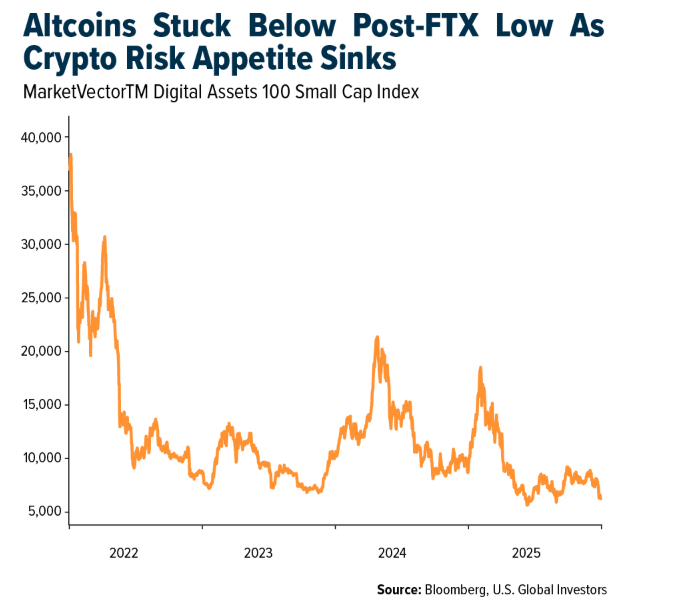
- The crypto market is in limbo following a nearly $20 billion selloff, marking the largest single-day wipeout in the industry’s history. A market-cap weighted index tracking the 50 smallest tokens now trades below the 2022 FTX-era lows, indicating that speculative capital is retreating from the crypto frontier, according to Bloomberg.
- The market for digital items in Counter-Strike fell 25% overnight following an update by Valve Corp. The update changed the exchange rates between different item categories, causing prices to drop and wiping out approximately $1.75 billion in value, according to Bloomberg.
Opportunities
- A company called Evernorth is set to go public through a blank-check firm that will hold the cryptocurrency XRP, tied to the Ripple payment network. The deal is expected to raise over $1 billion in proceeds, with SBI Holdings Inc. contributing $200 million and Ripple Labs making an undisclosed investment, according to Bloomberg.
- BitMine Immersion Technologies, an Ethereum-focused digital asset treasury company led by Fundstrat’s Thomas Lee, extended its ether buying streak by purchasing over 200,000 tokens—approximately $800 million—through last week. After the latest purchase, the company held $13.4 billion in combined crypto equity and cash assets as of Sunday evening, Bloomberg reports.
- Argentines like Ruben Lopez are turning to cryptocurrencies to protect their savings as President Milei tightens currency controls ahead of the midterm elections. A new strategy uses stablecoins to leverage Argentina’s official exchange rate and earn quick profits of up to 4% per transaction, according to Bloomberg.
Threats
- Chen Zhi, chairman of Cambodian conglomerate Prince Group, was charged with running a “sprawling cyber fraud empire” that led to the seizure of Bitcoin worth about $15 billion. Chen’s operation allegedly used forced labor in Cambodia to emotionally manipulate thousands of victims in the U.S. and worldwide, inflating their accounts before draining them in a scheme known as “pig butchering,” according to Bloomberg.
- Crypto firm Xeltox Enterprises received Canada’s largest-ever penalty from the country’s anti–money laundering agency for allegedly violating rules on suspicious transactions. Xeltox, which operates under the name Cryptomus, was fined C$177 million by the Financial Transactions and Reports Analysis Centre of Canada, Bloomberg reports.
- Man Group and LGT Capital Partners have yet to see strong investor interest in crypto hedge fund strategies due to inefficiencies and operational risks. Roger Hilty stated that the return of capital is more important than the return on capital, according to Bloomberg.
Defense and Cybersecurity
Strengths
- General Dynamics reported a strong Q3 2025, with revenue rising 10.6% to $12.9 billion and earnings per share (EPS) up 15.8% to $3.88, both exceeding expectations. Robust growth across all four segments—especially aerospace, which surged 30%—and $19.3 billion in new orders (book-to-bill 1.5) underscore solid execution, resilient demand and a record $167.7 billion backlog positioning the company for continued momentum in both defense and business aviation.
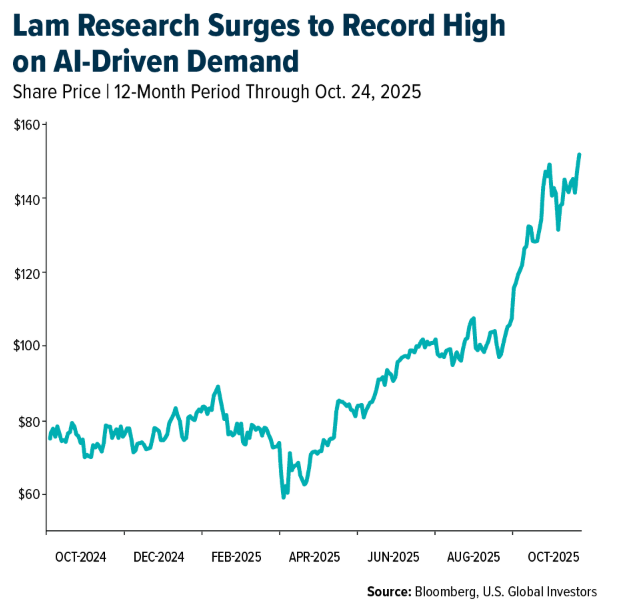
- Lam Research delivered record Q1 2026 results, with revenue up 28% year-over-year to $5.32 billion and strong EPS and free cash flow, driven by surging AI-related demand and memory upgrades. Despite China trade headwinds, analysts from Oppenheimer and Bank of America named Lam their top semiconductor equipment pick, raising price targets and forecasting over 20% ex-China growth in 2026.
- The best performing stock was Carpenter Technology, rising +32% after reporting first-quarter adjusted EPS of $2.43, beating estimates and reaffirming strong multi-year growth targets. The company highlighted a 23% sequential increase in aerospace and defense bookings and its fifteenth consecutive quarterly margin expansion, signaling robust demand and improving profitability.
Weaknesses
- Amazon’s AWS servers suffered a major outage on October 20, taking down major platforms such as Snapchat, Zoom and Fortnite, and even disrupting bank card operations. The incident highlights the growing vulnerability of global infrastructure concentrated in a few hyperscale providers.
- Salesforce faced public backlash after reports it offered AI capabilities to ICE for immigration raids, sparking reputational damage and political criticism of its leadership. The controversy underscores the ethical and governance challenges facing tech firms expanding into sensitive government projects.
- The weakest stock was Rocket Lab, declined 2.58% amid mild profit-taking and technical weakness after a strong prior rally, with no negative news but some investor caution over valuation and momentum cooling.
Opportunities
- Airbus, Leonardo and Thales announced the merger of their space divisions into a single joint company, consolidating Europe’s satellite and exploration programs. The move boosts industrial efficiency and European strategic autonomy in the rapidly growing global space market.
- Meta unveiled a $27 billion partnership with Blue Owl Capital to construct the Hyperion data center in Louisiana, set to deliver over 2 gigawatts of compute capacity and 500 jobs. The project underscores accelerating U.S. investment in large-scale AI infrastructure.
- Lockheed Martin added 151 aircraft and $11 billion in new contracts to the F-35 program under Lots 18 and 19, reflecting continued global demand for fifth-generation fighters and strengthening its position as the cornerstone of allied air power.
Threats
- A former L3Harris executive was charged with selling trade secrets to a Russian buyer for $1.3 million, including classified defense technologies. The case exposes the persistent risk of insider espionage undermining Western defense integrity.
- Russia’s secret “Harmony” underwater surveillance system in the Arctic—built over a decade with imported Western components—has raised NATO concerns over submarine detection and nuclear deterrence vulnerabilities.
- Israel resumed airstrikes on Gaza following clashes in Rafah that killed two Israeli soldiers, risking renewed regional escalation just weeks after a ceasefire. The renewed violence threatens fragile diplomatic progress in the Middle East.
Gold Market
This week gold futures closed the week at $4,118, down $95.30 per ounce, or 2.26%. Gold stocks, as measured by the NYSE Arca Gold Miners Index, ended the week lower by 7.01%. The S&P/TSX Venture Index came in off just 0.19%. The U.S. Trade-Weighted Dollar rose 0.46%.
Strengths
- The best performing commodity for the week was platinum, but still down 1.58%, despite surging over 6% to $1,646/oz earlier in the week, its biggest intraday gain since 2020, as China ended a long-standing VAT rebate that distorted imports and triggered a rush for physical metal. With a structural supply deficit and rising demand from China’s jewelry and hydrogen sectors, platinum stands out as a point of strength among precious metals despite broader market volatility.
- Japan Physical Gold ETF plunged as much as 6.7%, the most since April 2013, after Tokyo Stock Exchange said investors should pay attention to its net asset value as it’s been consistently trading at a premium, according to Bloomberg.
- A relentless surge in the price of gold is delivering windfalls across emerging markets, boosting investor confidence in countries that mine and buy the metal. In South Africa, home to the world’s deepest gold mines, stocks are on track for the best year in two decades, with shares of miners like Sibanye Stillwater, AngloGold Ashanti and Gold Fields tripling in value, according to Bloomberg.
Weaknesses
- The worst performing precious metals this week was palladium taking a 3.83% hit with the precious metal’s correction this week. Norilsk Nickel’s palladium output fell 9% year-on-year in Q3 to 617,000 ounces as operational transitions and ore changes disrupted production. The decline underscores ongoing weakness in palladium supply growth, with full-year guidance trimmed and limited recovery expected amid equipment upgrades and lower-grade ore.
- Gold and silver slid as traders took stock of record-breaking rallies, with technical indicators looking stretched while U.S.-China tensions ease. Gold’s ferocious rally has measures like relative strength indicating that prices have passed well into overbought territory. A strengthening US dollar has also made precious metals more expensive for most buyers, according to Bloomberg.
- Newmont shares sold off following the earnings release as analysts cautioned that the company may be leaning too heavily on gold price momentum rather than demonstrating strong operational execution or near-term production growth. While free cash flow and EPS handily beat expectations, BMO noted that guidance still reflects stagnant production through 2026, leaving investors concerned about limited organic growth catalysts despite solid cost control and shareholder returns.
Opportunities
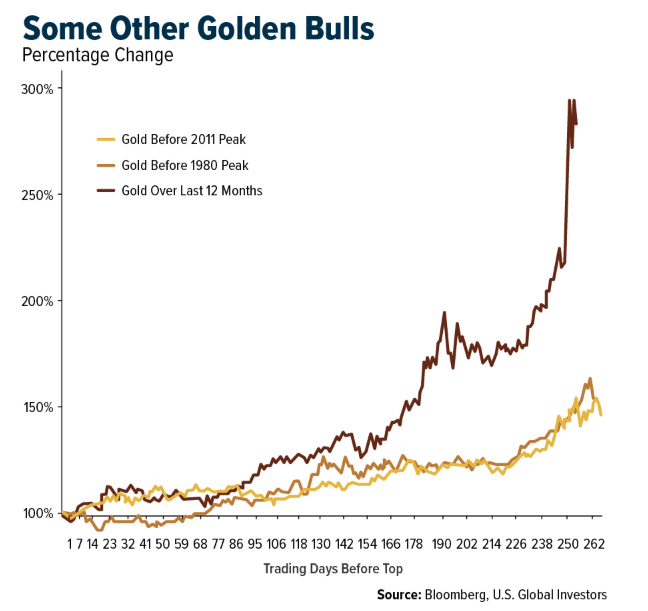
- John Authers’ column this week on Bloomberg looked at past bull markets in gold, to put the recent correction into context. “It’s useful to compare with the last two great bull markets, which peaked in January 1980 at the depths of fears over eternal stagflation, and in September 2011 after Standard & Poor’s had downgraded U.S. Treasuries’ credit rating. This bull market looks very much like 2011 and nothing like 1980.” In January of 1980, the Soviet Union had just invaded Afghanistan, there were US hostages in Tehran, the Federal Reserve was hiking rates, US stocks were deep in a bear market, and all hope had been lost. This gold rally has coincided with what many describe as a stock market bubble. Looking more closely at 2011, and at the very different behavior of stocks, reveals more differences. Back then, S&P triggered an extreme “debasement trade” with the downgrading of the U.S. credit rating from AAA to AA+. Within weeks, the world was still turning, it was apparent that the QE bond purchases of the era hadn’t sparked inflation, and a fresh equity bull market was underway. This time, gold has outperformed a booming stock market, and there was no clear triggering event like the downgrade to get people talking about debasement.
Threats
- According to BloombergNEF, the cost of silver in a solar module has now overtaken aluminum, making silver the single largest contributor to module costs at 17% of the total. This compares to 3% of the total cost in 2023. Silver is up 79% YTD, driven by tight supply, rising ETF demand and more recently a physical squeeze, according to Morgan Stanley.
- According to RBC, larger corrections for gold are typical in bull markets—in the current cycle that started in 2022, there have already been 7 corrections greater than 5% which have each lasted an average of 70 days and with drawdowns of a median -7%. Correction periods of >5% for gold represented a median drawdown of -8% and occurred over an average 103 days, which if compared to recent highs could represent a decline in prices of $337/ounce to arrive at $4,019/ounce.
- Paired with the above argument, this sounds like over the next couple of months investors should look elsewhere for better market returns than gold has to offer. There is a perception that with lower energy prices and the backdrop for falling interest rates this is going to benefit the broader equity markets, and you don’t need gold. However, the budget impasse is still unresolved with no clear side showing the willingness to cave, there is still a lot of risks to hedge.
A message from Advisor Perspectives and VettaFi: Discover something new! Click here to register for our upcoming webcasts.
U.S. Global Investors, Inc. is an investment adviser registered with the Securities and Exchange Commission (“SEC”). This does not mean that we are sponsored, recommended, or approved by the SEC, or that our abilities or qualifications in any respect have been passed upon by the SEC or any officer of the SEC.
This commentary should not be considered a solicitation or offering of any investment product. Certain materials in this commentary may contain dated information. The information provided was current at the time of publication. Some links above may be directed to third-party websites. U.S. Global Investors does not endorse all information supplied by these websites and is not responsible for their content. All opinions expressed and data provided are subject to change without notice. Some of these opinions may not be appropriate to every investor.
Holdings may change daily. Holdings are reported as of the most recent quarter-end. The following securities mentioned in the article were held by one or more accounts managed by U.S. Global Investors as of (09/30/2025):
Embraer SA
Grupo Aeroportuario del Pacifico
Ryanair Holdings Plc
Wizz Air Holdings Plc
Airbus SE
COSCO Shipping
Hilton Worldwide Holdings Inc.
Tesla Inc.
Hermes International SCA
LVMH Moet Hennessy Louis Vuitton
Kering SA
Royal Caribbean Cruises Ltd.
Carnival Corp.
General Dynamics Corp.
Lam Research Corp.
Laopu Gold Co. Ltd.
Sibanye Stillwater Ltd.
AngloGold Ashanti Ltd.
Gold Fields Ltd.
Newmont Corp.
IAMGOLD Corp.
*The above-mentioned indices are not total returns. These returns reflect simple appreciation only and do not reflect dividend reinvestment.
The Dow Jones Industrial Average is a price-weighted average of 30 blue chip stocks that are generally leaders in their industry. The S&P 500 Stock Index is a widely recognized capitalization-weighted index of 500 common stock prices in U.S. companies. The Nasdaq Composite Index is a capitalization-weighted index of all Nasdaq National Market and SmallCap stocks. The Russell 2000 Index® is a U.S. equity index measuring the performance of the 2,000 smallest companies in the Russell 3000®, a widely recognized small-cap index.
The Hang Seng Composite Index is a market capitalization-weighted index that comprises the top 200 companies listed on Stock Exchange of Hong Kong, based on average market cap for the 12 months. The Taiwan Stock Exchange Index is a capitalization-weighted index of all listed common shares traded on the Taiwan Stock Exchange. The Korea Stock Price Index is a capitalization-weighted index of all common shares and preferred shares on the Korean Stock Exchanges.
The Philadelphia Stock Exchange Gold and Silver Index (XAU) is a capitalization-weighted index that includes the leading companies involved in the mining of gold and silver. The U.S. Trade Weighted Dollar Index provides a general indication of the international value of the U.S. dollar. The S&P/TSX Canadian Gold Capped Sector Index is a modified capitalization-weighted index, whose equity weights are capped 25 percent and index constituents are derived from a subset stock pool of S&P/TSX Composite Index stocks. The NYSE Arca Gold Miners Index is a modified market capitalization weighted index comprised of publicly traded companies involved primarily in the mining for gold and silver. The S&P/TSX Venture Composite Index is a broad market indicator for the Canadian venture capital market. The index is market capitalization weighted and, at its inception, included 531 companies. A quarterly revision process is used to remove companies that comprise less than 0.05% of the weight of the index, and add companies whose weight, when included, will be greater than 0.05% of the index.
The S&P 500 Energy Index is a capitalization-weighted index that tracks the companies in the energy sector as a subset of the S&P 500. The S&P 500 Materials Index is a capitalization-weighted index that tracks the companies in the material sector as a subset of the S&P 500. The S&P 500 Financials Index is a capitalization-weighted index. The index was developed with a base level of 10 for the 1941-43 base period. The S&P 500 Industrials Index is a Materials Index is a capitalization-weighted index that tracks the companies in the industrial sector as a subset of the S&P 500. The S&P 500 Consumer Discretionary Index is a capitalization-weighted index that tracks the companies in the consumer discretionary sector as a subset of the S&P 500. The S&P 500 Information Technology Index is a capitalization-weighted index that tracks the companies in the information technology sector as a subset of the S&P 500. The S&P 500 Consumer Staples Index is a Materials Index is a capitalization-weighted index that tracks the companies in the consumer staples sector as a subset of the S&P 500. The S&P 500 Utilities Index is a capitalization-weighted index that tracks the companies in the utilities sector as a subset of the S&P 500. The S&P 500 Healthcare Index is a capitalization-weighted index that tracks the companies in the healthcare sector as a subset of the S&P 500. The S&P 500 Telecom Index is a Materials Index is a capitalization-weighted index that tracks the companies in the telecom sector as a subset of the S&P 500.
The Consumer Price Index (CPI) is one of the most widely recognized price measures for tracking the price of a market basket of goods and services purchased by individuals. The weights of components are based on consumer spending patterns. The Purchasing Manager’s Index is an indicator of the economic health of the manufacturing sector. The PMI index is based on five major indicators: new orders, inventory levels, production, supplier deliveries and the employment environment. Gross domestic product (GDP) is the monetary value of all the finished goods and services produced within a country’s borders in a specific time period, though GDP is usually calculated on an annual basis. It includes all private and public consumption, government outlays, investments and exports less imports that occur within a defined territory.
The S&P Global Luxury Index is comprised of 80 of the largest publicly traded companies engaged in the production or distribution of luxury goods or the provision of luxury services that meet specific investibility requirements.
The Shanghai Containerized Freight Index (SCFI) is a weekly index that tracks spot rates for container shipping from Shanghai to major global destinations, serving as a key indicator of global shipping costs and demand.
The MarketVector Digital Assets 100 Small-Cap Index is a market cap-weighted index which tracks the performance of the 50 smallest digital assets in The MarketVector Digital Assets 100 Index.
The trade-weighted dollar is an index created by the Federal Reserve to measure the value of the USD based on its competitiveness versus trading partners.
Please consider carefully a fund’s investment objectives, risks, charges and expenses. For this and other important information, obtain a fund prospectus by visiting our prospectus page or by calling 1-800-US-FUNDS (1-800-873-8637). Read it carefully before investing. Foreside Fund Services, LLC, Distributor. U.S. Global Investors is the investment adviser.
Read additional important information.
Membership required
Membership is now required to use this feature. To learn more:
View Membership Benefits