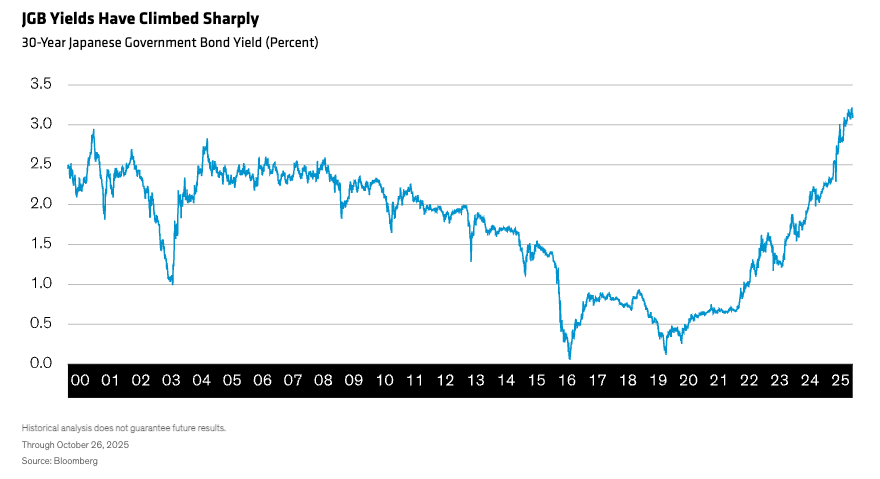
After decades of ultra-low yields and chronic deflation, Japan’s government bond market is stirring. After drifting higher through the spring and summer, Japanese government bond (JGB) yields surged in September and October (Display) as investors reacted to new leadership in Tokyo. For the first time in a generation, on some measures—notably the 20-year forward 10-year rate—long-dated JGBs now yield more than comparable US Treasuries.

That shift reflects more than changing rate expectations. It signals a deeper political and policy transition. In Japan’s July election, the ruling Liberal Democratic Party lost its majority in both houses of parliament, and parties favoring more expansionary fiscal policy gained ground.
The new prime minister, Sanae Takaichi, has long argued for “pro-growth fiscal policy” and voiced skepticism about the Bank of Japan’s (BoJ’s) recent tightening. Her administration’s new mantra—"responsible fiscal expansion”—is more than a slogan. It marks a philosophical shift in how Japan thinks about debt and growth.
Shifting the Fiscal Goalposts
For two decades, Japan’s fiscal framework has centered on a primary-balance rule: the idea that the government should aim to match its revenues and non-interest spending over time. In practice, that goal was never met. Successive administrations fell short, and debt ratios kept climbing.
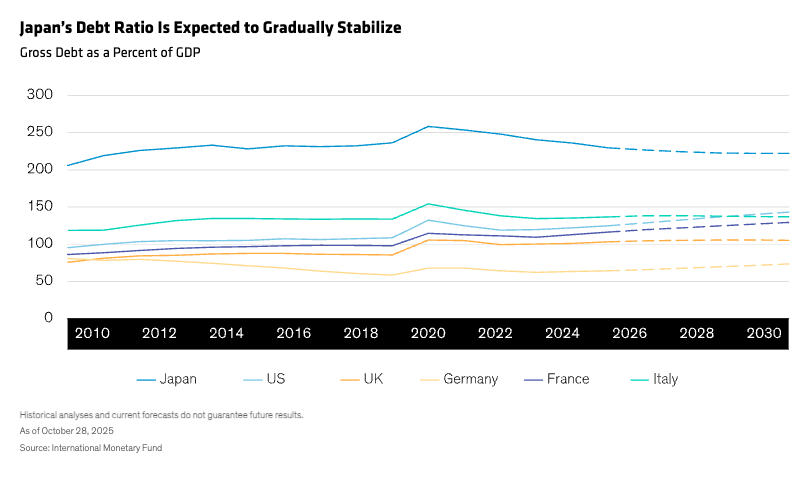
Now, the conversation is changing. The new finance minister, Satsuki Katayama, has invoked a more flexible framework—one that emphasizes the relationship between growth and borrowing costs. The logic is straightforward: if the economy grows faster than the government’s interest expenses, debt remains manageable (Display) even with moderate deficits.
That shift moves Japan’s policy focus from a narrow accounting target toward a broader measure of economic sustainability. It’s not about abandoning fiscal discipline; it’s about redefining it for a world where nominal growth and inflation finally exist again.
Japan’s Window of Opportunity
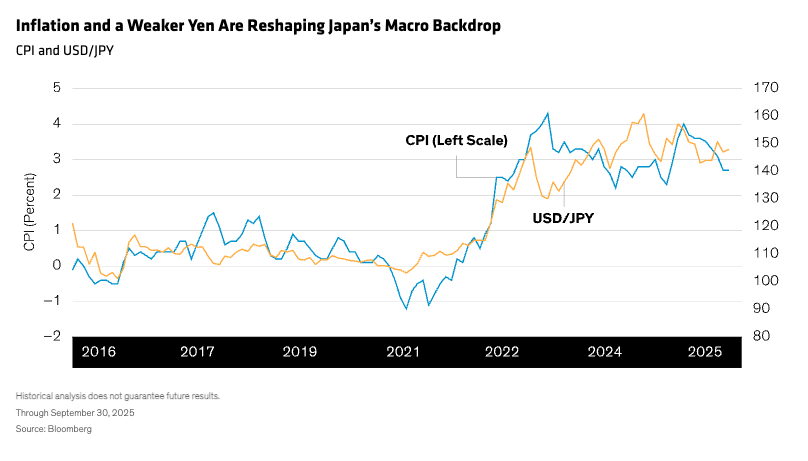
Japan’s post-pandemic environment has altered the fiscal equation. The global inflation shock and a weaker yen (Display) have combined to lift nominal growth and domestic prices.
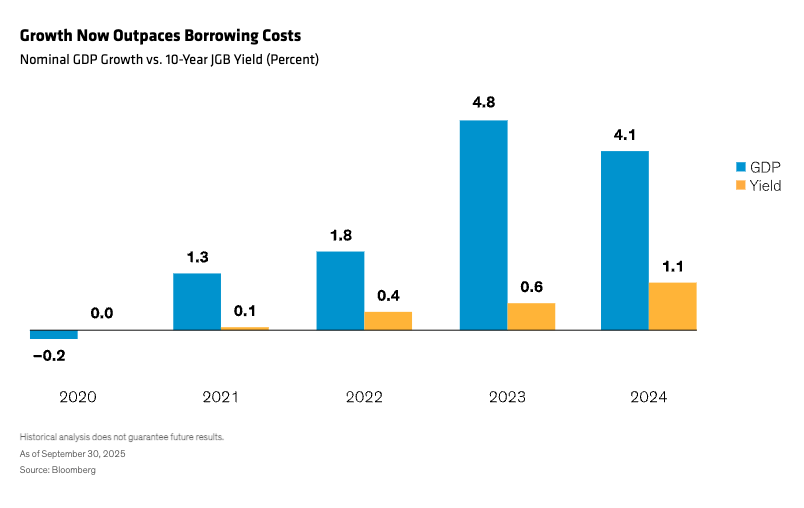
Thus, despite this year’s yield rise, the government’s borrowing costs remain manageable (Display) even as it spends more to support growth and social programs.
This is the first time in decades that Japan’s growth rate meaningfully exceeds its funding cost—a rare window that makes “responsible expansion” economically plausible. This isn’t a license for unchecked spending. But it does mean that Japan can use fiscal policy more actively without immediately undermining stability.
Implications for Investors
For bond investors, this shift has clear consequences. With the BoJ in a rate-hike phase and less present as a buyer, and with domestic life insurers’ appetite for very long duration fading faster than the Ministry of Finance is trimming issuance, upward pressure has centered on the long end: 30-year JGB yields are up nearly a full percentage point year to date.
The good news is that a steeper, more active JGB curve restores some of the yield and volatility that global investors have missed in Japan for years. For portfolios, that means renewed potential for diversification and relative-value opportunities along the curve.
At the same time, Japan’s experience may influence how other developed economies think about fiscal sustainability. The underlying principle—that growth can coexist with moderate deficits when borrowing costs are low—echoes debates in Europe and the US about how to balance stimulus and debt reduction in a post-pandemic world.
What Could Derail the Strategy?
This strategy depends on a fragile equation: nominal growth staying above interest rates. A sharp BoJ tightening cycle or a global slowdown could easily reverse that balance. If growth falters or yields rise too quickly, Japan’s debt trajectory would tilt upward again.
Still, today’s environment is far removed from the deflationary stagnation of past decades. Inflation expectations have stabilized, corporate balance sheets are healthier and wage growth—though modest—shows signs of life. In short, Japan has room to run, provided policymakers maintain credibility and avoid turning short-term stimulus into long-term habit.
A Delicate Balance
Japan’s fiscal reset represents more than a change in leadership. It’s a rethinking of how global growth, inflation and debt interact in a maturing economy. By embracing “responsible expansion,” Tokyo is betting that a little more fiscal flexibility will reinforce, not weaken, long-term stability.
For investors, this means that watching the spread between growth and yields—not just deficit headlines—will be key to understanding where Japan’s bond market, and perhaps the broader global rate environment, goes next.
The views expressed herein do not constitute research, investment advice or trade recommendations, do not necessarily represent the views of all AB portfolio-management teams and are subject to change over time.
A message from Advisor Perspectives and VettaFi: Discover something new! Click here to register for our upcoming webcasts.
© AllianceBernstein
Read more commentaries by AllianceBernstein