Artificial Intelligence (AI) has the potential to be a transformative technology that impacts how we all live and do business. With some creativity, and time for current offerings to improve, it is not difficult to imagine how in the future these systems could enhance or even replace much of the work that we humans are currently doing. Late in 2025, none of this is breaking news and the relevant questions for investors are ultimately: what is the utility of these new tools in dollar terms and when should we expect to see the benefit? More use cases uncovered, or benefits realized sooner than expected would add additional tailwinds to the AI theme, while the opposite also holds. At the index level, this is what markets are grappling with — the excitement surrounding how impactful (and ideally profitable) these technologies could be in the future, tempered by the concern that the expectations implied by current valuations are too high.
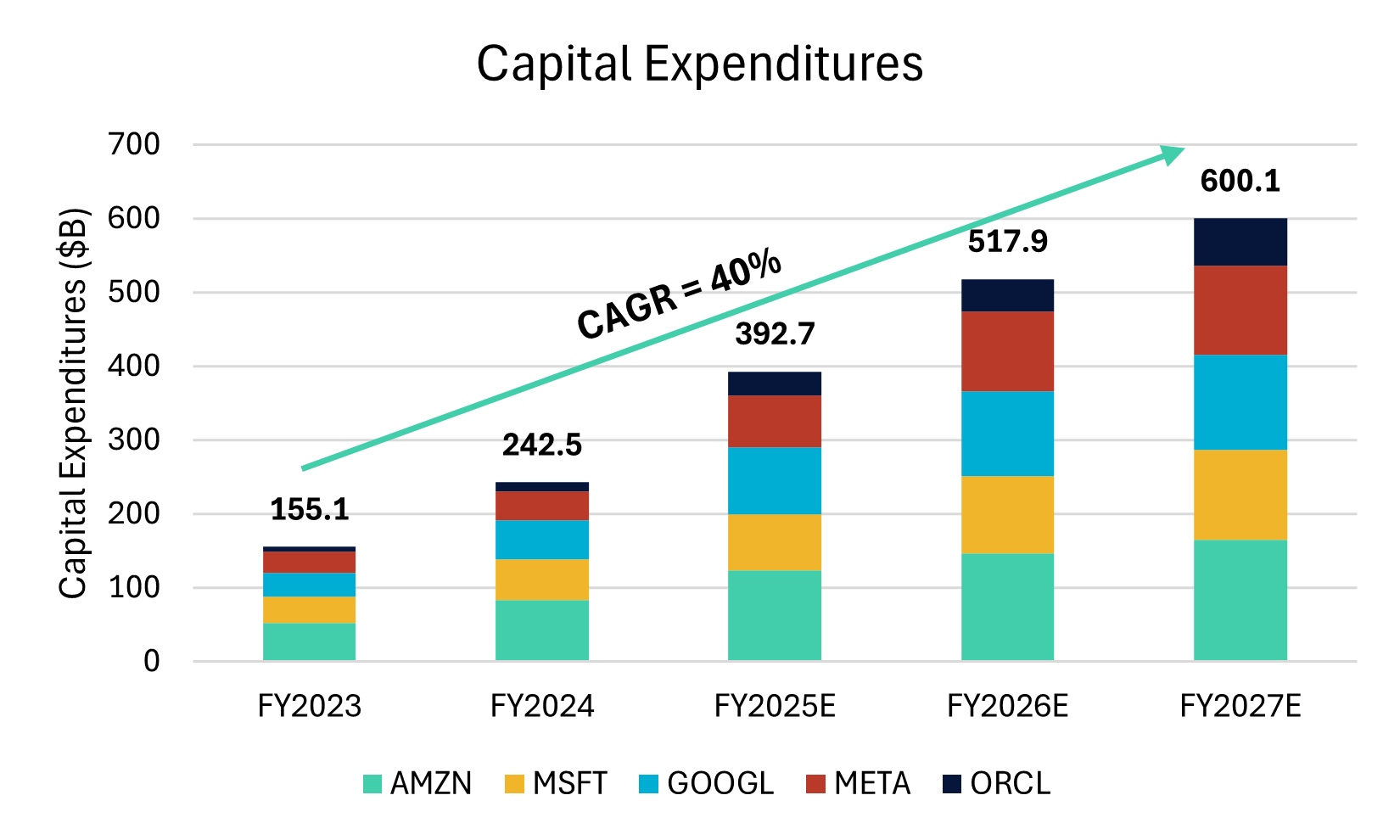
Hyperscaler Capital Expenditures

Source: LPL Research, Bloomberg (Consensus) 11/05/25
Disclosures: Past performance is no guarantee of future results. Any companies or options referenced are being presented as a proxy, not as a recommendation. Estimates may not materialize as predicted and are subject to change.
The AI hyperscalers, included in the “Hyperscaler Capital Expenditures” chart above, are fully convinced that this is a race worth winning, which is reflected in their capital expenditures (capex) growth. Across the AI theme, the investments for the supporting infrastructure (semiconductors/datacenters/energy/talent/compute) required to “stay in the game” are staggering, and the large language model business that is leveraging these new technologies is currently unprofitable. While companies like OpenAI are not profitable today, they are projecting strong growth and a path to profitability that has kept investors interested. This has allowed chipmakers, most notably NVIDIA (NVDA), to benefit from booming demand while end users work on a path to profitability. As a result, NVDA briefly achieved a $5 trillion market cap in October, has plenty of cash coming in, and can invest in its customers.
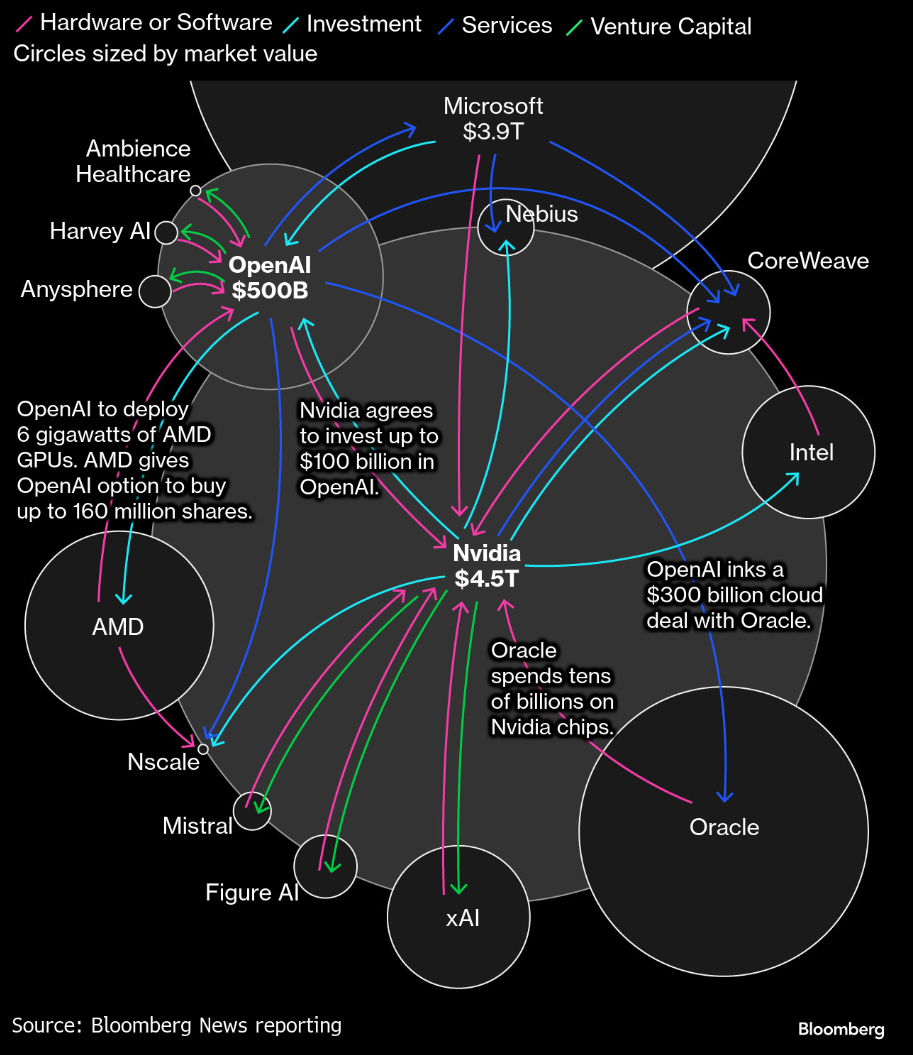
These investments could be interpreted as a vote of confidence that the users downstream will crack the profitability code, and an investment that reflects the desire to participate in the resulting growth. A more pessimistic take would be that this circular financing is being used to buttress the financial position of unprofitable business lines to maintain demand for chips. The AI ecosystem has many such relationships, as outlined in the graphic below.
How NVIDIA and OpenAI Fuel the AI Money Machine
Source: LPL Research, Bloomberg 10/08/25
Disclosures: Past performance is no guarantee of future results. Any companies or options referenced are being presented as a proxy, not as a recommendation.
In aggregate, investors have welcomed AI dealmaking and driven share prices higher following deal announcements. That said, we are watching for signs that enthusiasm may be waning. For example, we wrote about Remaining Performance Obligations (RPOs) in September when a large deal was announced between OpenAI and Oracle (ORCL). Following the announcement, ORCL shares rose sharply but are now trading closer to pre-announcement levels.
To keep up with the AI race, companies are leveraging multiple sources of capital, including Special Purpose Vehicles (SPVs). These SPVs are separate companies with their own balance sheets created by a parent company to isolate and share financial risk with other investors and creditors. While on its own, this is not nefarious, history is littered with the corporate remains of financial engineers finding clever ways to manage (i.e. hide) balance sheet risk. SPV’s catch our attention as this is how Enron hid its fraud and how banks took on much higher leverage during the great financial crisis. Regardless, it is another development that we are monitoring as companies are going to greater lengths to keep investing.
While the number of items on our list of AI theme concerns and the amount of dollars involved has grown, this general line of reasoning with respect to AI is not new. We ourselves have written similarly titled notes with similar messages over the past few years, and the AI bellwether stocks have continued to march impressively higher. All of that to say, while we believe these concerns are legitimate and each dollar invested in AI raises the bar for the expected payoff, the momentum behind this theme is strong and it is not something we are ready to step in the way of today. Earnings expectations are still growing; the synergies between AI and quantum computing remain unknown, and the current administration appears aligned with AI initiatives.
The LPL Research Strategic and Tactical Asset Allocation Committee (STAAC) remains tactically neutral on the information technology sector, where many of these AI names are concentrated, and overweight US large cap growth equities. Given NVDA’s concentration in large U.S. indexes (~8.4% of the S&P 500, and ~13.7% of the Russell 1000 Growth Index), our current positioning provides exposure to the AI theme. While cyclical investing, high capex, high valuations, and SPVs are driving us to pay even closer attention, we will happily participate in price appreciation should it continue. Furthermore, there are genuine use cases for AI, and as with most new technologies, we believe a subset of companies will find ways to leverage this new tool to create a meaningful edge and sustainably increase profits.
Thomas Shipp leads the Equity Research team at LPL Financial, which provides insights driven from quantitative and fundamental equity research.
A message from Advisor Perspectives and VettaFi: Discover something new! Click here to register for our upcoming webcasts.
Important Disclosures
This material is for general information only and is not intended to provide specific advice or recommendations for any individual. There is no assurance that the views or strategies discussed are suitable for all investors. To determine which investment(s) may be appropriate for you, please consult your financial professional prior to investing.
Investing involves risks including possible loss of principal. No investment strategy or risk management technique can guarantee return or eliminate risk.
Indexes are unmanaged and cannot be invested into directly. Index performance is not indicative of the performance of any investment and does not reflect fees, expenses, or sales charges. All performance referenced is historical and is no guarantee of future results.
This material was prepared by LPL Financial, LLC. All information is believed to be from reliable sources; however LPL Financial makes no representation as to its completeness or accuracy.
Unless otherwise stated LPL Financial and the third party persons and firms mentioned are not affiliates of each other and make no representation with respect to each other. Any company names noted herein are for educational purposes only and not an indication of trading intent or a solicitation of their products or services.
Asset Class Disclosures –
International investing involves special risks such as currency fluctuation and political instability and may not be suitable for all investors. These risks are often heightened for investments in emerging markets.
Bonds are subject to market and interest rate risk if sold prior to maturity.
Municipal bonds are subject and market and interest rate risk and potentially capital gains tax if sold prior to maturity. Interest income may be subject to the alternative minimum tax. Municipal bonds are federally tax-free but other state and local taxes may apply.
Preferred stock dividends are paid at the discretion of the issuing company. Preferred stocks are subject to interest rate and credit risk. They may be subject to a call features.
Alternative investments may not be suitable for all investors and involve special risks such as leveraging the investment, potential adverse market forces, regulatory changes and potentially illiquidity. The strategies employed in the management of alternative investments may accelerate the velocity of potential losses.
Mortgage backed securities are subject to credit, default, prepayment, extension, market and interest rate risk.
High yield/junk bonds (grade BB or below) are below investment grade securities, and are subject to higher interest rate, credit, and liquidity risks than those graded BBB and above. They generally should be part of a diversified portfolio for sophisticated investors.
Precious metal investing involves greater fluctuation and potential for losses.
The fast price swings of commodities will result in significant volatility in an investor's holdings.
This research material has been prepared by LPL Financial LLC.
Not Insured by FDIC/NCUA or Any Other Government Agency | Not Bank/Credit Union Deposits or Obligations | Not Bank/Credit Union Guaranteed | May Lose Value
For Public Use – Tracking: #822109
Read more commentaries by LPL Financial