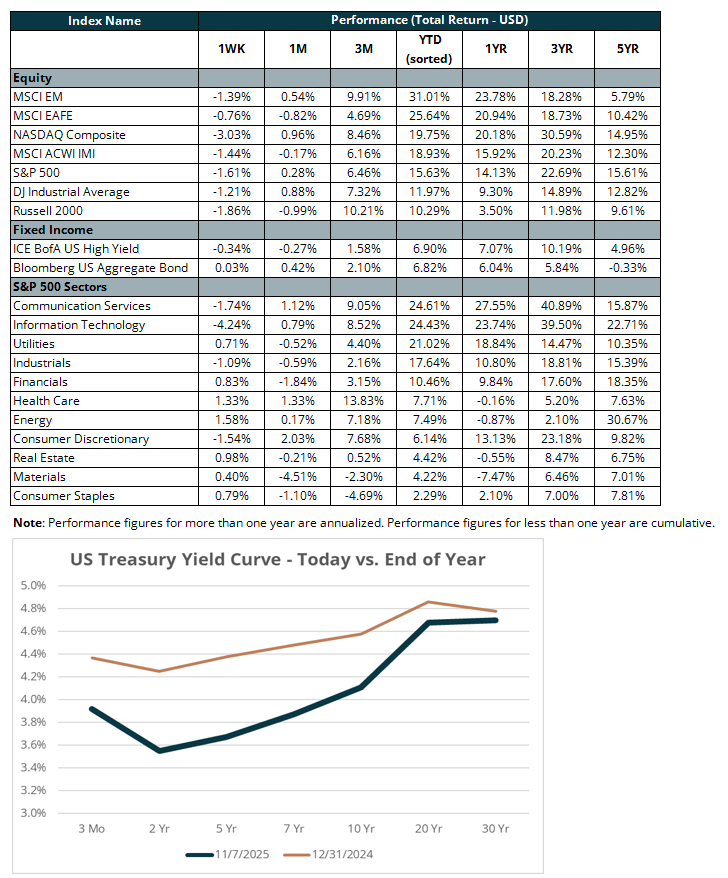
Tech stocks stumbled this week as investors questioned whether the artificial intelligence (AI) boom can continue to drive market gains. After months of sharp rallies that pushed valuations to lofty levels, warnings from Goldman Sachs and Morgan Stanley that expectations may have become overextended triggered a broad sell-off. The NASDAQ fell 1.6 per cent on Friday and capping its worst week since April, while the S&P 500 and the Dow slipped about one per cent and 0.6 per cent, respectively. Volatility surged, with the VIX jumping 16 per cent and CNN’s Fear and Greed Index sliding into “extreme fear.” By week’s end, the S&P 500 had dropped below its 50-day moving average, underscoring cooling enthusiasm for tech and a broader loss of investor confidence.
The tech-led retreat pulled down the major indices, erasing much of the prior week’s gains. The NASDAQ lost roughly three per cent for the week, its weakest performance since early April, while the S&P 500 and the Dow each declined more than one per cent. Losses deepened midweek as Nvidia, AMD, Tesla, and Microsoft slumped, weighing heavily on the broader market. Oracle fell two per cent on Friday, extending its weekly drop to about nine per cent, while AMD and Broadcom also finished lower. Stocks pared some losses late in the session after Senate leaders opened negotiations to end the federal government shutdown. Nonetheless, concerns over stretched valuations and a narrowing leadership in equities kept investors cautious heading into the weekend.
As the record-breaking shutdown dragged on and air travel chaos deepened, the Senate moved toward voting on a House funding bill after a weekend of stalled talks. Eight Democrats crossed party lines to support the measure, dropping their demand to renew Affordable Care Act subsidies in exchange for a future vote on the issue—a compromise that divided the party and drew criticism from leaders like Elizabeth Warren and Hakeem Jeffries. While the deal offered Democrats little beyond ending the impasse, it marked a political reset, as polls continued to blame Republicans for the gridlock, setting the stage for a renewed fight over healthcare ahead of the 2026 elections.
Meanwhile, cracks are emerging in the labor market. Companies announced 153,074 layoffs in October, a 183 per cent jump from September and the highest October total since 2003, according to Challenger, Gray & Christmas. Tech firms led the way with more than 33,000 job cuts as they restructured around AI, while the consumer goods and nonprofit sectors also saw steep reductions. Although Challenger’s data can be volatile, the surge rattled investors already unsettled by the lack of official employment data during the shutdown. The wave of layoffs has amplified signs of a softening job market and fueled doubts about whether the Federal Reserve will maintain its current pace of monetary easing after two rate cuts since September.
With official data releases on hold, investors are turning to alternative indicators to gauge the direction of the economy. The University of Michigan’s Consumer Sentiment Survey tumbled to 50.3 in early November, its lowest level since mid-2022 and well below expectations. The decline reflects mounting anxiety across income and political groups over the shutdown’s disruptions, from delayed flights to suspended food benefits. Economists warned that while shutdowns are usually brief, the prolonged duration of this one could inflict more lasting economic damage as job growth slows and spending weakens. The Bureau of Labor Statistics, unable to publish its monthly jobs report for a second consecutive month, had been expected to show a loss of 60,000 jobs and a rise in unemployment to 4.5 per cent. Inflation expectations have edged higher, and while the Fed recently lowered rates again, Chair Jerome Powell cautioned that another cut in December is far from guaranteed.
Looking ahead, markets are likely to remain on edge as investors weigh the fallout from the shutdown, mounting layoffs, and signs of waning consumer confidence against hopes for continued monetary policy support. Inflation data and corporate updates in the coming weeks should offer a clearer view of whether the pullback in tech and softer labor trends marks a temporary cooling or something more sustained. Until there’s greater clarity on growth, policy, and the path of interest rates, sentiment is likely to remain cautious.

The views expressed represent the opinion of Sequoia Financial Group. The views are subject to change and are not intended as a forecast or guarantee of future results. This material is for informational purposes only. It does not constitute investment advice and is not intended as an endorsement of any specific investment. Stated information is derived from proprietary and nonproprietary sources that have not been independently verified for accuracy or completeness. While Sequoia believes the information to be accurate and reliable, we do not claim or have responsibility for its completeness, accuracy, or reliability. Statements of future expectations, estimates, projections, and other forward-looking statements are based on available information and Sequoia’s view as of the time of these statements. Accordingly, such statements are inherently speculative as they are based on assumptions that may involve known and unknown risks and uncertainties. Actual results, performance or events may differ materially from those expressed or implied in such statements. Investing in equity securities involves risks, including the potential loss of principal. While equities may offer the potential for greater long-term growth than most debt securities, they generally have higher volatility. Past performance is not an indication of future results. Investment advisory services offered through Sequoia Financial Advisors, LLC, an SEC Registered Investment Advisor. Registration as an investment advisor does not imply a certain level of skill or training.
A message from Advisor Perspectives and VettaFi: Discover something new! Click here to register for our upcoming webcasts.
© Sequoia Financial Group
Read more commentaries by Sequoia Financial Group