Dear fellow investors,
My first experience with a major economic/stock market bubble was the dot-com bubble of 1998-2000. Many investors forget that the Nasdaq and S&P 500 Index bubble that ended March 10, 2000, was the first bubble in a series of three bubbles. In this missive, with the help of the band Foreigner, we will walk through the three bubbles that cursed investors from early 2000 through 2015.

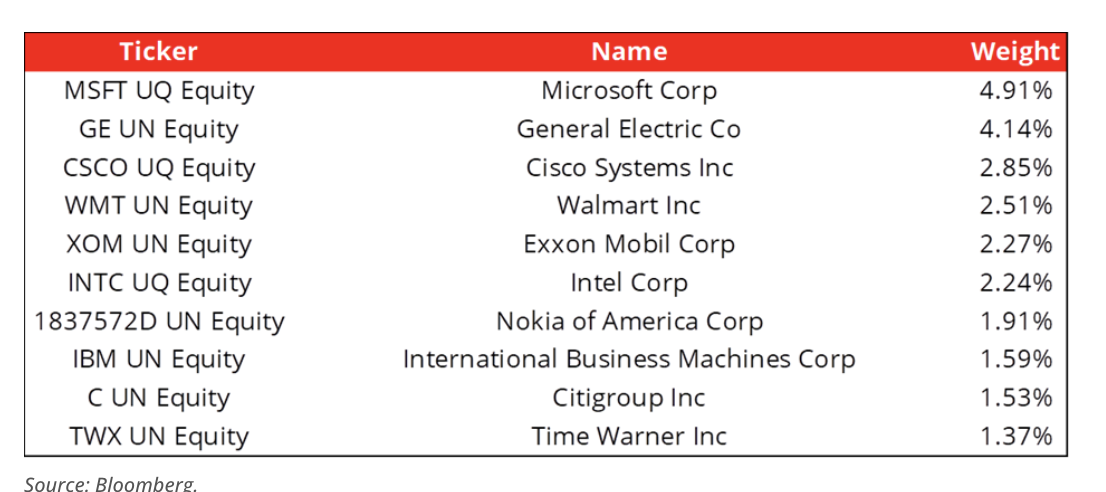
The dot-com bubble helped common stocks and the S&P 500 Index climb to heights it had never seen before. Stocks like eBay (EBAY) went public at $18 per share and soared within 12 months to a height of $640 per share. Here is a picture of the mountain that investors were climbing to make their money at the end of 1999:
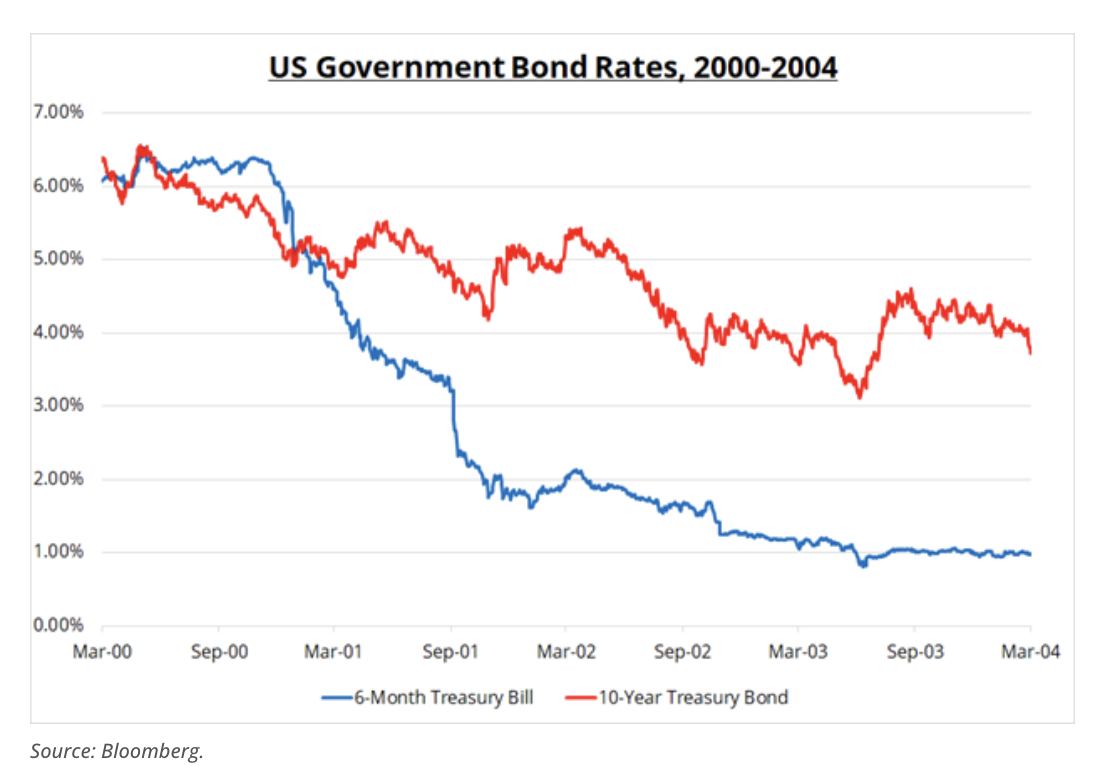
The internet was going to change our lives and ultimately become a huge economic factor in our society, but that didn’t stop it from creating a “stormy sea.” The top ten stocks reached 25.3% of the S&P 500 Index. However, the bursting of the mania around it crippled the economy and led President George W. Bush to promote what he called an “ownership society.” He knew that the multiplier effect in the economy is the highest in home building. The federal government attempted through looser regulations and moral suasion to convince average Americans to stretch their budget to buy a house. This approach encouraged aggressive lending in the property market during the recession that followed the bursting of the dot-com bubble. Lastly, it caused the Federal Reserve to bring short-term interest rates down dramatically (as shown in the next chart).
This led to the second mania in housing, which really geared up in 2003-2006. The Federal Reserve brought interest rates down in the recession that followed the dot-com bust, and investors swung into residential real estate in a big way. Investors were buying multiple homes to take advantage of the looser borrowing environment.
The housing mania poisoned the banking system in the U.S. and led to the financial crisis of 2007-2009. However, while the dot-com mania wound down in the bear market of 2000-2002 and the residential real estate mania of 2003-2006 was gearing up, the third mania of that era developed for completely different reasons. Beginning in the late 1990s, two massive population countries emerged on the global stage. China and India emerged as major economic powerhouses. Simultaneously, countries rich in natural resources like Russia, Brazil, Australia and Canada were able to attract massive investment dollars in what ended up being called “the B.R.I.C. trade.” As the S&P 500 Index went nowhere for ten years, these foreign stock markets produced superior returns and attracted massive capital flows.
This culminated in what I call the double-booth phenomenon at the Schwab and Morningstar conferences. These were the only places we could go to promote our business in the early years. In 2010 and 2011, funds like Delaware Ivy Natural Resources and managers like Matthews Asia dominated the middle of the conferences with their double booths. This indicated to us that the B.R.I.C. trade and the companies at the top of the market caps in the S&P 500 at the end of 2010, which were a part of it, must be avoided.
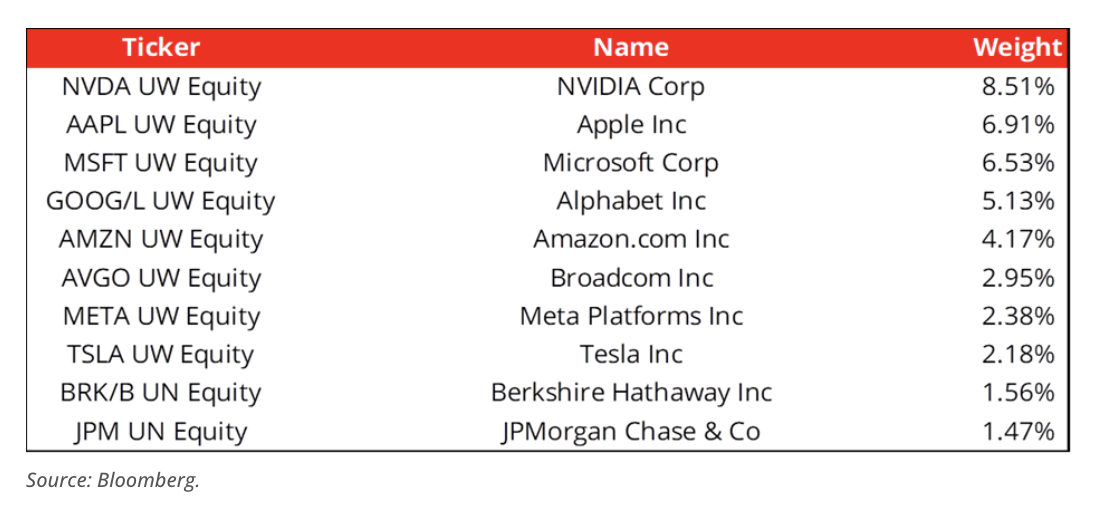
Therefore, this brings us back to arguments that are being made about why this current AI mania is nowhere near as egregious as the dot-com mania.
Now the top ten stocks are 41.78% of the entire S&P 500 Index, and people think that it’s not as crazy as the first one at 25.3%! As my favorite actor, Eugene Levy, said to his girlfriend, Queen Latifa, in the movie Burning Down the House, we are “…all twisted up in the game!” This means that we believe almost every portfolio that is overloaded in the S&P 500 Index and/or heavily invested in the top ten names will likely lose money for a decade! If the prior manias offer any instruction, you must find other ways to make money and then hope that the new format doesn’t get caught up in its own mania.
In conclusion, we are reminded of what happened in the broader stock market when the dot-com mania died. If the tiniest slice of the money that comes out of the highly concentrated glam stocks comes into undervalued areas like energy, healthcare and home builders, we could see the kind of gains that occurred in portfolios in 2000-2001, which avoided that bubble.
Lastly, we will quote the bridge lyric from the song as advice to our investors when it comes to playing with fire in popular securities or pivoting to undervalued and meritorious stocks: “Won’t you open up the door?”
Play The Long Game,
William Smead
A message from Advisor Perspectives and VettaFi: Discover something new! Click here to register for our upcoming webcasts.
The information contained in this missive represents Smead Capital Management’s opinions, and should not be construed as personalized or individualized investment advice and are subject to change. Past performance is no guarantee of future results. Bill Smead, Chairman & CIO, wrote this article. It should not be assumed that investing in any securities mentioned above will or will not be profitable. Portfolio composition is subject to change at any time and references to specific securities, industries and sectors in this letter are not recommendations to purchase or sell any particular security. Current and future portfolio holdings are subject to risk. In preparing this document, SCM has relied upon and assumed, without independent verification, the accuracy and completeness of all information available from public sources. A list of all recommendations made by Smead Capital Management within the past twelve-month period is available upon request. ©2025 Smead Capital Management, Inc. All rights reserved. This Missive and others are available at www.smeadcap.com
© Smead Capital Management
Read more commentaries by Smead Capital Management