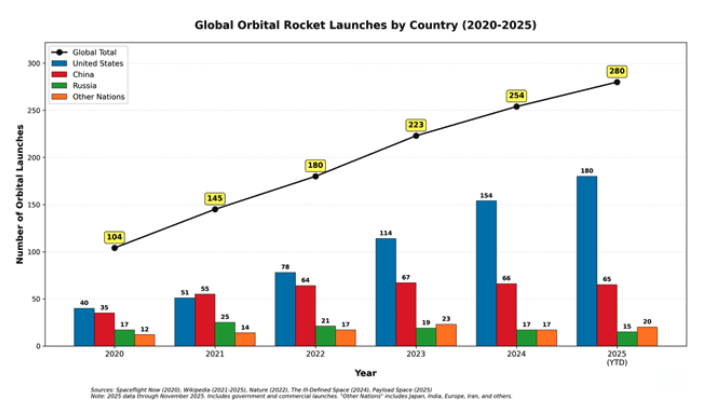
If you’d told me twenty years ago that we’d soon see rockets launching into orbit every day-and-a-half, I’d have smiled politely and changed the subject. Yet here we are: in the first half of 2025, a new launch hit the sky every 28 hours—six hours ahead of last year’s record pace. The space economy isn’t coming; it’s here and expanding faster than most nations’ GDPs.
In 2024, the global space economy hit $613 billion—up nearly 8% year-over-year. The commercial sector was responsible for nearly 80% of that growth, putting “space” on par with the GDP of Sweden. By 2035, projections put the industry at $1.8 trillion, growing at twice the expected global GDP.
Reusable Rockets and the Private Innovation Boom
Governments no longer dominate space. Private companies like SpaceX have launched a new era of innovation. Reusable rocket technology has slashed launch costs by up to 65%, powering a rapid-fire cadence of launches that’s altering the economics of everything from phone calls to pharmaceuticals.

Consider Starlink: with 10,000+ satellites in orbit and 8 million customers, SpaceX’s move into satellite internet is reshaping geopolitics as much as global communications. Amazon isn’t content to sit out the space race, having invested more than $10 billion in its Project Kuiper low orbit satellite network. It must launch over 1,600 satellites by July 2026 to meet FCC requirements.
A decade ago, the idea of tens of thousands of satellites in orbit would have been unimaginable for almost anyone not named “Musk.” Today there are equally sci-fi sounding efforts in the works, like space-based mineral mining, which could change fortunes and the global balance of power.
Asteroids: The Next Frontier (with a Few Caveats)
Investors and governments are placing real bets on space mining. Take NASA’s Psyche mission, now en route to study a metal-rich asteroid. It launched on October 13, 2023 on a SpaceX Falcon Heavy, destined for asteroid 16 Psyche, where it’s scheduled to arrive by August 2029. Psyche will spend about two years mapping the 140-mile-wide asteroid’s composition using a multispectral imager, gamma-ray and neutron spectrometer, and magnetometer.
Recent analysis indicates the Psyche 16 asteroid is likely a mixture of rock and metal, with metal composing 30% to 60% of its volume. Early estimates suggested the asteroid could contain metals worth quadrillions (!) of dollars.
Or consider California-based AstroForge, which launched its first deep-space mining mission in early 2025. While they lost contact with the craft, the speed and cost of development—10 months and $6.5 million—demonstrate private sector’s efficiency. AstroForge’s upcoming mission could become the first private landing beyond the Moon, and a sample return is already on their calendar before decade’s end.
One estimate has the market value for commercial space mining efforts growing to over $5 billion by 2030, and possibly hitting $23 billion by 2040.
The nearer-term value proposition centers on using space-mined resources in space rather than returning them to Earth. Water extracted from asteroids could potentially be converted into hydrogen and oxygen for rocket fuel, creating a virtual “gas station in space.” This would reduce deep-space mission costs. Similarly, building materials extracted from asteroids could enable space construction without materials sent from Earth.
Over the longer term, space mining could disrupt resource markets. One simulation by Tel Aviv University researchers found that a single shipment of space minerals could devalue gold by 50%. And space mining could drastically impact nations such as South Africa, which produces around 70% of the world’s platinum. Developing nations wholly dependent on mineral exports could be even more vulnerable—the Democratic Republic of Congo, which produces 70% of the world’s cobalt comes to mind.
For now, though, the logistics of asteroid mining are beyond complex and expensive. NASA’s OSIRIS-REx brought home just 122 grams of asteroid dust at a cost of over $770 million. This is not a tomorrow event, but something to watch closely.
Military Space Budgets Rising
The legal landscape around space mining is murky. The US and Luxembourg have passed laws granting property rights over extracted resources, but they’ve stopped short of sovereign territorial claims. International rules lag reality, and there’s a reason why military space budgets are rising nearly as fast as launch rates.
As Pippa Malmgren often says, “We are in a hot war in cold places”—and space is one of those places.
The new space-based economy will bring tremendous opportunities—and just as many unknowns. There will be booms, busts, and surprises we cannot imagine yet.
For now, just know that the pace of change is accelerating.
New Interview with Bruce Mehlman
It’s been a busy week in Washington. Before you go, please check out my new interview with DC insider and bipartisan lobbyist Bruce Mehlman. We cover the AI bubble, its impact on the American middle class, trade policy, and more.
Thanks for reading and watching.
Ed D'Agostino
P.S. No more app—now you can post comments directly below each Global Macro Update article. No login required, so jump in and join the conversation!
P.P.S. If you find this letter valuable, you should consider investing with me in Macro Advantage—where we uncover the forces shaping tomorrow’s markets, identify companies poised to thrive, and build resilient portfolios designed to weather inflation, economic shifts, and geopolitical shocks. Click here to learn more.
© Mauldin Economics
Read more commentaries by Mauldin Economics