Canada has long prided itself on being a winter bastion, built to withstand sudden chills and snowstorms. But when frost settles deep and the wind refuses to ease, endurance can be tested. It takes strength and resolve to persevere during a season that feels endless.
Canadians are now realizing that the U.S. trade war is no passing frost: it’s a full-blown blizzard, cutting visibility and threatening to freeze the flow of cross-border commerce. For a nation accustomed to harsh conditions, this storm feels different and harder to escape.
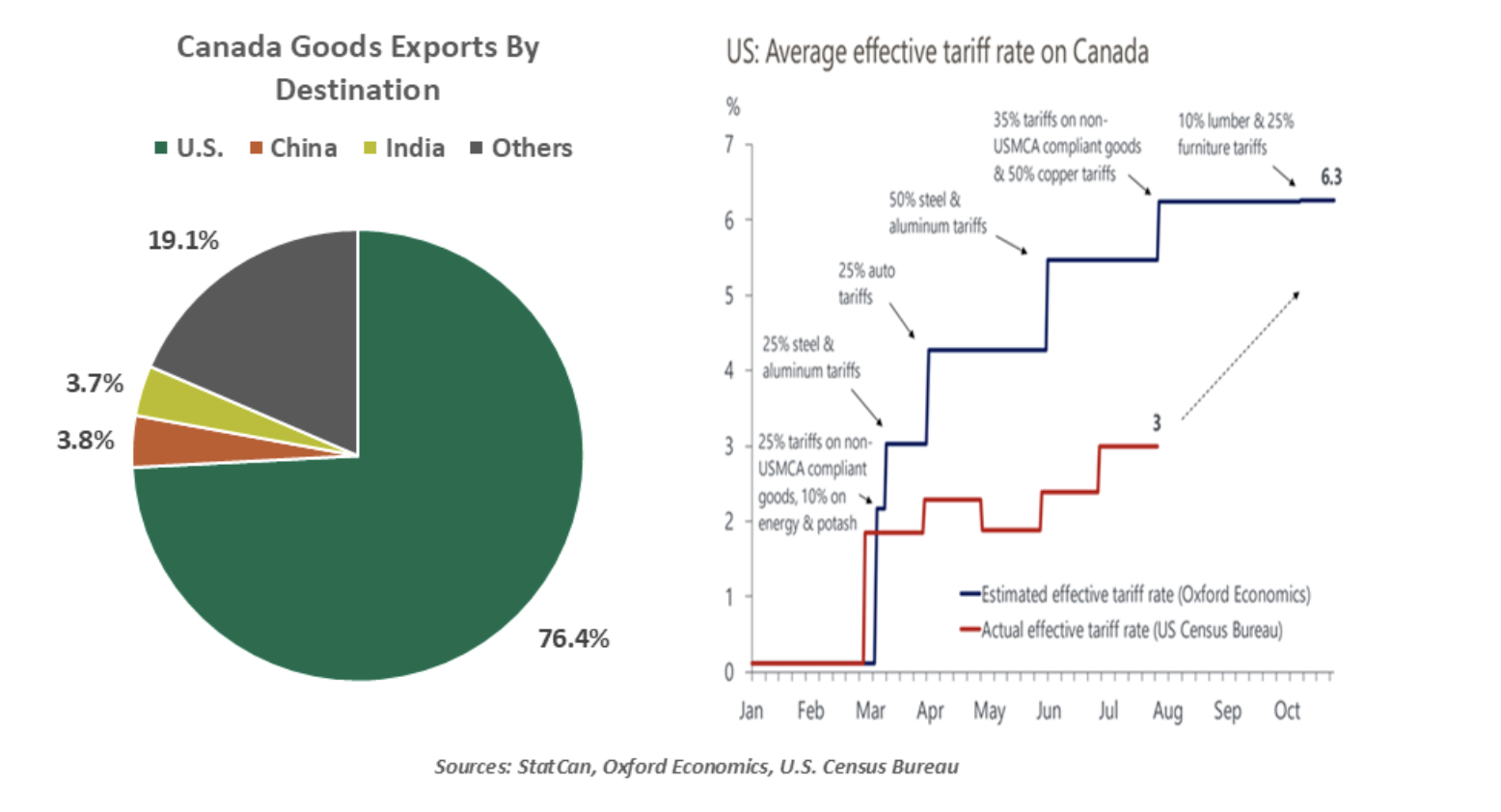
Canada and the U.S. share one of the world’s most integrated trading relationships, with about $2.5 billion in goods and services crossing the border daily. But Canada’s economic exposure to the United States far exceeds U.S. dependence on Canadian markets. The U.S. has long been Canada’s largest export destination, absorbing three-quarters of its goods shipments.
Commercial ties between Canada and the United States have grown increasingly fragile this year, not only because Canadian goods face higher tariffs, but also because Canada is among the few countries that has actively retaliated against U.S. actions. Energy resources and critical minerals, Canada’s top exports to the U.S., are now subject to a 10% levy. Beyond energy, Canada’s major shipments include autos and a wide range of agricultural products.
Trade negotiations recently stalled following an anti-tariff ad campaign aired in the U.S. by a Canadian provincial government, the latest flashpoint in a year-long dispute. In response, the U.S. administration raised duties to 35% on numerous Canadian imports and imposed higher tariffs on strategic sectors such as metals, autos, lumber and select agricultural goods.

Yet Canada still has one of the world’s lowest average effective U.S. tariff rates, as more than 85% of Canadian goods enter duty-free under the United States-Mexico-Canada Agreement (USMCA).
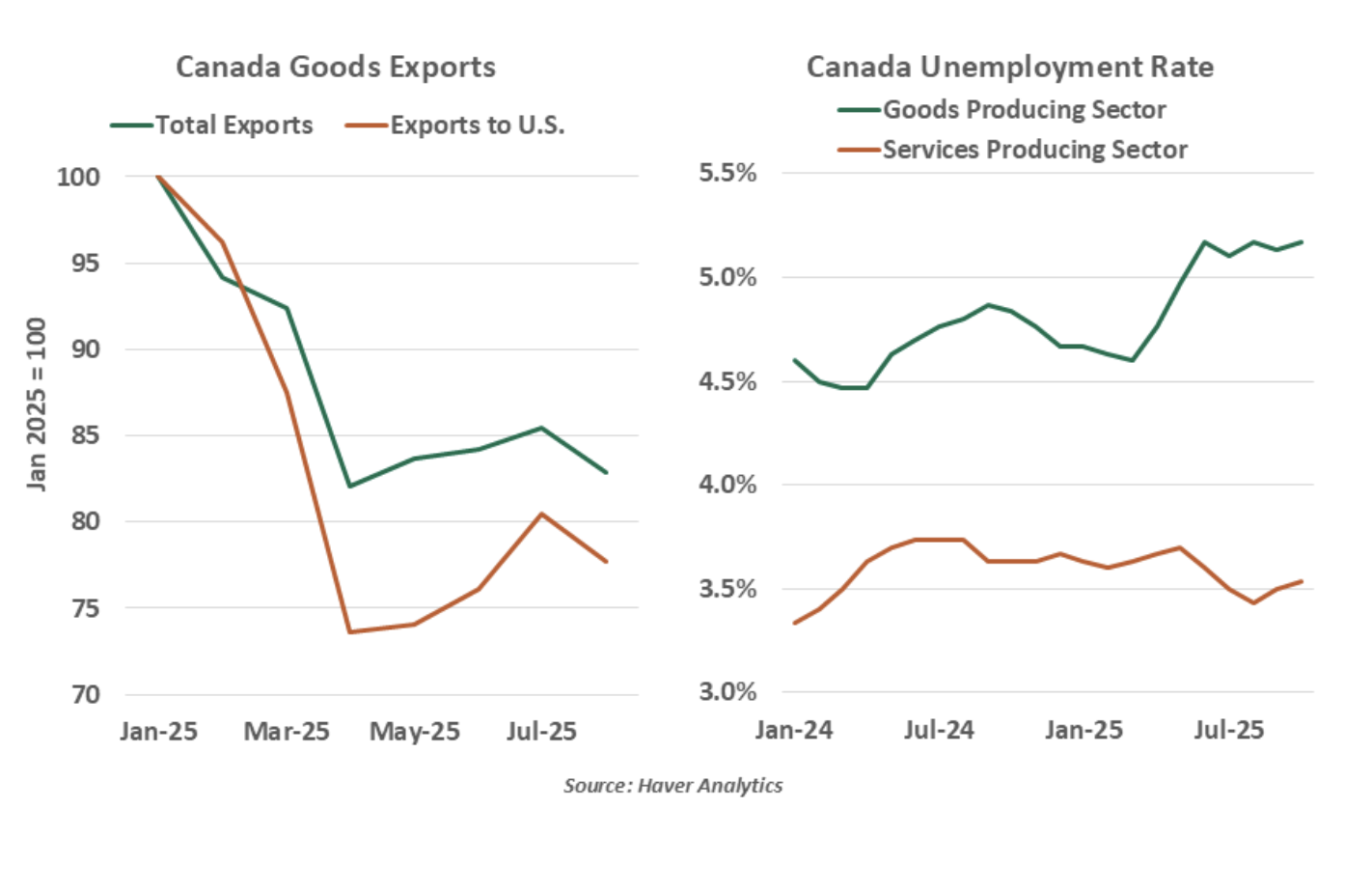
Despite these exemptions, the new levies have rattled Canadian exporters. The average effective tariff rate appears modest because it’s spread across all goods, including those exempt from duties. But for the sectors in the crosshairs, tariffs run as high as 35%, causing severe disruption. After a front-loaded surge in the first quarter, shipments from Canada to the U.S. have fallen nearly 24% from their peak at the start of the year. In April alone, exports of motor vehicles, steel and aluminum plunged by 30%. The steep decline in shipments has rippled through labor markets, pushing the economy to the verge of a recession.
With the U.S. increasingly viewed as an unreliable trade partner, the Canadian government is urging consumers to buy Canadian to cushion the blow; consumer preferences have rapidly shifted in a patriotic direction. Canadian firms are accelerating efforts to grow domestically and diversify to new overseas markets to reduce dependence on the U.S. As one example, Canadian producers are attempting to divert about 10% of the lumber normally shipped to the United States to new buyers across Europe and the Middle East.
Replacing its largest export partner next door with distant markets will be a formidable challenge. However, Canada can leverage its existing network of free trade agreements (FTAs) to access destinations offering reduced tariffs. The country currently maintains 15 FTAs with 51 nations.
Prime Minister Carney has set an ambitious goal: doubling Canada’s non-U.S. exports over the next decade. His strategy focuses on deepening ties with “the economic giants of Asia.” With the U.S. now posing its biggest economic risk, Canadians recognize they cannot afford prolonged trade or diplomatic standoffs with other major economies. This realization has prompted a thaw in relations with countries like China and India, reviving partnerships that had gone cold.
Signs of rapprochement with China are emerging. Both sides are working to resolve trade irritants, including China's tariffs on Canadian agricultural products like canola and seafood, imposed in response to Canada's 100% tariffs on Chinese electric vehicles (EVs). Beijing has signaled willingness to lift these tariffs if Ottawa reciprocates on EV duties. China recently reinstated Canada on its approved travel list for tour groups, a move expected to boost tourism and signal a cautious reopening of bilateral ties.
While most imports from Canada and Mexico are still protected under USMCA, the agreement is up for review in July 2026. Under its sunset clause, the deal expires in 2036 unless renewed; next year’s review will determine whether it will be extended for another 16 years or become subject to annual renegotiation. This review will carry high stakes, with Washington likely to leverage the process to extract further concessions on trade and non-trade issues like immigration. Potential changes could include revisions to automotive rules of origin, labor standards and dispute resolution mechanisms.
While Ottawa decries U.S. protectionism, Canada is not entirely blameless. Canadian dairy and poultry sectors are shielded by tariffs as high as 200% and a decades-old supply management system that tightly controls distribution and procurement of these items. This has been a sticking point in trade negotiations since President Trump’s first term.
The outcome of the USMCA review will shape long-term trade strategy. While the U.S. administration has recently signaled some willingness to ease tariffs for American consumers, offering a glimmer of hope for Canadian exporters, Washington shows little appetite for lifting industrial duties. Every month that auto tariffs remain in place increases the risk that global automakers shift production south of the border, a move that could severely hurt Canada’s auto industry and erode one of its most critical manufacturing pillars.
Tariff uncertainty has made the U.S.-Canada trade relationship frosty, threatening to alter business strategies and investment decisions. As the winds of U.S. protectionism howl, Canada must look beyond its southern neighbor, forging ties with other major economies. In this extreme climate, adaptability is not optional; it is the only hope for survival.
Information is not intended to be and should not be construed as an offer, solicitation or recommendation with respect to any transaction and should not be treated as legal advice, investment advice or tax advice. Under no circumstances should you rely upon this information as a substitute for obtaining specific legal or tax advice from your own professional legal or tax advisors. Information is subject to change based on market or other conditions and is not intended to influence your investment decisions.
© 2025 Northern Trust Corporation. Head Office: 50 South La Salle Street, Chicago, Illinois 60603 U.S.A. Incorporated with limited liability in the U.S. Products and services provided by subsidiaries of Northern Trust Corporation may vary in different markets and are offered in accordance with local regulation. For legal and regulatory information about individual market offices, visit northerntrust.com/terms-and-conditions.
A message from Advisor Perspectives and VettaFi: Stay ahead of market changes with our daily updates on key market and economic indicators. Visit the AP Charts and Analysis site for our expert insights.
© Northern Trust
Read more commentaries by Northern Trust