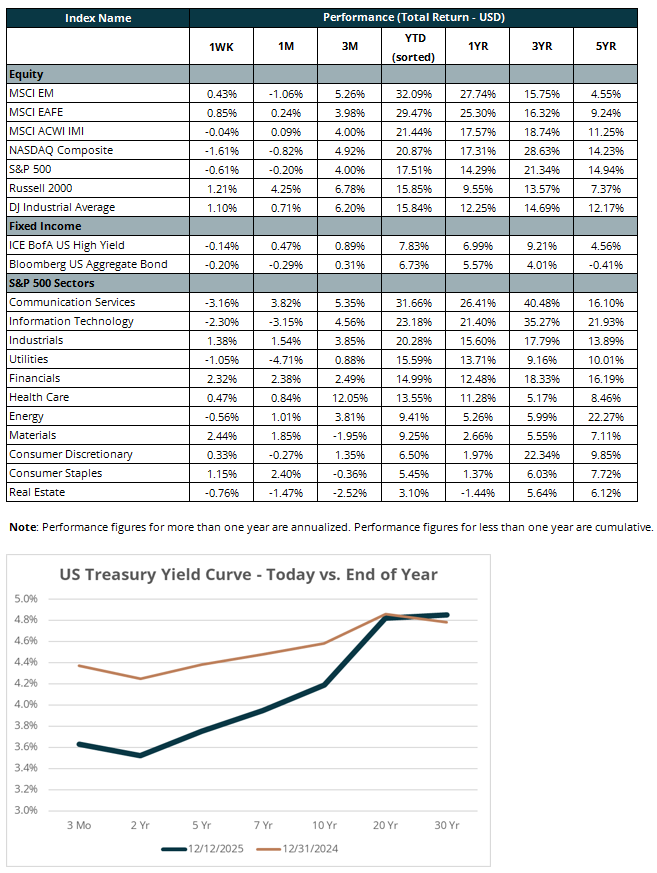
As widely expected, a divided Federal Reserve cut its benchmark interest rate by a quarter of a percentage point, marking the third consecutive meeting with a rate reduction. One voting member dissented in favor of a larger half-point cut, while two members voted to leave rates unchanged. The decision signals that the Fed is placing greater weight on softening employment data than on still-elevated inflation, as lower rates are intended to stimulate spending, investment, and hiring.
While the rate cut itself was largely priced in, the Fed surprised markets by announcing a balance-sheet expansion alongside an upward revision to its GDP growth outlook. The balance-sheet move, which involves the purchase of short-term bonds, is designed to ensure ample liquidity in the banking system ahead of the tax season. Meanwhile, the Fed raised its 2026 growth estimate to 2.3 percent from 1.8 percent, indicating confidence in the economy despite signs of labor market fatigue.
Equities rallied sharply following the announcement. The S&P 500 and Dow Jones Industrial Average extended gains into Thursday, with both indices closing at record highs. The Nasdaq, however, failed to keep pace, pressured by a disappointing earnings report from Oracle. The company reported revenue below expectations and raised its spending forecast, rekindling investor concerns about whether massive AI investments will ultimately generate adequate returns. Oracle’s results weighed on other AI-linked names as sentiment toward the sector cooled.
At the same time, investors continued to shift their focus toward other areas of the market. Financial stocks rose on expectations that increased merger and acquisition activity in 2026 could support earnings, while industrials benefited from optimism surrounding data center construction and ongoing reshoring trends.
The week ended on a weaker note after Broadcom’s earnings report added fuel to AI-related skepticism. Although Broadcom posted a 74 percent surge in AI chip sales that exceeded Wall Street estimates, management guided to a gross margin of 77 percent, down from 79 percent last year. The stock fell 11 percent on Friday, dragging the tech-heavy Nasdaq to a 1.6 percent loss for the week.
One notable bright spot late in the week was the cannabis sector. The President indicated he would soon sign an executive order reclassifying marijuana as a less-regulated Schedule III drug. Shares of Tilray Brands and Canopy Growth both jumped more than 50 per cent on the news.
In contrast to the volatility in equities, the bond market was relatively subdued. With the rate cut already reflected in prices, bond investors focused on signals about the future policy path. While markets are pricing in two rate cuts in 2026, the Fed suggested it may only cut once next year, potentially not until after a new Fed Chair takes over in May. As a result, the Fed’s announcement generated little enthusiasm in fixed income, leaving the Bloomberg Aggregate Bond Index slightly lower on the week.
Overall, the week underscored a familiar theme: even as headline indices reach new highs, leadership within the market continues to shift, reinforcing the importance of diversification across sectors and asset classes.

The views expressed represent the opinion of Sequoia Financial Group. The views are subject to change and are not intended as a forecast or guarantee of future results. This material is for informational purposes only. It does not constitute investment advice and is not intended as an endorsement of any specific investment. Stated information is derived from proprietary and nonproprietary sources that have not been independently verified for accuracy or completeness. While Sequoia believes the information to be accurate and reliable, we do not claim or have responsibility for its completeness, accuracy, or reliability. Statements of future expectations, estimates, projections, and other forward-looking statements are based on available information and Sequoia’s view as of the time of these statements. Accordingly, such statements are inherently speculative as they are based on assumptions that may involve known and unknown risks and uncertainties. Actual results, performance or events may differ materially from those expressed or implied in such statements. Investing in equity securities involves risks, including the potential loss of principal. While equities may offer the potential for greater long-term growth than most debt securities, they generally have higher volatility. Past performance is not an indication of future results. Investment advisory services offered through Sequoia Financial Advisors, LLC, an SEC Registered Investment Advisor. Registration as an investment advisor does not imply a certain level of skill or training.
A message from Advisor Perspectives and VettaFi: Discover something new! Click here to register for our upcoming webcasts.
© Sequoia Financial Group
Read more commentaries by Sequoia Financial Group