Additional content provided by Brian Booe, Associate Analyst, Research.
As investors stepped away from the tape to hang their final holiday decorations, pack their bags to visit loved ones, and prepare for the New Year, markets fell quiet over the last two weeks of 2025. Amid the heavily thinned trading, the Bureau of Economic Analysis revised their print for third quarter economic growth on December 23, which cruised past estimates and indicated the resilient U.S. economy expanded at its fastest pace in two years. While the headline result is a positive sign — and helped lift the S&P 500 to a record high above 6,900 following the release — another notable data point was potentially overlooked — the stock and flow of U.S. money supply in circulation.
Money supply, the total volume of money held by the public, is released alongside gross domestic product (GDP) data, and fresh metrics on economic growth and money supply also yield updated M2 velocity data. The U.S. M2 money supply is made up of cash, checking deposits, and non-cash assets than can easily be converted into cash, and the velocity of M2 money supply measures how fast money changes hands in purchases of goods and services.
The Velocity Quandary
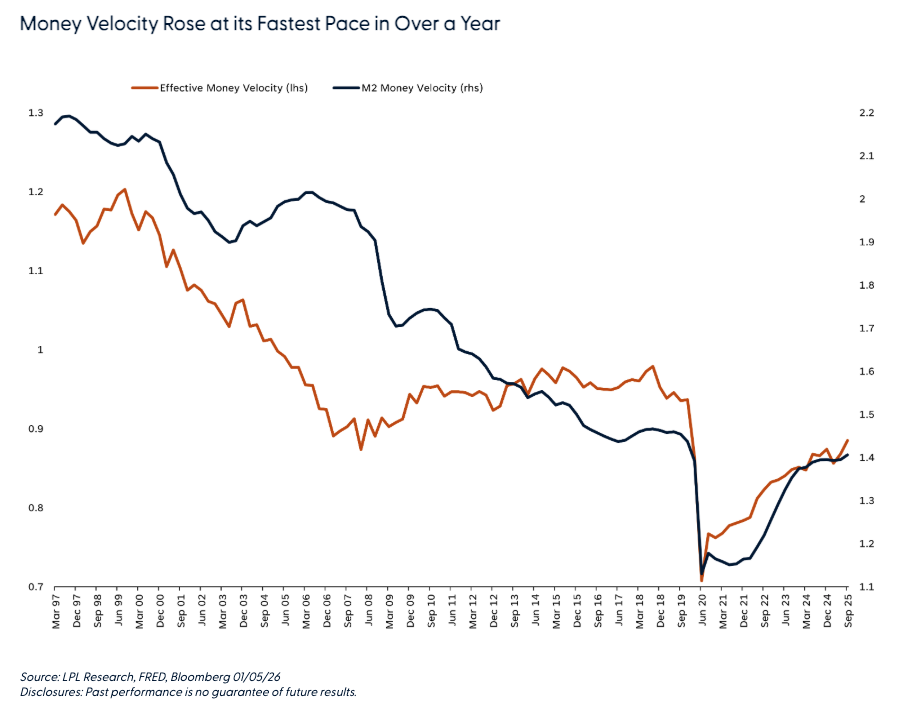
For some background on why we find the latest velocity data noteworthy, the market remains in one of the most peculiar conundrums of modern economic history. M2 velocity has steadily declined since 1997 and remains stuck near historic lows, likely a side effect of consumers and businesses hoarding cash, increased investment channels, and low interest rates and quantitative easing from the Federal Reserve (Fed). Further, despite money supply increasing at the fastest rate in 75 years during the pandemic, velocity plummeted before recovering in 2022 and 2023, as the pandemic entered the rearview mirror and as M2 money supply declined. However, velocity entered a rare period of stagnation over the last year and a half as the economy cooled.
Fast forward to the latest release, and the velocity of M2 money supply rose to 1.406. The increase — while modest — marked the largest rise since the second quarter of 2024, snapped velocity’s recent flatline, and moved above levels seen at the onset of the pandemic, indicating that the economy may be poised for accelerated expansion as we expect. In addition to the rise in M2 velocity, a measure of effective money velocity from Bloomberg, which has historically led M2 velocity over the last 50 years, also rose at its fastest pace since the second quarter of 2024, and at its third-fastest rate in the last five years.

Why Does Velocity Matter?
Velocity isn’t an abstract metric, but a pulse check on economic vitality, consumer confidence, and an important economic indicator when used in conjunction with other data points such as GDP. While it would take time for money velocity to, if ever, reapproach levels seen at the turn of the century, the recent rise in M2 velocity suggests the U.S. economy’s spending intensity is recuperating toward pre-pandemic levels, and that the Fed successfully managed to stabilize M2 money supply growth while supporting a stable financial system. While we recognize that one data point does not constitute a trend, money supply and velocity data points in the coming quarters may garner more attention in addition to economic growth figures as, should velocity metrics continue to improve, a renewed uptrend could help strengthen corporate revenue and earnings, helping justify elevated equity valuations and carry a bullish tone for equities. Another potential tailwind for equities would be welcome, of course, and could help underpin our view that the bull market is poised to extend its run in 2026. LPL Research remains tactically neutral equities while waiting for a more attractive entry point to consider adding to equities and maintains a preference for growth style stocks over value.
Jeffrey Roach guides the overall view of the economy for LPL Financial Research and has over 20 years of experience in investing and economics.
Important Disclosures
This material is for general information only and is not intended to provide specific advice or recommendations for any individual. There is no assurance that the views or strategies discussed are suitable for all investors. To determine which investment(s) may be appropriate for you, please consult your financial professional prior to investing.
Investing involves risks including possible loss of principal. No investment strategy or risk management technique can guarantee return or eliminate risk.
Indexes are unmanaged and cannot be invested into directly. Index performance is not indicative of the performance of any investment and does not reflect fees, expenses, or sales charges. All performance referenced is historical and is no guarantee of future results.
This material was prepared by LPL Financial, LLC. All information is believed to be from reliable sources; however LPL Financial makes no representation as to its completeness or accuracy.
Unless otherwise stated LPL Financial and the third party persons and firms mentioned are not affiliates of each other and make no representation with respect to each other. Any company names noted herein are for educational purposes only and not an indication of trading intent or a solicitation of their products or services.
Asset Class Disclosures –
International investing involves special risks such as currency fluctuation and political instability and may not be suitable for all investors. These risks are often heightened for investments in emerging markets.
Bonds are subject to market and interest rate risk if sold prior to maturity.
Municipal bonds are subject and market and interest rate risk and potentially capital gains tax if sold prior to maturity. Interest income may be subject to the alternative minimum tax. Municipal bonds are federally tax-free but other state and local taxes may apply.
Preferred stock dividends are paid at the discretion of the issuing company. Preferred stocks are subject to interest rate and credit risk. They may be subject to a call features.
Alternative investments may not be suitable for all investors and involve special risks such as leveraging the investment, potential adverse market forces, regulatory changes and potentially illiquidity. The strategies employed in the management of alternative investments may accelerate the velocity of potential losses.
Mortgage backed securities are subject to credit, default, prepayment, extension, market and interest rate risk.
High yield/junk bonds (grade BB or below) are below investment grade securities, and are subject to higher interest rate, credit, and liquidity risks than those graded BBB and above. They generally should be part of a diversified portfolio for sophisticated investors.
Precious metal investing involves greater fluctuation and potential for losses.
The fast price swings of commodities will result in significant volatility in an investor's holdings.
This research material has been prepared by LPL Financial LLC.
Not Insured by FDIC/NCUA or Any Other Government Agency | Not Bank/Credit Union Deposits or Obligations | Not Bank/Credit Union Guaranteed | May Lose Value
For Public Use – Tracking: #845248
A message from Advisor Perspectives and VettaFi: Discover something new! Click here to register for our upcoming webcasts.
Read more commentaries by LPL Financial