Last week in our latest Cyclical Outlook, “Compounding Opportunity,” we argued that beneath the economy’s broad resilience lies a stark divergence. U.S. policy pivots combined with the surge in adoption of AI technology have created winners and losers: Many large, capital-intensive firms that are aggressively deploying AI are pulling ahead, while more and more workers (and their households) are falling behind. These crucial macro trends appear poised to continue, with ramifications for the economy, markets, and politics in 2026 and beyond.
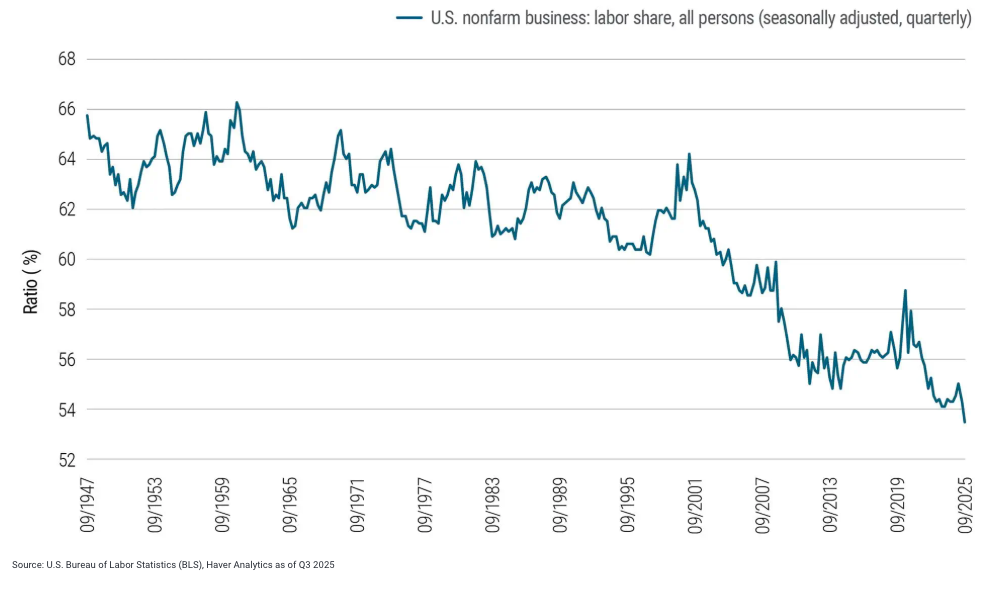
The latest U.S. productivity and labor cost data offer a clear illustration of the diverging trends underlying resilient economic growth – the so-called K-shaped economy. As of the third quarter of 2025, U.S. productivity grew roughly 2% from a year earlier, in line with its post-pandemic average and well above trends in other developed markets. Yet U.S. laborers weren’t able to capture the full benefit of their more productive work. Indeed, U.S. labor’s share of income fell to a record low in a dataset stretching back nearly eight decades – see Figure 1.
Figure 1: U.S. labor market’s share of income has hit a record low

The decline of labor share: a structural story, not a cyclical one
U.S. labor share – the fraction of an economy’s income that accrues to workers in exchange for their labor services – was relatively stable from the 1940s (when the U.S. Bureau of Labor Statistics or BLS began reporting the labor share metric in its productivity and cost report) to the 1990s, averaging roughly 60%–65%. There were cyclical swings in these decades, with labor share rising in response to falling unemployment and tighter labor markets, and dropping after recessions amid rising labor market slack.
After the late 1990s, something changed. Labor share continued to fall in the wake of every major recession, but unlike in the pre-1990s, it never really recovered during the post-recession expansions, when labor market slack was absorbed. What’s more, during the acute labor shortages following the 2020 pandemic – a period when job openings outpaced unemployed workers by a ratio of two to one, according to the BLS – labor share similarly dropped without recovery.
So what happened?
Economists generally link this three-decade decline in labor share to several forces:
-
Weakened labor bargaining power: The long-term decline in numbers of unionized workers, alongside fissured employment structures more heavily reliant on contract and gig workers, plus reduced job-switching in the past few years have all permanently shifted bargaining dynamics.
-
Globalization: China‑driven import competition has hollowed out high‑labor‑share U.S. manufacturing sectors.
-
Technological change: Starting with PCs and software, and now adding automation and AI, technological tools are easily substituting for mid‑skilled and increasingly high‑skilled labor. The falling relative price of software, computers, and components also make capital a relatively cheap substitute for labor.
-
Market concentration: “Superstar firms” with high margins, intangible‑heavy business models, and global scale compress labor’s ability to capture value.
-
Accounting shifts: The reclassification of research and development as intangible capital instead of expenses mechanically lowered labor share. Similarly, the evolution toward equity‑based pay and the reclassification of self‑employment income blurs the line between labor and capital income.
In other words, today’s leading firms rely heavily on intangible capital – software, IP, data, algorithms, brand equity – that scales with little additional labor. This shifts income structurally toward capital. Intangibles generate high returns and tend to widen competitive moats. They also reduce labor’s marginal contribution to output, even when headcount grows. Intangibles increase concentration, which weakens wage pass‑through.
This inexorable growth in intangible capital helps explain why even historically strong post-pandemic U.S. labor markets in 2021–2022 did not deliver sustained wage share gains. Further forced digitization of the service sector due to pandemic-related social distancing, plus the persistence of flexible work arrangements (e.g., working from home), also likely contributed to the recent drop in labor share.
Looking ahead: AI and policy to further weigh down labor share
The outlook for labor share isn’t great. Indeed, further declines shouldn’t be surprising given tax incentives, trade policy, and technology transformations. Large, relatively capital-intensive firms now have a strong tax incentive to invest in labor-cost-saving technologies. AI remains a relatively affordable and deployable substitute for many tasks that are currently done by humans.
On top of that, there is little evidence that labor-intensive manufacturing supply chains are returning to the U.S. The U.S. increasingly specializes in high‑capital‑share industries by design – semiconductors, cloud infrastructure, AI computing – sectors that generate output with small marginal labor requirements.
Wider economic context
Why does this matter? A lower labor share has important implications for aggregate demand, inflation, and the economy’s sensitivity to financial market movements, in addition to political ramifications.
The downshift in labor share could make the economy more volatile and sensitive to asset price changes, where negative wealth shocks transmit more quickly into real activity. Indeed, the flipside of labor share losses is capital share gains. Recently, these gains have supported corporate profitability as well as equity performance, in turn creating greater wealth for those who own equities. These wealth gains, in turn, appeared to have bolstered aggregate consumption, despite falling real income growth.
However, historically, higher-income and wealthy households tend to have lower marginal propensities to consume, raising questions around the durability of resilient real consumption. Indeed, as the income distribution further shifts, consumption growth is likely to become more fragile and more dependent on asset prices, credit, or fiscal support.
In addition to creating economic fragilities, falling labor share has potentially dovish implications for monetary policy. Productivity gains that do not accrue to workers tend to be disinflationary, as they reduce unit labor input costs, which should eventually feed into price dynamics. Mathematically speaking, nominal wage inflation should equal price inflation + productivity gains + changes in labor share of income. The fact that labor share has fallen means that nominal wages haven’t kept pace with productivity growth plus inflation. In other words, workers haven’t been able to capture the real income gains generated by their own (and AI-related) higher productivity, reducing corporate cost pressures.
Rising financial stability risks are also a potential by-product of these macroeconomic trends, including widespread AI adoption. U.S. equity valuations appear elevated, and past experience reminds us that boom-and-bust investment cycles have tended to coincide with the proliferation of new general-purpose technologies. An overly dovish Federal Reserve could exacerbate potential overinvestment and economic imbalances.
Finally, persistent declines in labor share have also historically coincided with public policy shifts, including protectionist or interventionalist policies and rising populist pressures. Political cycles are likely to be more volatile.
Investment implications
These macro trends suggest that investors should be prepared for greater economic and policy volatility. In this environment, high quality fixed income continues to offer attractive yields, flexibility, and global diversification at a time of stretched equity valuations and tight credit spreads.
A message from Advisor Perspectives and VettaFi: Discover something new! Click here to register for our upcoming webcasts.
Disclosures
All investments contain risk and may lose value.
Statements concerning financial market trends or portfolio strategies are based on current market conditions, which will fluctuate. There is no guarantee that these investment strategies will work under all market conditions or are appropriate for all investors and each investor should evaluate their ability to invest for the long term, especially during periods of downturn in the market. Outlook and strategies are subject to change without notice.
PIMCO as a general matter provides services to qualified institutions, financial intermediaries and institutional investors. Individual investors should contact their own financial professional to determine the most appropriate investment options for their financial situation. This material contains the opinions of the author and such opinions are subject to change without notice. This material has been distributed for informational purposes only and should not be considered as investment advice or a recommendation of any particular security, strategy or investment product. Information contained herein has been obtained from sources believed to be reliable, but not guaranteed. No part of this material may be reproduced in any form, or referred to in any other publication, without express written permission. PIMCO is a trademark of Allianz Asset Management of America LLC in the United States and throughout the world.
© PIMCO
Read more commentaries by PIMCO