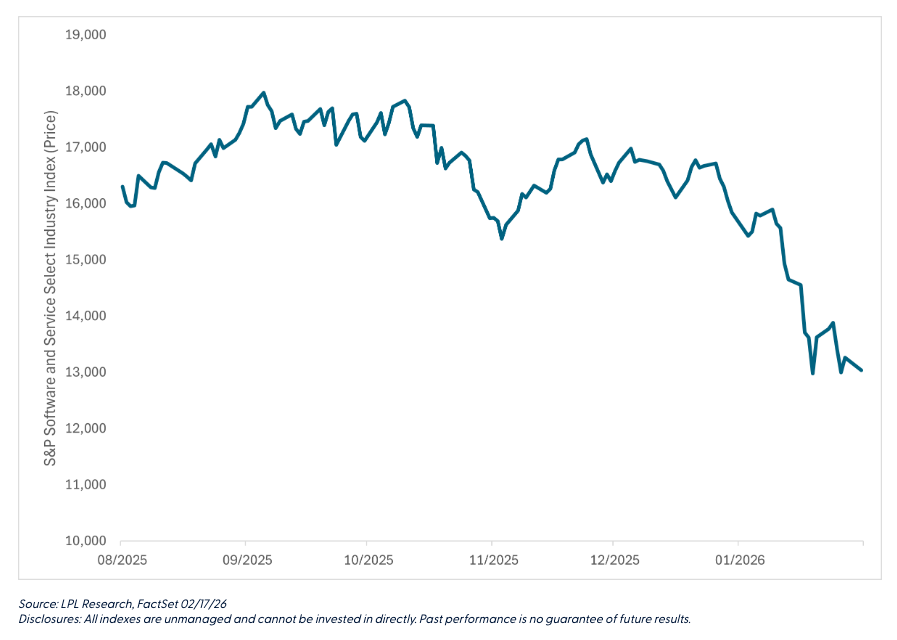
Many software stocks have been under pressure in recent months, as investors have started to perceive them as vulnerable to emerging artificial intelligence (AI) technology. As highlighted in the “6-Month Price History of the S&P Software and Service Index” chart, software stocks have declined roughly 27% from their September 2025 high.
6-Month Price History of the S&P Software and Service Index

Is This a Buying Opportunity?
Do current stock prices represent an opportunity, or are the market’s concerns about AI justified? Today, we highlight the bull and bear case for software stocks as seen by two well respected managers of growth equities at notable investment firms. Ronald Zibelli is Chief Investment Officer of Growth Equities at Invesco and holds a cautious view on software companies in the current environment. Randy Gwirtzman, Portfolio Manager at Baron Capital, specializing in small cap growth stocks, is excited about particular opportunities in the software industry.
The Bear Case for Software
According to Zibelli, many software companies are vulnerable to disruption from AI-driven competitors. In his four-decade career in money management, he has never been more bearish on software stocks. He believes investors have become accustomed to stellar performance from software stocks over a strong two-decade run, but he notes these companies have matured and growth rates are falling. Meanwhile, AI startups that could offer competing solutions are rapidly scaling. Investors have historically assigned software stocks a high valuation, but Zibelli believes the prudence of that is now in question. The urgency for companies to invest in AI is acute, which may be crowding out spending on traditional software. Companies often have a limited IT budget, and they may be more willing to spend on AI than to upgrade their legacy systems. Strategies managed by Zibelli’s team are likely to be underweight software compared to the benchmark indexes, which is a notable change from prior years.
The Bull Case for Software
Gwirtzman provides an opposing, bullish case on particular software companies. According to Gwirtzman, “the [AI] story is overwhelming the reality.” Among the companies he monitors, he believes valuations are the lowest they have been since 2015. At these reduced valuation levels, private equity buyers are showing interest in buying software companies outright, which may help provide price support to the stocks. Gwirtzman walked us through examples of software companies that serve critical functions that he believes AI cannot replicate. When asked about the potential for declining profit margins, Gwirtzman responded that, for companies that cannot be replaced by AI solutions, the margins are sustainable. This may be important to investors, because the software industry developed a reputation for recurring revenue that required relatively modest costs to generate. In other words, once a product was developed, it could be continually resold with little additional cost. Gwirtzman is focused on identifying the best companies and is not buying software indiscriminately. Rather, he is focusing mainly on companies that are vertically integrated, often serving crucial functions to niche industries, and he is avoiding companies dependent on their number of users, particularly where the number of users could be declining.
Software Valuations in Historical Context
Largely due to their high profit margins, software companies have historically been rewarded by investors with price-to-sales ratios above the overall market. The price-to-sales ratio for many software companies has recently fallen below that of the overall market for the first time in 10 years. For software companies to re-establish a premium valuation, investors may want to see reassurance that profit margins will continue to be robust.
Take-Aways for Investors
If certain mutual funds, exchange-traded funds (ETFs), or separately managed accounts (SMAs) in your portfolio have recently underperformed, it may be due to their software exposure. You may want to investigate their holdings and rationale for their investments. Investors who partner with LPL may benefit from our ongoing monitoring of portfolios. LPL Research offers our own proprietary views on the economy, markets, and sectors that we believe are valuable to investors. We also provide access to outside money managers who are free to represent their own unique views in the portfolios they manage. When outsourcing money management, such as when purchasing a mutual fund, ETF, or SMA, investors delegate daily decisions to experienced professionals actively researching and trading in the markets. Furthermore, when LPL Research provides oversight of its model portfolios, we periodically review the exposures we are getting from various funds, ETFs, and SMAs to review that they are well-balanced and not unduly exposed to a particular investment style or market segment.
A message from Advisor Perspectives and VettaFi: Discover something new! Click here to register for our upcoming webcasts.
Important Disclosures
This material is for general information only and is not intended to provide specific advice or recommendations for any individual. There is no assurance that the views or strategies discussed are suitable for all investors. To determine which investment(s) may be appropriate for you, please consult your financial professional prior to investing.
Investing involves risks including possible loss of principal. No investment strategy or risk management technique can guarantee return or eliminate risk.
Indexes are unmanaged and cannot be invested into directly. Index performance is not indicative of the performance of any investment and does not reflect fees, expenses, or sales charges. All performance referenced is historical and is no guarantee of future results.
This material was prepared by LPL Financial, LLC. All information is believed to be from reliable sources; however LPL Financial makes no representation as to its completeness or accuracy.
Unless otherwise stated LPL Financial and the third party persons and firms mentioned are not affiliates of each other and make no representation with respect to each other. Any company names noted herein are for educational purposes only and not an indication of trading intent or a solicitation of their products or services.
Asset Class Disclosures –
International investing involves special risks such as currency fluctuation and political instability and may not be suitable for all investors. These risks are often heightened for investments in emerging markets.
Bonds are subject to market and interest rate risk if sold prior to maturity.
Municipal bonds are subject and market and interest rate risk and potentially capital gains tax if sold prior to maturity. Interest income may be subject to the alternative minimum tax. Municipal bonds are federally tax-free but other state and local taxes may apply.
Preferred stock dividends are paid at the discretion of the issuing company. Preferred stocks are subject to interest rate and credit risk. They may be subject to a call features.
Alternative investments may not be suitable for all investors and involve special risks such as leveraging the investment, potential adverse market forces, regulatory changes and potentially illiquidity. The strategies employed in the management of alternative investments may accelerate the velocity of potential losses.
Mortgage backed securities are subject to credit, default, prepayment, extension, market and interest rate risk.
High yield/junk bonds (grade BB or below) are below investment grade securities, and are subject to higher interest rate, credit, and liquidity risks than those graded BBB and above. They generally should be part of a diversified portfolio for sophisticated investors.
Precious metal investing involves greater fluctuation and potential for losses.
The fast price swings of commodities will result in significant volatility in an investor's holdings.
This research material has been prepared by LPL Financial LLC.
Not Insured by FDIC/NCUA or Any Other Government Agency | Not Bank/Credit Union Deposits or Obligations | Not Bank/Credit Union Guaranteed | May Lose Value
Read more commentaries by LPL Financial