Ongoing military actions in the Middle East have increased investor uncertainty. Of course, geopolitical risk has always existed, and this time is no different. But the impact of events like these on U.S. investors will vary depending on the lasting effects on fundamental drivers of returns, such as job creation, inflation, economic growth, and corporate earnings.
For example, military action in Venezuela earlier this year had little market effect because it was short-lived and did not significantly affect economic conditions. In contrast, Russia’s invasion of Ukraine in 2022 had a longer-lasting impact on investors. Reduced supplies of energy and agricultural goods contributed to accelerated inflation in the U.S. In June of that year, overall inflation (CPI) was up 9 percent from the year before. Stock and bond markets struggled for the first nine months of the year before eventually bottoming in October.
So, with the surging oil prices we’re now seeing, what should investors watch going forward—and how could markets be impacted?
Crude Oil Supply Is the Focal Point
The lack of a short-term resolution to the current conflict has resulted in concerns about production and shipping channels. The benchmark price of West Texas Intermediate crude has surged roughly 50 percent to around $100 per barrel. This marks the biggest weekly percentage move in oil prices since 1983. The magnitude of that move prompted understandable concerns about its impact on the global economy, and markets consequently sold off.
The Middle East is a major oil-producing area. The longer the conflict goes on, the greater the risk of significant disruption to oil supplies. A major shipping channel in the region—the Strait of Hormuz—handles roughly 20 percent of the world’s crude oil. It has been basically closed over the past week. This development is no longer just a concern for investors but is instead a real disruption to global supplies. According to AAA, gas prices at the pump in the U.S. have moved up over 15 percent since the day before the U.S. and Israel strikes on Iran. The average price for regular gas is now $3.48.
The Economic Impact Is the Key
Coming into 2026, consensus expected the U.S. economy would begin to accelerate later in the year. Indeed, there should be reasons for business and consumer spending to pick up because of the stimulus passed in last year’s One Big Beautiful Bill Act. Business investment outlays are more attractive due to the benefit of accelerated depreciation on new capital projects. Also, tax refunds are anticipated to be higher this year. This should give consumers some money in their pockets and provide an economic stimulus.
Inflation had been moderating at the end of 2025. This was an encouraging sign for investors hoping the Fed would reduce interest rates later in the year. But rising oil prices bring back memories of 2022 and lead to concerns about accelerating inflation. The most recent report on producer price inflation revealed an acceleration to start the year—and that was before the move higher in oil prices.
Additionally, last week’s February employment report showed negative job growth of 92,000 and the unemployment rate moving up 4.44 percent. This brought back headlines about stagflation being a risk. The combination of slow growth and high inflation is most often associated with the economic backdrop in the 1970s. These fears were also rampant in 2022 and didn’t materialize. It would certainly be an issue if it were to happen. That backdrop would make it challenging for the Fed to reduce interest rates if the economy were to slow further, as the central bank wouldn’t want to exacerbate inflation.
It is too early to conclude if consensus is wrong. The situation in the Middle East is fluid and bears watching. But the U.S. is in a different place to face rising prices than it was in the 1970s. The country is now energy-independent, and our economy is less gasoline-intensive. This could help mute the full impact of rising prices.
The Long-Term View
The concerns are real and shouldn’t be dismissed. Indeed, as a result of those concerns, last week the broad U.S. market Russell 3000 Index, which includes the 3,000 largest U.S. stocks, declined a little over 2 percent. International markets also declined more than 6 percent, and the U.S. Treasury market sold off as interest rates rose. It was a challenging week for portfolios.
The impact that sell-offs have on portfolios leads to heightened emotions and concerns. That reaction is more than understandable. Coming into 2026, the S&P 500 was coming off three years of strong double-digit gains. This resulted in the index reaching its all-time high on January 28. Despite all the uncertainty facing investors this past week, as of Monday morning, the S&P 500 is down just under 5 percent from the high five weeks ago.
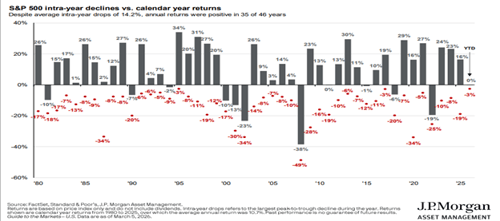
While the catalyst for sell-offs may differ, they occur every year. Some are minor; some cause greatly increased volatility. We have seen a number of these events recently, from the global pandemic to the inflation scare of 2022 to the tariff and trade policy announcements last spring. The average annual decline in the market is 14 percent.

Stay the Course
Peter Lynch, the famous Fidelity portfolio manager, once said that people have lost more money preparing for a correction than they lose in corrections themselves. And the above chart shows that. Despite the sell-offs that have and will continue to occur every year, in the past 23 years, we have had only three with negative total returns greater than 1 percent.
Risks continue to rise given the fluid situation in the Middle East. But portfolios built with long-term objectives as their underpinning are designed to help navigate all types of markets. This is one of those times when they should help navigate the volatility.
Disclosure
The information on this website is intended for informational/educational purposes only and should not be construed as investment advice, a solicitation, or a recommendation to buy or sell any security or investment product. Please contact your financial professional for more information specific to your situation.
Certain sections of this commentary contain forward-looking statements that are based on our reasonable expectations, estimates, projections, and assumptions. Forward-looking statements are not guarantees of future performance and involve certain risks and uncertainties, which are difficult to predict. Past performance is not indicative of future results. Diversification does not assure a profit or protect against loss in declining markets.
The S&P 500 Index is a broad-based measurement of changes in stock market conditions based on the average performance of 500 widely held common stocks. All indices are unmanaged and investors cannot invest directly in an index.
The MSCI EAFE (Europe, Australia, Far East) Index is a free float‐adjusted market capitalization index that is designed to measure the equity market performance of developed markets, excluding the U.S. and Canada. The MSCI EAFE Index consists of 21 developed market country indices.
The Dow Jones Industrial Average is computed by summing the prices of the stocks of 30 large companies and then dividing that total by an adjusted value, one which has been adjusted over the years to account for the effects of stock splits on the prices of the 30 companies. Dividends are reinvested to reflect the actual performance of the underlying securities.
The Russell 2000 is a market-capitalization weighted index, with dividends reinvested, that consists of the 2,000 smallest companies within the Russell 3000 Index. It is often used to track the performance of U.S. small market capitalization stocks.
One basis point (bp) is equal to 1/100th of 1 percent, or 0.01 percent.
The VIX (CBOE Volatility Index) measures the market’s expectation of 30-day volatility across a wide range of S&P 500 options.
The forward price-to-earnings (P/E) ratio divides the current share price of the index by its estimated future earnings.
Third-party links are provided to you as a courtesy. We make no representation as to the completeness or accuracy of information provided on these websites. Information on such sites, including third-party links contained within, should not be construed as an endorsement or adoption by Commonwealth of any kind. You should consult with a financial advisor regarding your specific situation.
Member FINRA, SIPC
Please review our Terms of Use.
Commonwealth Financial Network®
© Commonwealth Financial Network
Read more commentaries by Commonwealth Financial Network