I sat down with Jacob Shapiro this week, my go-to expert on all things geopolitics, to talk about what’s unfolding in the Middle East after the coordinated US-Israeli strikes on Iran.
We covered a lot of ground, but one image stuck with me: He called the Strait of Hormuz the sword of Damocles hanging over the global economy. For decades, the world’s most critical energy chokepoint has dangled there. Everyone knew the thread was thin, but the sword never fell…
Until now.
Roughly 20% of the world’s oil passes through the strait, along with massive volumes of liquified natural gas (LNG) and fertilizer. It’s the jugular vein of global energy. And for years, the nightmare scenario has been a sustained blockage—not a skirmish, not a brief dust-up, but a real shutdown. The kind where ship captains are afraid to sail through.
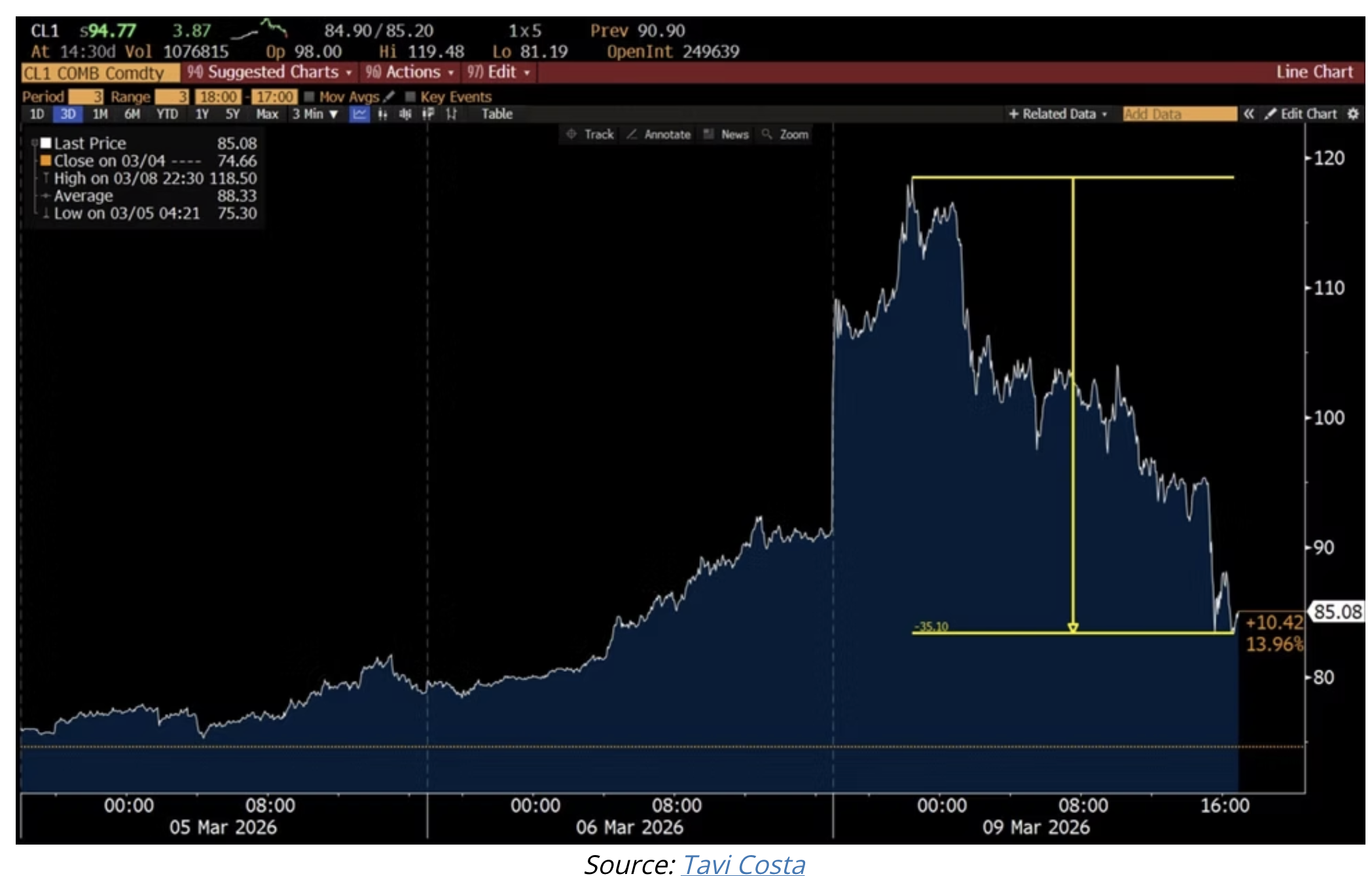
Jacob pointed out something that I think a lot of market participants are missing in the noise of daily price swings. Yes, oil whipsawed from nearly $120 to the mid-$80s in the span of about 48 hours.

And yes, if you’re a short-term trader, geopolitics probably didn’t help you navigate the volatility. But zoom out. The real question isn’t what oil does in the days ahead. Rather, it’s what does every energy-importing nation do over the next decade now that they’ve seen the true fragility of Hormuz?
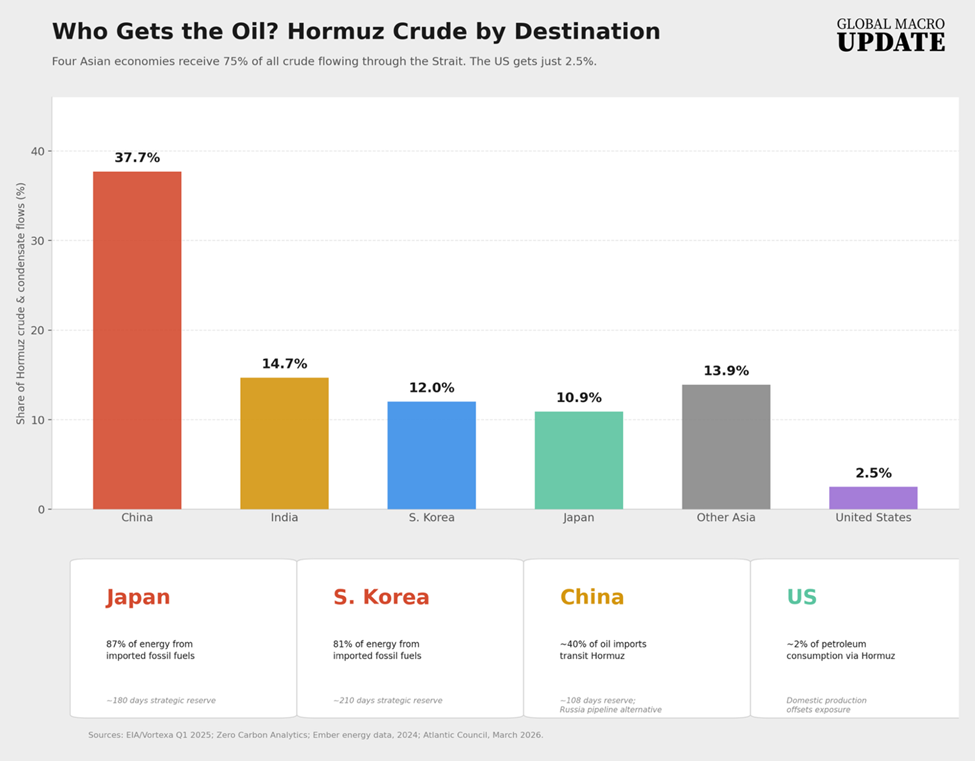
If you’re Japan, South Korea, India, or China—countries whose massive industrial economies depend on hydrocarbons flowing through that strait—you just watched a few drones and some determined militants shut it down.
And here’s the kicker Jacob raised: Even if the current conflict ends tomorrow, the sword goes right back up. What’s to stop it from falling again in three months? Six months? What’s to stop a future Iranian government or non-state actor hiding in the mountains from doing exactly what the Houthis did to Red Sea shipping, except in one of the world’s most consequential chokepoints?
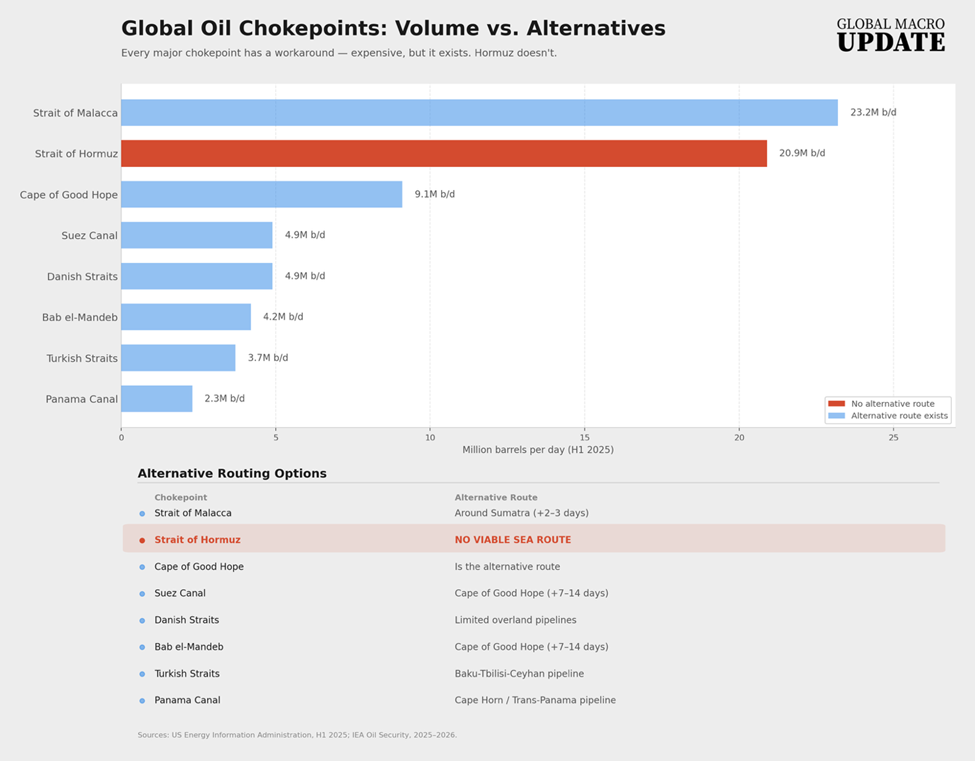
Aside from some pipeline alternatives, there is no substitute to the Strait of Hormuz. That’s what makes it different from the Panama Canal or the Strait of Malacca. Those have workarounds—expensive ones, but they exist. Hormuz doesn’t.
Once you internalize that, the calculus changes and calls for a new geopolitical framework.
The Post-Hormuz World
Jacob’s argument is that we may be living through an inflection point in global energy strategy. Not because of a policy paper or a climate summit, but because of a war that exposed a vulnerability everyone already knew about but chose to ignore. If you’re advising the Chinese government or the Japanese government, and you’re currently dependent on Middle Eastern hydrocarbons, why would you choose to still be dependent 10 years from now? Is this not the moment you wake up and start diversifying?
The tools are already there: plummeting renewable costs, a nuclear renaissance, shale opening new markets globally. Jacob compared it to the shift from coal to oil in the late 1800s and early 1900s. He believes we’re in a similar moment, except the destination isn’t singular. Different countries will chart different courses depending on their geography and resources. The US, sitting on enormous hydrocarbon reserves, will likely remain a hydrocarbon economy. China, which doesn’t have that luxury, is already tripling down on renewables and nuclear. Europe, which bet its energy future on Russian gas—well, it’s got some soul-searching to do.
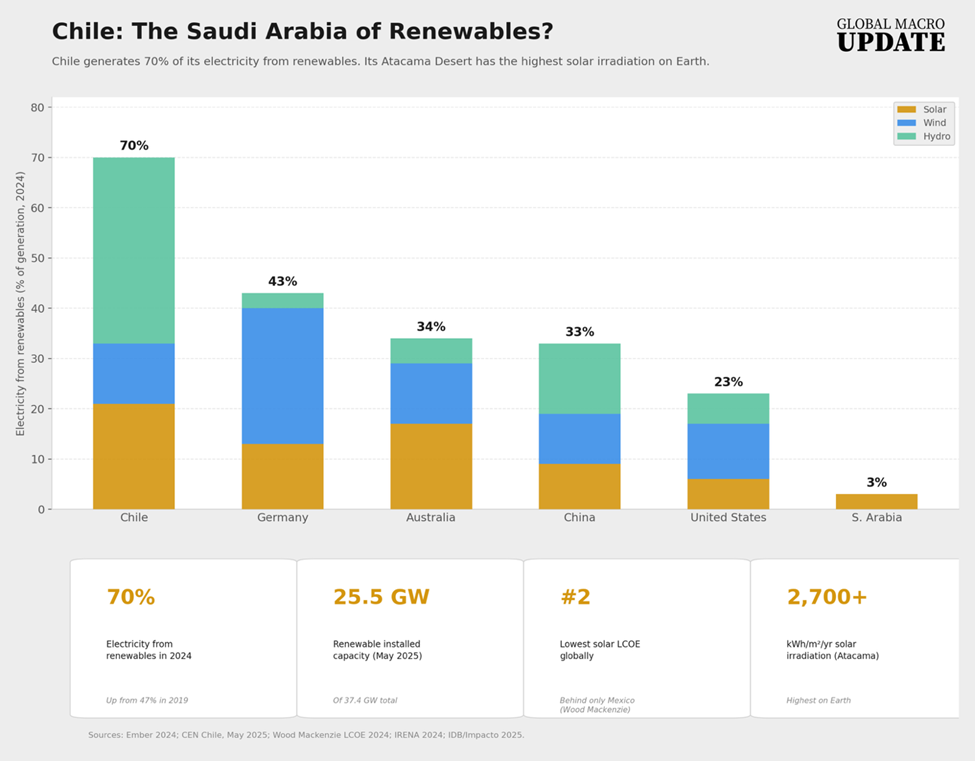
What caught my attention was where Jacob sees the real opportunity in all of this. Countries that have abundant clean energy resources and are far removed from geopolitical hotspots could become the economic winners of the next generation. He mentioned Chile as a standout—blessed with solar, wind, and geothermal potential that makes it something like the Saudi Arabia of renewables.
Cheap energy plus political stability, he argues, is the formula for economic prosperity in a post-Hormuz world.
The framework is powerful: We’re moving from a world where a barrel of oil is a barrel of oil to a world where energy portfolios diverge by geography. That’s a massive structural shift, the kind of thing that plays out over years and decades.
Jacob put it to me plainly: On a short-term trading horizon, geopolitics is mostly noise. But as your time frame gets longer, everything is geopolitics. The Strait of Hormuz crisis is a perfect case study because it’s a moment that forces us to rethink the entire energy landscape.
You can watch my full conversation with Jacob Shapiro here.
A transcript of our conversation is available here.
You can learn more about Jacob here.
Thank you for watching and reading,
Ed D’Agostino, Partner & COO
A message from Advisor Perspectives and VettaFi: Discover something new! Click here to register for our upcoming webcasts.
© Mauldin Economics
Read more commentaries by Mauldin Economics