Key Takeaways
- The SEC is reportedly finalizing a proposal to allow U.S. companies to transition from quarterly to semi-annual reporting (SAR), potentially ending a 90-year-old mandate.
- Following the March 2026 launch of the CSA’s SAR Pilot, TMX Group CEO John McKenzie is calling for an expansion of the rules to include larger cap companies to lower barriers for new IPOs.
- Proponents, including leaders like Larry Fink and Jamie Dimon, argue that reducing reporting frequency allows management to focus on long-term strategic growth rather than meeting 90-day targets.
- Critics warn that a six-month "information vacuum" could lead to increased stock price volatility and reduced accountability for investors.
- Moving to a twice-yearly cadence would align North American markets with the UK and European standards, potentially making U.S. exchanges more competitive for international listings.
The long-standing debate over how frequently publicly traded companies should report their financial results has reached a tipping point. Following renewed interest from the SEC and successful pilot programs abroad, the U.S. is closer than ever to a fundamental shift in its reporting regime. According to a report from the Wall Street Journal on March 16, the SEC is finalizing a proposal that would officially give U.S. companies the option to report financial results semi-annually rather than quarterly. 1
The Canadian "SAR" Pilot Takes Flight
Our neighbors to the north have already moved from theory to practice. On March 19, 2026, the Canadian Securities Administrators (CSA) officially launched its Semi-Annual Reporting (SAR) Pilot. Under this program, eligible venture issuers listed on the TSX Venture Exchange (TSXV) or the Canadian Securities Exchange (CSE) can opt to file financial reports only for the first and third quarters, skipping the traditional Q2 and Q4 interim hurdles.
While the current framework is targeted at smaller companies with less than $10 million in annual revenue, there is significant pressure to go bigger. Our parent company, TMX Group, is the operator of the largest exchange in Canada (Toronto Stock Exchange) and has been a big proponent of the semi-annual move. CEO John McKenzie has emerged as a leading voice for expansion of the current pilot. McKenzie recently argued that the choice should not be restricted by company size, stating that the proposal should expand to include larger publicly listed companies to help revitalize the broader IPO market. He noted that reducing these administrative "entry barriers" is critical for smaller firms looking to go public and suggested that if the U.S. adopts a semi-annual standard, Canada should match it with "zero lag time" to maintain North American market competitiveness.2
Global Context: The U.S. as the Quarterly Outlier
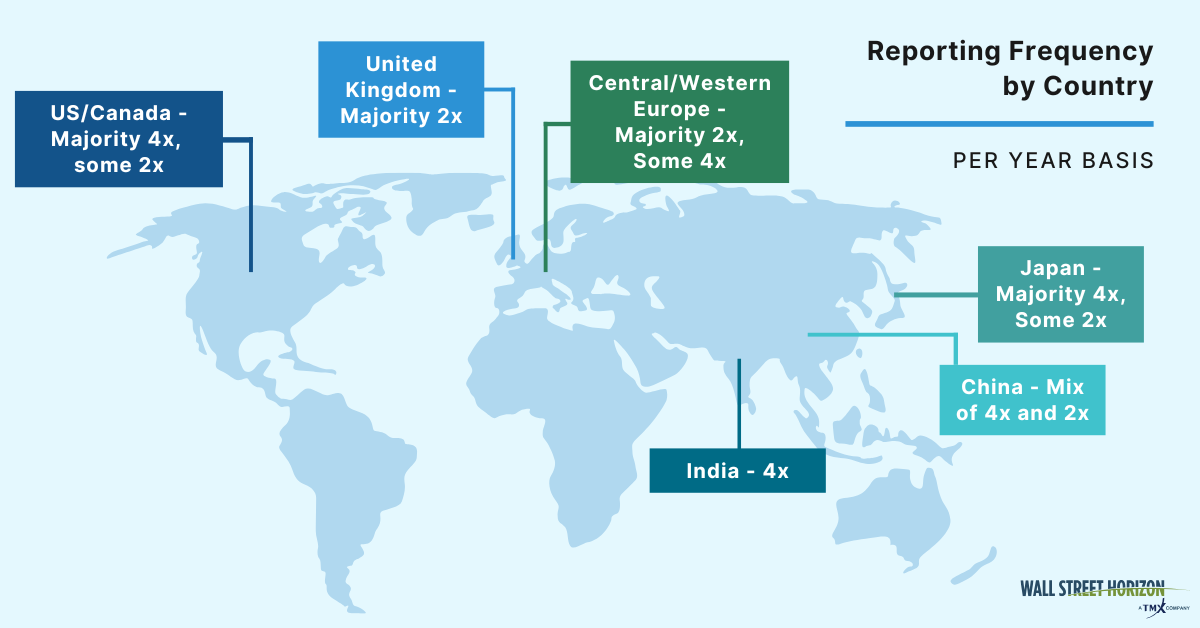
The U.S. remains the primary global outlier in reporting frequency. Since the Securities Exchange Act of 1934, the SEC has mandated quarterly filings. In contrast, the majority of international governing bodies, including those in the European Union, Australia, and parts of Asia, require only semi-annual filings.
Data from the Wall Street Horizon universe of 11,000 global equities shows that only about 13% of companies worldwide report twice a year. This figure is skewed by the heavy concentration of North American listings (62% of the universe). Of the firms that do report semi-annually, 72% are American Depository Receipts (ADRs) from the UK and Europe, highlighting that for much of the developed world, the six-month cadence is already the gold standard.
Data from the Wall Street Horizon universe of 11,000 global equities shows that only about 13% of companies worldwide report twice a year. This figure is skewed by the heavy concentration of North American listings (62% of the universe). Of the firms that do report semi-annually, 72% are American Depository Receipts (ADRs) from the UK and Europe, highlighting that for much of the developed world, the six-month cadence is already the gold standard.

UK Case Study: The Reporting Pendulum
The UK provides a unique historical lesson. British companies reported semi-annually prior to 2007, switched to mandatory quarterly reporting until 2014, and then reverted to a semi-annual requirement.
Research from the CFA Institute on this period found that while the frequency of reporting didn't significantly change corporate investment levels, mandatory quarterly reporting was associated with an increase in analyst coverage and higher forecast accuracy.3 However, critics argue these benefits are overshadowed by "quarterly capitalism,"4 a term popularized by Hillary Clinton, or what BlackRock’s Larry Fink calls "quarterly earnings hysteria."5
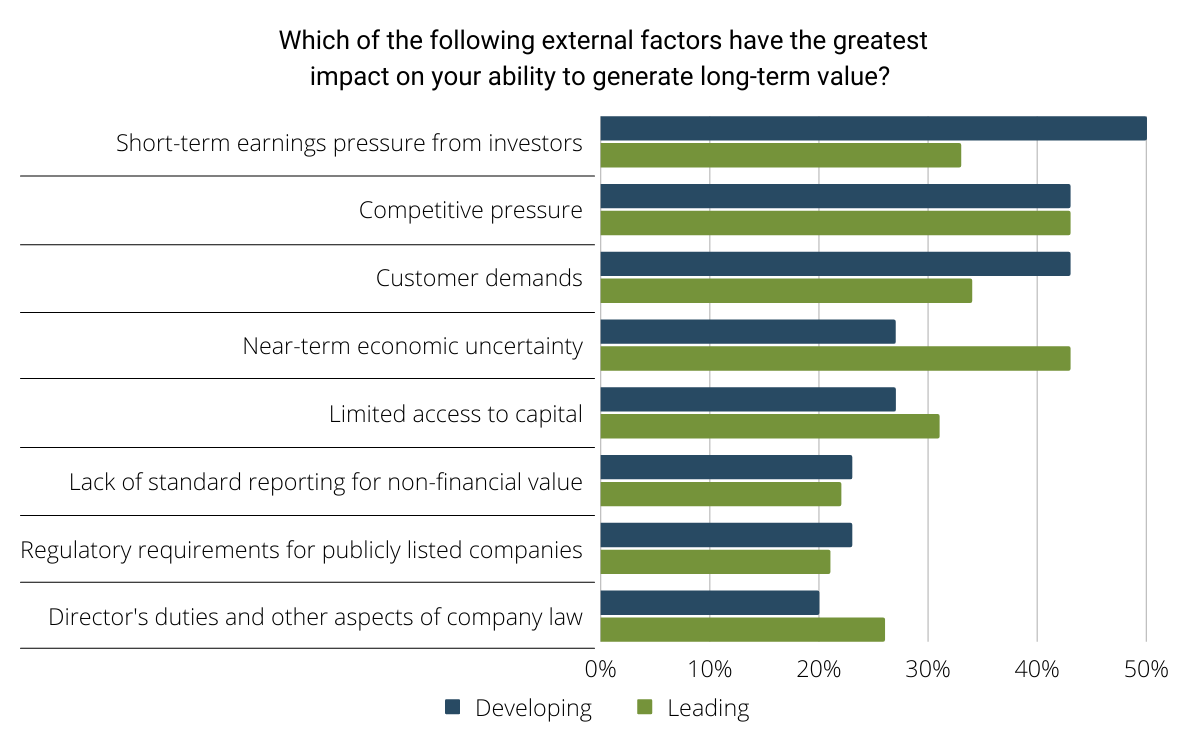
CEOs themselves point to short-term earnings pressure from investors as the number one factor promoting short-termism:
Original data from this chart found on page 15 of this EY report: view pdf.
The Pros of Semi-Annual Reporting
Proponents argue that moving to a twice-yearly schedule addresses three systemic issues:
- Combating Short-Termism: High-profile advocates like Larry Fink,6Jamie Dimon, and Warren Buffett argue that quarterly reporting forces executives to “manage to the quarter” rather than making long-term strategic investments.7
- Reviving the IPO Market: The cost and rigor of SEC quarterly compliance are often cited as reasons why companies stay private. As of early 2026, the number of publicly traded companies in the U.S. stands at approximately 3,657—a figure that has remained stagnant and is down nearly 50% from its 1997 peak.8
- Global Harmonization: Aligning with the UK and EU would simplify operations for multi-national corporations and make U.S. and Canadian exchanges more attractive to foreign issuers.
The Cons of Semi-Annual Reporting
The pushback against less frequent reporting centers on transparency:
- Information Asymmetry: Quarterly reports are usually followed by earnings calls, providing a vital forum for analysts to stress-test management’s strategy. Losing half of these touchpoints could leave investors in the dark for six months at a time.
- Risk of Fraud: Fewer checkpoints throughout the year could theoretically provide more room for accounting irregularities or “window dressing” to go unnoticed. Professor Salman Arif from the University of Minnesota's Carlson School of Management says, "If we want to reduce accounting fraud, reduce opportunities for insider trading, improve the strength of our capital markets, and allow companies to invest for the long run, I think more transparency is truly beneficial.” 9
- Market Volatility: Some academics warn that because more information would be packed into fewer reports, the market reaction to semi-annual results could be significantly more volatile than the current quarterly reactions.10
The Bottom Line
Ultimately, the debate over earnings frequency boils down to a fundamental question about the primary purpose of public markets. Is it to provide the most transparent, up-to-date information for investors to make decisions, or is it to create an environment where companies are shielded from short-term market pressures to foster long-term growth and innovation? As the SEC prepares its formal proposal, the U.S. may finally be ready to join the global trend toward a "longer-term" view of corporate health.
1“SEC Prepares Proposal to Eliminate Quarterly Reporting Requirement,” Wall Street Journal, Corrie Driebusch, March 16, 2026, https://www.wsj.com
2 “Canada's top exchange pushes to end quarterly reporting for all firms,” Reuters, Anirban Sen, March 12, 2026, https://www.reuters.com
3 “Impact of Reporting Frequency on UK Public Companies,” CFA Institute, March 1, 2017, https://rpc.cfainstitute.org
4 “Moving beyond quarterly capitalism,” Medium, Hillary Clinton, July 24, 2015, https://medium.com
5 “Some Heresy on Wall Street: Look Past the Quarter,” Wall Street Journal, Andrew Ross, Sorkin, February 1, 2016, https://www.nytimes.com
6 “Some Heresy on Wall Street: Look Past the Quarter,” Wall Street Journal, Andrew Ross, Sorkin, February 1, 2025, https://www.nytimes.com
7 “Short-Termism Is Harming the Economy,” Wall Street Journal, Jamie Dimon & Warren Buffet, June 6, 2018, https://www.wsj.com
8 “America has lost half its public companies since the 1990s,” CNN, Nicole Goodkind, June 9, 2023, https://www.cnn.com
9 “Why Trump wants companies to report earnings less frequently,“ NPR, Rafael Nam, September 15, 2025, https://www.npr.org
10 The Dark Side of Low Financial Reporting Frequency: Investors’ Reliance on Alternative Sources of Earnings News and Excessive Information Spillovers, The Accounting Review, Salman Arif; Emmanuel T. De George, November 2020, https://papers.ssrn.com
Copyright © 2026 Wall Street Horizon, Inc. All rights reserved. Do not copy, distribute, sell or modify this document without Wall Street Horizon's prior written consent. This information is provided for information purposes only. Neither TMX Group Limited nor any of its affiliated companies guarantees the completeness of the information contained in this publication, and we are not responsible for any errors or omissions in or your use of, or reliance on, the information. This publication is not intended to provide legal, accounting, tax, investment, financial or other advice and should not be relied upon for such advice. The information provided is not an invitation to purchase securities, including any listed on Toronto Stock Exchange and/or TSX Venture Exchange. TMX Group and its affiliated companies do not endorse or recommend any securities referenced in this publication. This publication shall not constitute an offer to sell or the solicitation of an offer to buy, nor may there be any sale of any securities in any state or jurisdiction in which such offer, solicitation or sale would be unlawful prior to registration or qualification under the securities laws of any such state or jurisdiction. TMX, the TMX design, TMX Group, Toronto Stock Exchange, TSX, and TSX Venture Exchange are the trademarks of TSX Inc. and are used under license. Wall Street Horizon is the trademark of Wall Street Horizon, Inc. All other trademarks used in this publication are the property of their respective owners.
A message from Advisor Perspectives and VettaFi: Discover something new! Click here to register for our upcoming webcasts.
© Wall Street Horizon
Read more commentaries by Wall Street Horizon