U.S. No Safe Haven from Oil Spike, Drivers Learn
Membership required
Membership is now required to use this feature. To learn more:
View Membership BenefitsThe Iran war gave investors a needed but painful refresher course on the global nature of crude oil supply and demand. The main lesson is there's no protection from commodity disruptions thousands of miles away.
"The United States imports almost no oil through the Hormuz Strait and won't be taking any in the future," President Trump said as the conflict raged and Iran closed the strait, blocking 20% of the world's oil. "We don't need it."
While Trump is right that most of the oil the United States uses doesn't flow through the strait, that didn't prevent more costly fill-ups—to the chagrin of drivers and anyone planning to travel by air. Gasoline prices in the United States quickly rose to around $4 per gallon from roughly $3, and many wondered why. The answer is that crude oil is a global market and U.S. prices don't trade in a vacuum. Nor do U.S. producers provide a "hometown discount" the way some athletes do when they want to stay with their current team. That means investors and anyone who drives or flies might want to monitor Middle East developments even after the immediate conflict subsides, as crude could stay elevated here and abroad.
Read more: First Quarter 2026 Earnings: Feelin' Alright
"Regardless of the strait 'reopening' or not, energy prices will take time to normalize," said Michelle Gibley, director of international equity research and strategy at the Schwab Center for Financial Research (SCFR).
Just 8% of the oil used in the United States comes from the Persian Gulf, a much lower amount than decades ago. Still, U.S. prices rose with the rest of the world in March for many reasons, including the country's growing importance as an oil exporter, producers' inability to suddenly raise output, continued need for gasoline refined overseas, and the dependence of so many products—from food to fertilizer—on oil and natural gas produced abroad.
Also, the Organization of the Petroleum Exporting Countries, or OPEC, still produces a large share of the world's crude oil. This gives its production decisions an outsized influence on global prices, even though the United States doesn't significantly depend on OPEC supplies.
Here's a closer look at some global factors affecting U.S. crude oil and gasoline prices:
U.S. oil exports expose the country to global price trends
For many years, the United States imported lots of crude but exported very little, in part because it didn't produce enough but also because of a 1975 ban on most U.S. oil exports. That ban wasn't lifted until 2015.
When oil prices spiked in 2008, the United States exported an average of just 29,000 barrels of crude oil each day, according to the U.S. Energy Information Administration (EIA), a drop in the tank for a global oil market that was producing more than 80 million barrels per day at the time.
By January 2026, the United States exported around 4 million barrels of oil per day, about 138 times as much as 18 years earlier, becoming a major world supply source. This increase was mainly because of technology improvements, like fracking, which raised U.S. crude production from below 6 million barrels per day in 2008 to more than 13 million barrels per day as of April 2026.
The Iran war almost immediately cut global supplies by 20 million barrels per day, or about 20%. U.S. crude prices quickly jumped roughly 50% to reflect anticipated heavier foreign demand for U.S. oil exports.
By mid-April, the European Union (EU) was grappling with tighter-than-normal jet fuel inventories. Though the EU can deal with shortages by canceling flights, jet traffic isn't likely to grind to a halt this summer. Instead, Europe would likely turn to other sources, perhaps the United States, for oil to refine into jet fuel.
If Europe looks elsewhere—like Canada or Mexico—it would likely raise prices for those countries' oil. That could translate into higher U.S. prices too, because higher prices in Canada or Mexico might send users looking elsewhere, potentially raising demand for oil produced in the U.S. Gulf or the Permian Basin.
And early indications are that the rest of the world has turned to U.S. oil to supplement what's not available from the Persian Gulf. U.S. crude oil and product exports topped 14 million barrels per day the week of April 24, up 33% from 10 million the same week a year earlier, according to the EIA. Exports of crude reached 6.44 million barrels per day, from 4 million the same week a year ago. This heavier demand from abroad likely contributed to a resurgence in U.S. crude prices back above $100 per barrel by the end of April from lows below $90 earlier in the month.
Production not easily increased
The United States produces far more oil now than in 2008, or more than at any point in its history, for that matter. But it can't raise production quickly, especially with so much depending on fracking technology.
Fracking is expensive to implement and depends on long-term planning by companies that may not want to invest in production if they think prices might ultimately fall. For now, this means import demand is rising as production has roughly stayed the same for several years, sending prices higher through the basic mechanism of supply and demand. The CME futures market, as of late April, priced in a moderate downward swing in crude prices for the rest of 2026, with December futures trading below $76 per barrel.
While that's probably more than enough for oil companies to profit, it's well under current levels of $90 and might not be a huge incentive for additional drilling.
U.S. still not fully self-sufficient
Many Americans believe that the United States is oil independent. That's far from true. The country's 13 million daily barrels of output don't meet domestic demand of about 20 million barrels of petroleum each day.
To supplement, the United States imported around 8 million barrels of crude per day as of early 2026. Most of that came from Canada and Mexico, but not all of it. The United States imported millions of barrels from OPEC and non-OPEC countries in January 2026, according to the most recent month of country-by-country import data from the EIA.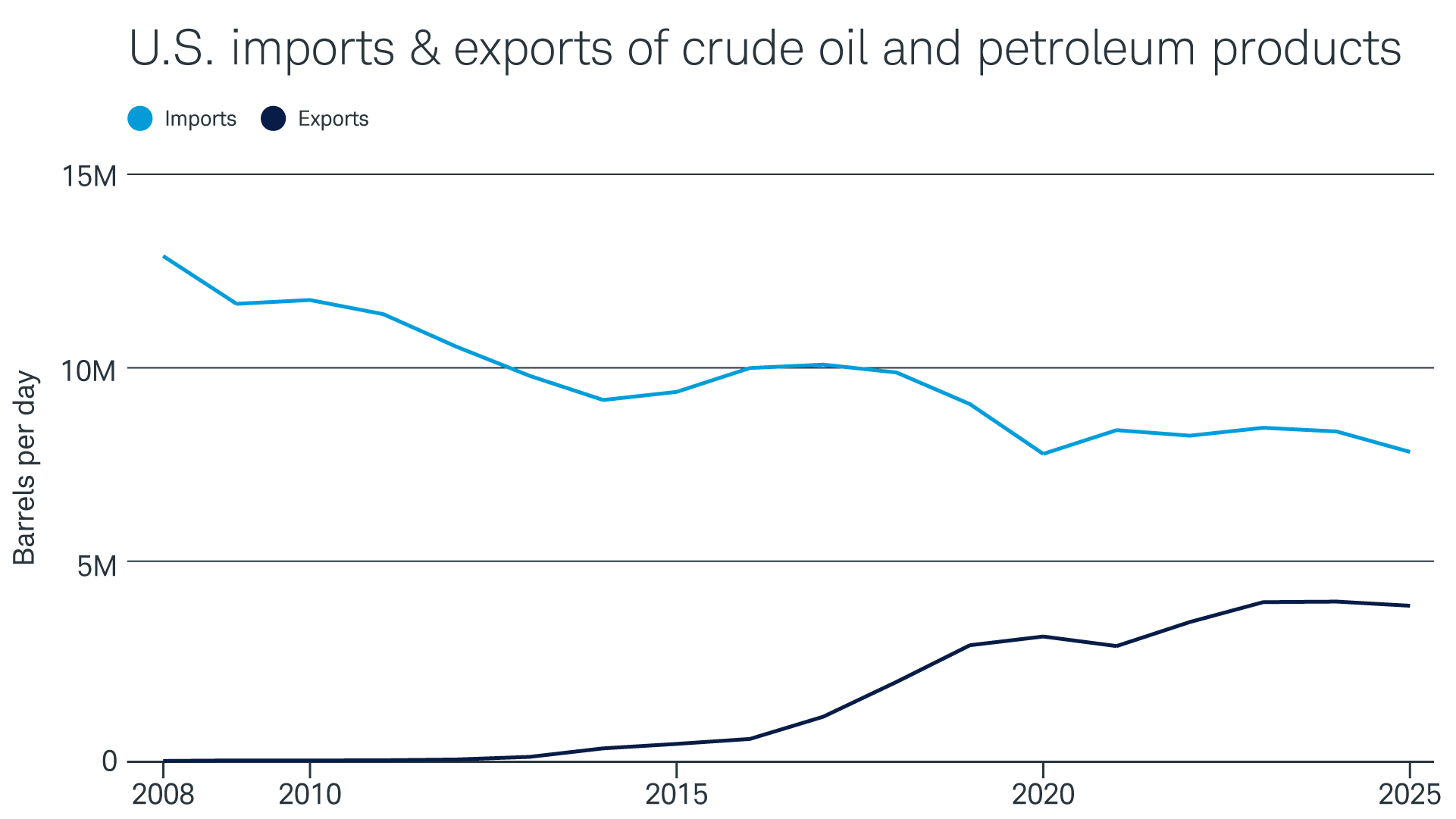

The relatively small share of crude the United States imported from the Persian Gulf in January probably wouldn't move prices significantly if it had to be replaced. But the United States has also imported crude from countries in South America, Africa, Europe, and Asia in recent months—to the tune of 253 million barrels in January, or about 12 days of U.S. usage of imported oil not from the Middle East.
Of that, 146 million barrels came from Canada, right next door and easily accessible. But Canada, like other producers, now sees heavier demand from overseas buyers as Middle East production dries up, raising Canadian prices and the price of U.S. imports. Ultimately, U.S. drivers and fliers pay for this.
Though U.S. imports from the Persian Gulf are down compared with past decades, it's unclear how they might be affected by the withdrawal of the United Arab Emirates (UAE) from OPEC in late April. The UAE has been aligning itself more with U.S. interests and away from those of its Gulf neighbors, The Wall Street Journal reported, and the UAE's production capacity is 4.8 million barrels per day, about 13% of OPEC's capacity of 3.4 million barrels per day.
U.S. imports gasoline too
Though it's mainly a regional affair, parts of the United States import gasoline from Europe and Asia, so when prices rise in those overseas regions, they rise in parts of the United States too.
For instance, New England imports lots of gasoline from Canada but also some from Europe because it's often cheaper to buy European gasoline and import it to New England than to ship it from the U.S. Gulf Coast. The West Coast is another regular importer of gasoline, the EIA noted.
Crude oil isn't just for gasoline
As investors were reminded time and again during this war, crude oil and natural gas aren't only used for energy. They go into many products, even down to the very buttons on our shirts. And certainly into fertilizer, which depends heavily on natural gas for its production.
When the United States imports fertilizer or plastic products made with oil from abroad, higher prices for oil overseas get factored into the end products on U.S. shelves, adding oil-generated inflation despite the United States depending little on actual crude from the Persian Gulf. When farmers pay more for fertilizer, agricultural processors pay more for crops and meat, leading to higher food prices.
While this may not show up at the gas pump or in airline tickets, it contributes to U.S. inflation growth, something that's helped drive down consumer sentiment as the conflict lingers. Unfortunately, an end to the war and re-opening of the strait likely wouldn't solve the problem right away.
"It could take several months at a minimum to get back to 'normal' in some parts of the market, and damage to liquid natural gas production in Qatar could take several years to normalize," Schwab's Gibley said. "Physical delivery of oil and gas is constrained and isn't reflected in energy futures prices. The delays in returning to 'normal' mean higher energy prices in physical markets in the meantime."
Higher oil prices don't just bother consumers. They can hurt companies by raising costs and threatening margins. The pain might be felt most by large U.S. companies with major overseas operations, where they might pay even more for fuel than they do at home. A longer war could weigh on S&P 500® earnings growth, putting pressure on the stock market.
U.S. output growth keeps slight lid on prices
While U.S. oil prices did surge on the war, their intraday peak on March 9 near $120 paled versus past oil crises, in part because the United States is more energy self-sufficient than in the past. The first Iran crisis in 1979 sent domestic prices as high as $40 per barrel in that era's dollars, equal to nearly $160 today. Western Texas Intermediate (WTI) crude oil's peak value of $145 in 2008 equals around $218 today, adjusted for inflation.
However, in July 2008, when WTI spiked to $145, U.S. crude oil production averaged just 5.1 million barrels per day, according to the EIA. The most recent monthly production figure, for January 2026, was 13.2 million barrels per day, up 159%. This could help explain why U.S. crude didn't jump to $200 or more when the war broke out.
It also helps explain why, despite their complaints, U.S. consumers didn't get hit as hard by rising gas prices once the war began. U.S. prices remain below those in Germany, South Korea, and most other developed countries, The Wall Street Journal reported in late April. Lower gas taxes compared to other parts of the world also keep U.S. gasoline prices cheaper. Mexican drivers often cross the river to El Paso and Brownsville to fill up, rather than pay $5.07 per gallon at home, the newspaper noted.
Natural gas is another U.S. advantage
The United States enjoys another advantage over the rest of the non-Persian-Gulf world, thanks to abundant natural gas output that's generally kept heating and air conditioning costs low for U.S. consumers despite the war.
U.S. natural gas production more than doubled over the last 20 years and reached record levels in 2025, partly due to oil production gains. Producing more oil often means producing more natural gas too, as natural gas is often found with deposits of oil. That's one reason Natural Gas (/NG) futures now command only about one-third the price they generally did two decades ago. Fracking technology also helped raise natural gas output.
Still, natural gas is much harder to import and export than crude oil, meaning its local price varies far more by country. That's why, despite the war, U.S. natural gas prices recently traded near $2.60 per British thermal unit (Btu), well below the 200-day moving average. In fact, the last time U.S. natural gas prices spiked—to above $7 in January—was due to frigid U.S. weather, not an overseas war.
Crude oil remained above pre-war levels into late April, and many analysts don't expect a return to pre-war levels of around $60 anytime soon, barring a serious recession. President Trump hinted that U.S. gas prices could stay at $4 per gallon over much of the year, which could mean more pain for U.S. drivers and flyers. It also could keep the Fed's hands off the rate cut handle for some time. Investors might want to closely follow U.S. inflation expectations in the coming months, as these often reflect consumers' anxiety about gasoline.
All this is another reminder that at their core, energy prices here reflect world events, and that's not liable to change anytime soon.
A message from Advisor Perspectives and VettaFi: Discover something new! Click here to register for our upcoming webcasts.
Some of the statements in this document may be forward-looking and contain certain risks and uncertainties.
This material is intended for general informational and educational purposes only. This should not be considered an individualized recommendation or personalized investment advice. The investment strategies mentioned are not suitable for everyone. Each investor needs to review an investment strategy for his or her own particular situation before making any investment decisions.
All expressions of opinion are subject to change without notice in reaction to shifting market, economic or political conditions. Data contained herein from third party providers is obtained from what are considered reliable sources. However, its accuracy, completeness or reliability cannot be guaranteed.
For illustrative purposes only.
Investing involves risk, including loss of principal.
Past performance is no guarantee of future results.
Futures and futures options trading involves substantial risk and is not suitable for all investors. Please read the Risk Disclosure Statement for Futures and Options prior to trading futures products.
Futures accounts are not protected by the Securities Investor Protection Corporation (SIPC).
Read additional CFTC and NFA futures and forex public disclosures for Charles Schwab Futures and Forex LLC.: https://www.schwab.com/legal/futures-disclosures
Futures and futures options trading services provided by Charles Schwab Futures and Forex LLC. Trading privileges subject to review and approval. Not all clients will qualify.
Charles Schwab Futures and Forex LLC is a CFTC-registered Futures Commission Merchant and NFA Forex Dealer Member.
Charles Schwab Futures and Forex LLC (NFA Member) and Charles Schwab & Co., Inc. (Member SIPC) are separate but affiliated companies and subsidiaries of The Charles Schwab Corporation.
The Schwab Center for Financial Research is a division of Charles Schwab & Co., Inc.
The Charles Schwab Corporation provides a full range of brokerage, banking and financial advisory services through its operating subsidiaries. Its broker-dealer subsidiary, Charles Schwab & Co. Inc. (Member SIPC), and its affiliates offer investment services and products. Its banking subsidiary, Charles Schwab Bank, SSB (member FDIC and an Equal Housing Lender), provides deposit and lending services and products.
This site is designed for U.S. residents. Non-U.S. residents are subject to country-specific restrictions. Learn more about our services for non-U.S. residents, Charles Schwab Hong Kong clients, Charles Schwab U.K. clients.
© 2026 Charles Schwab & Co., Inc. All rights reserved. Member SIPC. Unauthorized access is prohibited. Usage will be monitored.
Membership required
Membership is now required to use this feature. To learn more:
View Membership Benefits