When Monetary Policy Surprises Stop Translating
Membership required
Membership is now required to use this feature. To learn more:
View Membership BenefitsOne of the most interesting developments in rates markets this year is what hasn’t happened.
Inflation remains above target, especially the Federal Reserve’s preferred core Personal Consumption Expenditures (PCE) inflation measure, as choppy data have challenged the view that disinflation will proceed smoothly. The latest Consumer Price Index (CPI) print for June was softer than expected, but Fed officials have been cautious about declaring victory, arguing instead that they stand ready to hike rates if inflation doesn’t cool. Judging by changes in short-dated interest rates, the latest Fed meeting in June generated one of the largest hawkish monetary policy surprises1 in recent history (see Figure 1) – even though the fed funds rate was unchanged.
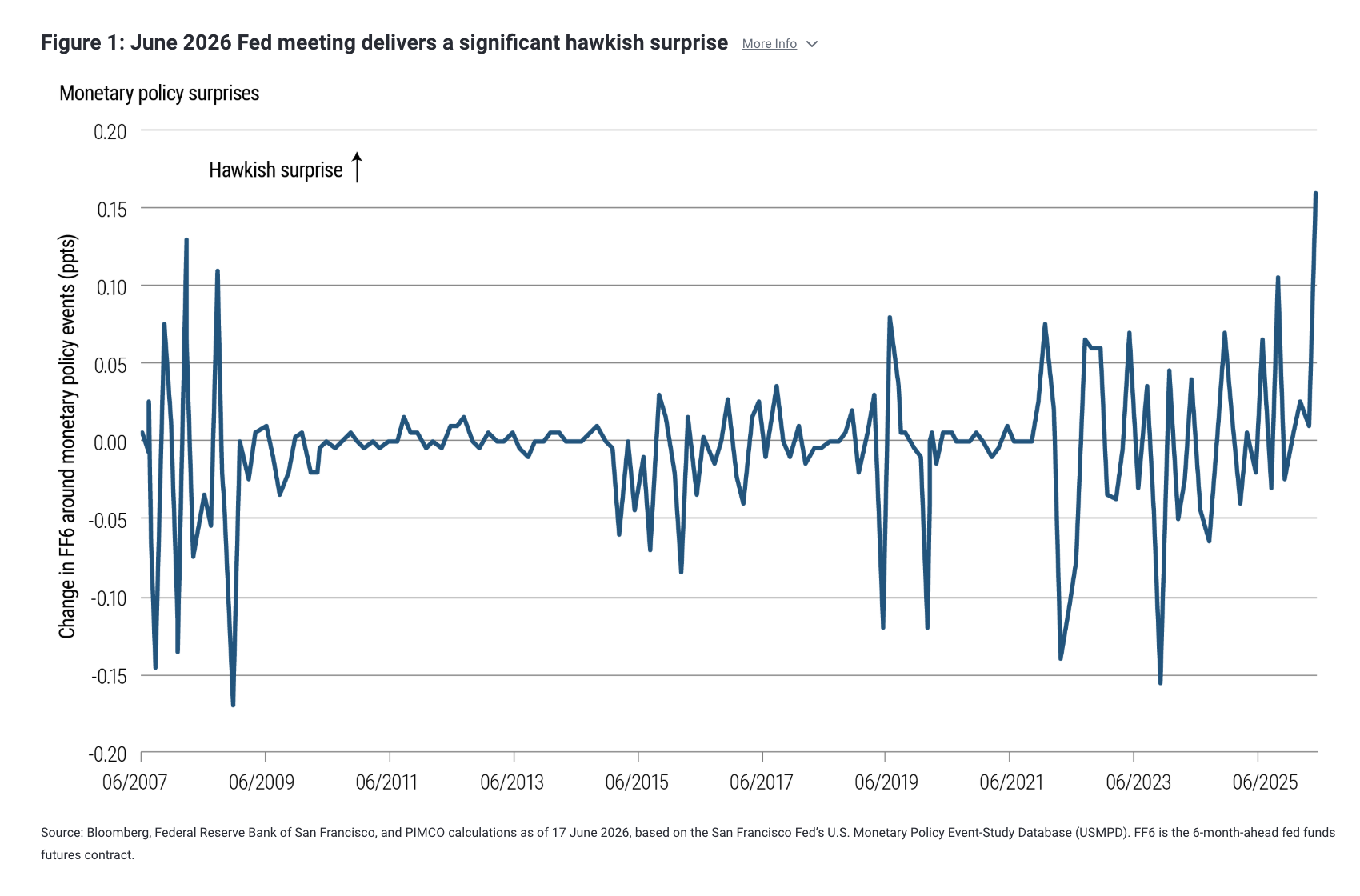
Yet despite the inflation concerns, the potential for rate hikes, and the hawkish meeting surprise, longer-dated forward rates have remained broadly stable.
While one never wants to overextrapolate short-term market moves, two changing forces may ultimately explain and ingrain this shift into a more lasting feature of market behavior around monetary policy events: a change in how the Fed communicates under Chair Kevin Warsh, and a change in what markets believe is driving inflation. Both point in the same direction – a weaker link between near-term policy surprises and long-run rates.
See more: Bond Investor’s “Bird in Hand”
Monetary policy surprises – the measurement …
The workhorse framework for measuring monetary policy surprises was developed by Gürkaynak, Sack, and Swanson in a 2007 paper,2 using high-frequency movements in federal funds futures around Fed announcements to isolate the unexpected component of policy decisions.
Prior to this work, economists often measured monetary policy surprises using only the unexpected component of changes in the federal funds target rate. The problem with this was that by the early 2000s the Fed had become increasingly transparent, allowing markets to anticipate the next meeting’s decision in advance with a high degree of certainty. So, a richer dataset was needed to measure how markets update views on future monetary policy around key events such as monetary policy statement and minutes releases. To do this, economists began examining high-frequency changes around monetary event windows in fed funds and eurodollar (now the Secured Overnight Financing Rate or SOFR) futures contracts, along with U.S. Treasury yields and other assets.
Subsequent analysis of these surprises found large moves in long-dated forward interest rates in response to monetary policy surprises – a puzzling result since longer-dated interest rates should in theory be relatively insensitive to cyclical economic variation and short-run monetary policy shifts.
Using the San Francisco Fed’s database of high-frequency changes in asset prices around Fed statements and minutes releases, we also find that historically, hawkish surprises – defined as increases in near-dated forward fed funds futures contracts around a monetary event – have been associated with similar yield changes further out the curve.
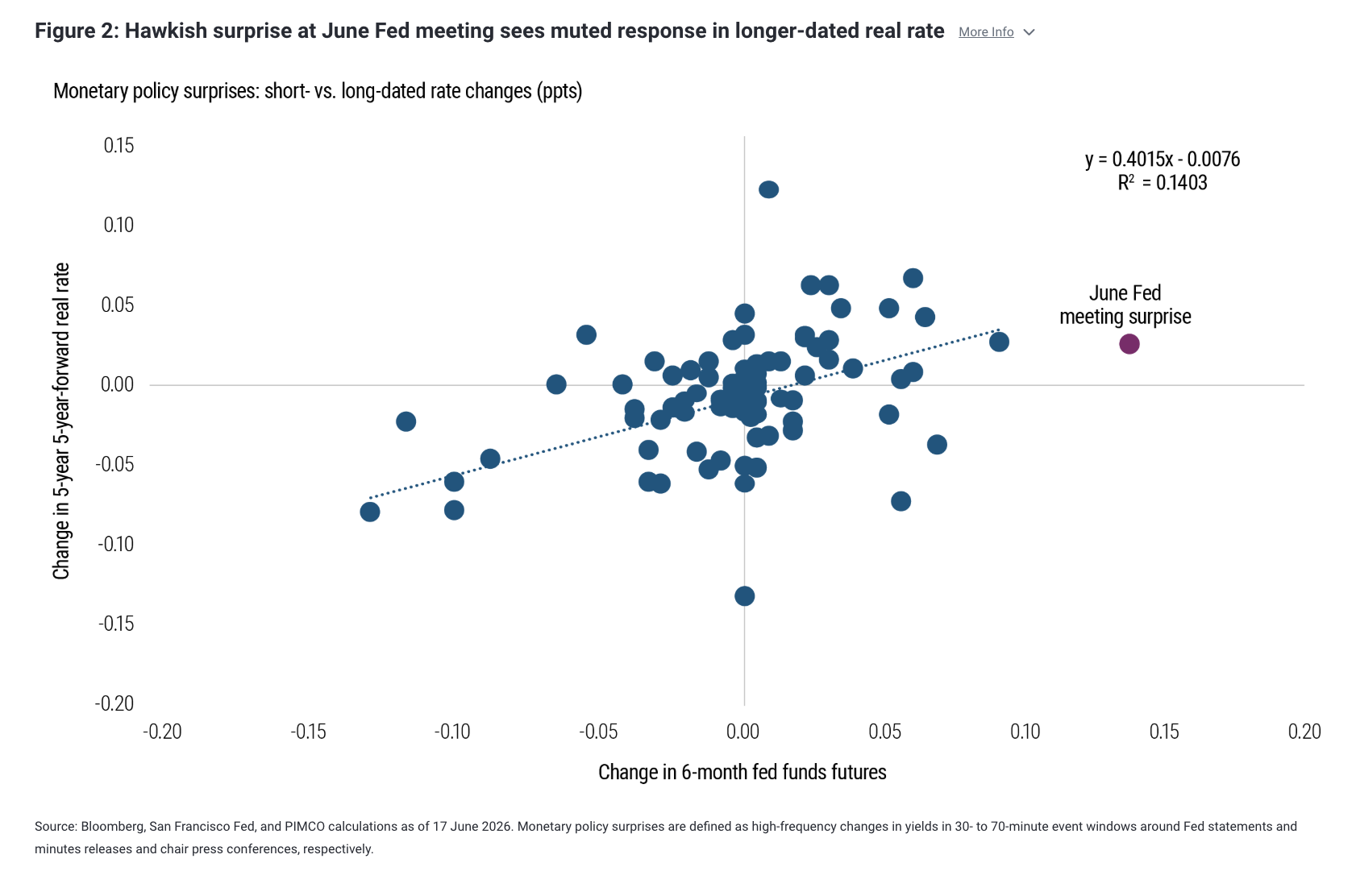
For example, the 5-year, 5-year-forward real U.S. interest rate over the last decade has tended to rise (fall) by roughly 10 basis points (bps) for every 25-bp hawkish (dovish) monetary policy surprise (see Figure 2). Narrowing the sample to 2016–2022, the sensitivity rises further to a roughly 18-bp move in the 5-year, 5-year-forward for every 25-bp surprise.
… And the meaning
In explaining the elevated sensitivity of intermediate- and long-dated forward rates to short-run meeting-by-meeting surprises, economists have argued3 that these changes result from markets viewing the surprise not as random noise, but as informative about more persistent shifts in how the Fed is likely to respond to macro conditions going forward. It’s the evolution of what’s become known as the “Fed reaction function.”
Fed Chair Alan Greenspan began using forward guidance in the 1990s, after a surprise hike in early 1994 kicked off a large and volatile move higher in yields across the curve. But the more prominent use of forward guidance after the global financial crisis (GFC) in 2008–2009 likely solidified this behavior, as Fed communications more clearly conveyed not only the reasoning behind current policy actions, but how policymakers would likely react at future meetings to evolving economic fundamentals.
The Fed’s use of large-scale asset purchases (known as quantitative easing or QE) likely also contributed. Surprises around QE announcements – which coincided with monetary policy rate surprises – likely directly reinforced the relationships between near-dated fed funds futures and yields further out the curve. QE had direct implications for both short- and long-term rates given its use to reinforce forward guidance and compress the premium that investors required to buy longer-maturity bonds. A significant body of research finds that QE programs did indeed reduce yields through these channels.
More recent research from the San Francisco Fed further extends this market reaction-function learning framework in an important direction: It shows that surprises are not only affected by how the Fed communicates, but what markets learn from a surprise depends on the state of the economy at the time.4 Specifically, the researchers find that a hawkish move during a demand-driven inflation episode teaches investors a great deal about the Fed’s likely future behavior, while the same move during a supply-driven episode teaches them very little
The post-2022 relationship between monetary policy surprises and long-term rate moves has declined notably. Unlike the 1990s through the post-GFC period, which was characterized mainly by demand shocks, a series of supply shocks have characterized the post-pandemic macro environment. Kristin Forbes, former external member of the Bank of England’s Monetary Policy Committee, and others find that the role of global shocks has increased sharply since the pandemic, and that these shocks tend to be more supply-focused and have greater volatility.5
Combined with broader research literature that has long argued for a more cautious monetary policy response to supply shocks, this suggests that markets have become increasingly sophisticated in distinguishing between different types of inflation – and they price monetary policy surprises accordingly. (Read more about supply-driven versus demand-driven inflation in last week’s Macro Signposts, “Fed Policymaker Comments Raise the Stakes for Inflation Data.”)
Takeaways for investors
What are the implications for today? While one never wants to overinterpret very short-run market behavior, the recent stability of longer-dated forward interest rates to changing near-term policy expectations is consistent with economic and policy shifts.
The sticky inflation over the past year (and more broadly since 2021) has coincided with a series of supply shocks and changing global trends. Energy prices have reacted to geopolitical developments and supply disruptions. Tariffs have raised the cost of imported goods across a range of categories at the same time that rapid investment in AI infrastructure has created bottlenecks in semiconductors, data centers, and related capital goods.
These factors are likely boosting demand as well. Governments, companies, and households race to invest and build resilience against a more uncertain world, while greater wealth – at least at the top of the income distribution – has supported consumption.
The bond market appears more sanguine, however. The fact that the 5-year, 5-year-forward real rate barely moved around the June meeting despite one of the largest recorded surprises in recent history is notable, but not inexplicable. Less forward guidance coinciding with elevated energy market volatility meant that markets discounted the meeting’s signals about durable medium-term shifts in policy rates.
As these macro fundamentals continue to prevail – a higher frequency of global supply shocks with less of a forward guidance policy anchor – then short-dated interest rate volatility is likely to rise. However, based on recent relationships, that may not translate into more volatile longer-dated rates. And this is yet another factor, along with generally elevated yield levels and a more volatile macroeconomic environment, making high quality bonds look attractive on a risk-adjusted basis.
Footnotes
1. Monetary Policy Surprises.” Federal Reserve Bank of San Francisco, Research & Insights ↩
2. Refet S. Gürkaynak, Brian P. Sack, and Eric T. Swanson. “Market-Based Measures of Monetary Policy Expectations.” Journal of Business & Economic Statistics (April 2007) ↩
3. Michael D. Bauer and Eric T. Swanson. “A Reassessment of Monetary Policy Surprises and High-Frequency Identification.” National Bureau of Economic Research Working Paper 29939 (April 2022) ↩
4. Rami Najjar and Adam Hale Shapiro, “Not All Inflation Is the Same: State-Dependent Transmission of Monetary Policy.” Federal Reserve Bank of San Francisco Working Paper 2025-28 (June 2026) ↩
5. Kristin J. Forbes, Jongrim Ha, and M. Ayhan Kose. “Heaven or Earth? The Evolving Role of Global Shocks for Domestic Monetary Policy.” National Bureau of Economic Research Working Paper No. 34806 (February 2026) ↩
Disclosures
This material contains the current opinions of the manager and such opinions are subject to change without notice. This material is distributed for informational purposes only and should not be considered as investment advice or a recommendation of any particular security, strategy or investment product. Information contained herein has been obtained from sources believed to be reliable, but not guaranteed.
PIMCO as a general matter provides services to qualified institutions, financial intermediaries and institutional investors. Individual investors should contact their own financial professional to determine the most appropriate investment options for their financial situation. This is not an offer to any person in any jurisdiction where unlawful or unauthorized. | Pacific Investment Management Company LLC, 650 Newport Center Drive, Newport Beach, CA 92660 is regulated by the United States Securities and Exchange Commission. | PIMCO Europe Ltd (Company No. 2604517, 11 Baker Street, London W1U 3AH, United Kingdom) is authorised and regulated by the Financial Conduct Authority (FCA) (12 Endeavour Square, London E20 1JN) in the UK. The services provided by PIMCO Europe Ltd are not available to retail investors, who should not rely on this communication but contact their financial adviser. Since PIMCO Europe Ltd services and products are provided exclusively to professional clients, the appropriateness of such is always affirmed. | PIMCO Europe GmbH (Company No. 192083, Seidlstr. 24-24a, 80335 Munich, Germany) is authorized and regulated by the German Federal Financial Supervisory Authority (BaFin) (Marie- Curie-Str. 24-28, 60439 Frankfurt am Main) in Germany in accordance with Section 15 of the German Securities Institutions Act (WpIG). | PIMCO Europe GmbH Italian Branch (Company No. 10005170963, Via Turati nn. 25/27 (angolo via Cavalieri n. 4) 20121 Milano, Italy), PIMCO Europe GmbH Irish Branch (Company No. 909462, 57B Harcourt Street Dublin D02 F721, Ireland), PIMCO Europe GmbH UK Branch (Company No. FC037712, 11 Baker Street, London W1U 3AH, UK), PIMCO Europe GmbH Spanish Branch (N.I.F. W2765338E, Paseo de la Castellana 43, Oficina 05-111, 28046 Madrid, Spain), PIMCO Europe GmbH French Branch (Company No. 918745621 R.C.S. Paris, 50–52 Boulevard Haussmann, 75009 Paris, France) and PIMCO Europe GmbH (DIFC Branch) (Company No. 9613, Unit GD-GB-00-15-BC-05-0, Index Tower Floor 10, unit 1001 Dubai International Financial Centre, Dubai, United Arab Emirates) are additionally supervised by: (1) Italian Branch: the Commissione Nazionale per le Società e la Borsa (CONSOB) (Giovanni Battista Martini, 3 - 00198 Rome) in accordance with Article 27 of the Italian Consolidated Financial Act; (2) Irish Branch: the Central Bank of Ireland (New Wapping Street, North Wall Quay, Dublin 1 D01 F7X3) in accordance with Regulation 43 of the European Union (Markets in Financial Instruments) Regulations 2017, as amended; (3) UK Branch: the Financial Conduct Authority (FCA) (12 Endeavour Square, London E20 1JN); (4) Spanish Branch: the Comisión Nacional del Mercado de Valores (CNMV) (Edison, 4, 28006 Madrid) in accordance with obligations stipulated in articles 168 and 203 to 224, as well as obligations contained in Tile V, Section I of the Law on the Securities Market (LSM) and in articles 111, 114 and 117 of Royal Decree 217/2008, respectively, (5) French Branch: ACPR/Banque de France (4 Place de Budapest, CS 92459, 75436 Paris Cedex 09) in accordance with Art. 35 of Directive 2014/65/EU on markets in financial instruments and under the surveillance of ACPR and AMF and (6) DIFC Branch: Regulated by the Dubai Financial Services Authority ("DFSA") (Level 13, West Wing, The Gate, DIFC) in accordance with Art. 48 of the Regulatory Law 2004. The services provided by PIMCO Europe GmbH are available only to professional clients as defined in Section 67 para. 2 German Securities Trading Act (WpHG). They are not available to individual investors, who should not rely on this communication. According to Art. 56 of Regulation (EU) 565/2017, an investment company is entitled to assume that professional clients possess the necessary knowledge and experience to understand the risks associated with the relevant investment services or transactions. Since PIMCO Europe GMBH services and products are provided exclusively to professional clients, the appropriateness of such is always affirmed. | PIMCO (Schweiz) GmbH (registered in Switzerland, Company No. CH-020.4.038.582-2, Brandschenkestrasse 41 Zurich 8002, Switzerland). According to the Swiss Collective Investment Schemes Act of 23 June 2006 (“CISA”), an investment company is entitled to assume that professional clients possess the necessary knowledge and experience to understand the risks associated with the relevant investment services or transactions. Since PIMCO (Schweiz) GmbH services and products are provided exclusively to professional clients, the appropriateness of such is always affirmed. The services provided by PIMCO (Schweiz) GmbH are not available to retail investors, who should not rely on this communication but contact their financial adviser. | PIMCO Asia Pte Ltd (8 Marina View, #30-01, Asia Square Tower 1, Singapore 018960, Registration No. 199804652K) is regulated by the Monetary Authority of Singapore as a holder of a capital markets services licence and an exempt financial adviser. The asset management services and investment products are not available to persons where provision of such services and products is unauthorised. | PIMCO Asia Limited (Suite 2201, 22nd Floor, Two International Finance Centre, No. 8 Finance Street, Central, Hong Kong) is licensed by the Securities and Futures Commission for Types 1, 4 and 9 regulated activities under the Securities and Futures Ordinance. PIMCO Asia Limited is registered as a cross-border discretionary investment manager with the Financial Supervisory Commission of Korea (Registration No. 08-02-307). The asset management services and investment products are not available to persons where provision of such services and products is unauthorised. | PIMCO Investment Management (Shanghai) Limited. Office address: Suite 7204, Shanghai Tower, 479 Lujiazui Ring Road, Pudong, Shanghai 200120, China (Unified social credit code: 91310115MA1K41MU72) is registered with Asset Management Association of China as Private Fund Manager (Registration No. P1071502, Type: Other). | PIMCO Australia Pty Ltd ABN 54 084 280 508, AFSL 246862. This publication has been prepared without taking into account the objectives, financial situation or needs of investors. Before making an investment decision, investors should obtain professional advice and consider whether the information contained herein is appropriate having regard to their objectives, financial situation and needs. To the extent it involves Pacific Investment Management Co LLC (PIMCO LLC) providing financial services to wholesale clients, PIMCO LLC is exempt from the requirement to hold an Australian financial services licence in respect of financial services provided to wholesale clients in Australia. PIMCO LLC is regulated by the Securities and Exchange Commission under US laws, which differ from Australian laws. | PIMCO Japan Ltd, Financial Instruments Business Registration Number is Director of Kanto Local Finance Bureau (Financial Instruments Firm) No. 382. PIMCO Japan Ltd is a member of Japan Investment Advisers Association, The Investment Trusts Association, Japan and Type II Financial Instruments Firms Association. All investments contain risk. There is no guarantee that the principal amount of the investment will be preserved, or that a certain return will be realized; the investment could suffer a loss. All profits and losses incur to the investor. The amounts, maximum amounts and calculation methodologies of each type of fee and expense and their total amounts will vary depending on the investment strategy, the status of investment performance, period of management and outstanding balance of assets and thus such fees and expenses cannot be set forth herein. | PIMCO Taiwan Limited is an independently operated and managed company. The reference number of business license of the company approved by the competent authority is (112) Jin Guan Tou Gu Xin Zi No. 015 . The registered address of the company is 40F., No.68, Sec. 5, Zhongxiao East Rd., Xinyi District, Taipei City 110, Taiwan (R.O.C.), and the telephone number is +886 2 8729-5500. | PIMCO Canada Corp. (199 Bay Street, Suite 2050, Commerce Court Station, P.O. Box 363, Toronto, ON, M5L 1G2) services and products may only be available in certain provinces or territories of Canada and only through dealers authorized for that purpose. | Note to Readers in Colombia: This document is provided through the representative office of Pacific Investment Management Company LLC located at Carrera 7 No. 71-52 TB Piso 9, Bogota D.C. (Promoción y oferta de los negocios y servicios del mercado de valores por parte de Pacific Investment Management Company LLC, representada en Colombia.). | Note to Readers in Brazil: PIMCO Latin America Administradora de Carteiras Ltda.Av. Brg. Faria Lima, 3477 Itaim Bibi, São Paulo - SP 04538-132 Brazil. | Note to Readers in Argentina: This document may be provided through the representative office of PIMCO Global Advisors LLC AVENIDA CORRIENTES, 299, Buenos Aires, Argentina. | No part of this publication may be reproduced in any form, or referred to in any other publication, without express written permission. PIMCO is a trademark of Allianz Asset Management of America LLC in the United States and throughout the world. ©2026, PIMCO.
CMR2026-0722-5774230
A message from Advisor Perspectives and VettaFi: Discover something new! Click here to register for our upcoming webcasts.
© PIMCO
Membership required
Membership is now required to use this feature. To learn more:
View Membership BenefitsSponsored Content
Upcoming Virtual Events View All












